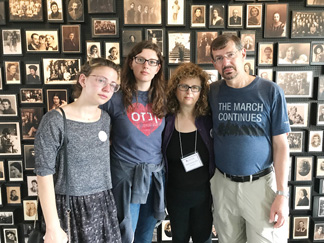
Sagi Rudnick, 2019 Margolis Memorial Essay Contest Winner


The Importance of Interfaith Dialogue

Hans Urs von Balthasar, a prominent 20th century Roman Catholic theologian, once said: “(E)ven if a unity of faith is not possible, a unity of love is.” If I had to encapsulate my views on interfaith dialogue and relations in one sentence, I would choose that quote. The incredibly diverse people of this planet are not, and will not be, united under a single religion. And that’s OK. In fact, I think that’s a good thing. I believe our discourse is richer and our future is brighter because multiple faith traditions exist.

As citizens of the world, we do not have to agree with other points of view. However, we must be willing to understand, appreciate and respect them. Learning how to empathize with those around us in this way is critical. This is especially true regarding different traditions of faith. It is imperative that Jews, Christians and all other religions engage in empathy-driven interfaith dialogue. This is the way we foster love — the tried and true foundation of any successful relationship.

During the fall of my freshman year, my school, the Hyman Brand Hebrew Academy, started an interfaith club. The students were informed of this new initiative one morning and were invited to apply to be part of HBHA’s delegation to the club. This was actually an interfaith partnership including my Jewish school, a Catholic school and a Muslim school.

After explaining in a written response why I was looking forward to being a part of this initiative and what I hoped to take out of it, I was soon accepted to be part of the school’s interfaith cohort. I was very excited upon hearing that I would get to take part in the club. I always felt that promoting positive interfaith relations between Jews and other religions, specifically Christians and Muslims, is important. So I relished the opportunity to engage in such relationship- building as part of this cohort of students.

Not long after I joined the interfaith club we had our first meeting. The club consisted of six students from HBHA — the Jewish school; six students from Notre Dame de Sion — the Catholic school; and six students from the Islamic School of Greater Kansas City — the Muslim school. Our very first event was at Pinstripes. The agenda was ice breakers, lunch and bowling. When we all arrived, there was some awkwardness between each group of students.

As we had never previously met, this was normal. But that soon changed as we began the ice breakers. The questions during this event were light and fun; the objective was simply to break the ice and get to know one another. We then had lunch, consisting of cookies and mac and cheese. In order to keep with the Jewish tradition of adherence to kosher dietary laws, HBHA supplied the food. This naturally led to a discussion among the students about the laws of kashrut. This was great because the Jewish students, of which I was a part, got the opportunity to share with the others a little bit about a significant piece of Judaism. After eating we all split into teams, each one having one member of each religion, and bonded over bowling.

This, like the icebreakers, was a great way to promote camaraderie between us and to overall get to further know each other. We then left to head back to school; the 18 of us had successfully laid the groundwork to a meaningful interfaith relationship from which we would all benefit. I couldn’t help but think to myself the following. If the world’s religions could accomplish on a larger scale what the 18 of us had today — simply taking genuine steps toward building a mutual relationship — the world would truly be a much better place.

While every subsequent interfaith club meeting was a success, in this essay I want to focus on two other specific events. The next year, my sophomore year, we focused on engaging in community service as an interfaith cohort. During my freshman year, we all got to know each other and establish a strong relationship. Now as sophomores, we sought to expand upon our newly-formed relationship and harness it in order to personally effect positive change.

My favorite way in which we did this is by volunteering together at Jewish Vocational Services of Greater Kansas City. JVS serves to help settle new immigrants coming to this country and to Kansas City specifically. They do this by providing them with housing, job training and any other resources they need in order to help them build a new life in the U.S. Because of JVS’s incredible work, we saw them as a great place to donate our time and to make a mark.

At JVS, we all split into groups — again with at least one member from each religion in each group. Each group was assigned a different task. My group worked in JVS’s clothing distribution area and our job was to sort articles of clothing that were donated for the immigrants. Sometimes, living in a place of privilege, we can forget the impact of a new coat, a new shirt or new shoes on someone who has traveled so long to live here in the land of the free. Being able to do my part to help ease these immigrants’ burdensome journeys meant a lot to me.

As someone who moved to this country from somewhere else (Israel), I can relate to the immigrants whom JVS serves and to the challenges they have to endure. Equally meaningful, however, was that I was participating in this important work together with Christians and Muslims hand-in-hand. Doing the literal work to aid the immigrants was important. But another very valuable piece was the side chatter that ultimately ensued between me and my fellow interfaith cohorts during the clothes sorting. 

This organic dialogue, both about religious topics and not, helped enrich the already rewarding work we were doing at JVS. By the end of our time working I felt so proud of us. We were able to build on our relationship and come together in a tangible act of interfaith-driven social justice to physically improve our community.

The final event I want to delve into was actually a series of three gatherings, all of which occurred during the year after as a junior. As freshmen, we had formed a relationship rooted in mutual respect. As sophomores, we had taken that relationship and translated it into action, improving our community via interfaith cooperation. Now, as juniors, we wanted to really dive deeper into each other’s respective religions, and learn about what makes each unique.

In order to do that in a meaningful way, we decided that the students from each religion would host those from the other two religions at their school. Each group would plan an engaging morning for the other two groups, teaching about their culture, traditions and anything else they saw fit. This trio of gatherings was incredibly meaningful for me, and I got a lot out of it.

The group that presented first was the six Muslim students. When we arrived at their school that morning, we first got a tour of a project gallery that younger students there had created. The gallery was in the gym and it consisted of many poster boards. Each poster board was created by a student at the school and each one depicted an important Muslim figure or story in the Islamic tradition.

Walking around and learning a little bit about these key people and narratives was very interesting for me, and it was a unique way to glean a lot of engaging information. As the Muslim students were presenting to the Jewish and Christian students, one board caught my eye. It was one of Malcolm X, who until that point I had not realized was Muslim. After seeing the projects, some of us had to use the restroom before the next planned event.

While in the restroom, I noticed several hand and feet washing stations, which intrigued me. Several Muslim students followed my gaze and explained the stations’ significance in Muslim tradition — specifically that they are used to prepare one’s self for the prayer services. That made a lot of sense to me, and reminded me of Jewish hand-washing cups that we use before eating bread. After that brief educational experience we all headed to a mosque that is actually part of the school. I, along with the other Jewish students and the Christian students, got to experience a Muslim service — one of the five daily services of Islam.

Next to present their religion were the six Catholic students. When we got to their school that day, we sat in on a few classes. I sat in on a theology class, as well as an anatomy class. It was cool for me to literally put myself in the shoes of those Christian students, and experience a little of how their school and religion work together. We then went down to their journalism area where students were hard at work producing the school yearbook. That reminded me of HBHA’s yearbook, whose staff I have been a part of for all of high school. So that was super interesting as well for me. But the most captivating part for me at their school was when we got to experience a Catholic mass service. Hearing their hymns, seeing their traditions unfold in front of my eyes and feeling the pride each of the participants felt in their religion was really great to witness; the energy in that room was palpable.

This of course leaves the six of us Jewish students. We had the Christian and Muslim students over on a Friday morning. On Fridays HBHA’s egalitarian prayer service conducts what we fondly call “musical services.” In lieu of the traditional morning prayers, on Fridays a group of students incorporates guitars, ukuleles and alternative tunes to foster an even more profound connection to our liturgy and tradition. This part of HBHA life was very meaningful for me and for the other Jewish students in the group. As such, I was really happy that the Muslim and Christian students got to experience that. After this, we Jewish students gave the others a tour of the school. The trio of cultural and religion immersion was a success.

During my time in high school, I have been able to take part in incredible interfaith experiences, and the interfaith club that I joined at inception is only growing. I look forward to continue experiencing cultures and ideas contrary to my own and engaging in interfaith-driven relationship-building at UMKC in the fall.


Sagi Rudnick is a 2019 graduate of the Hyman Brand Hebrew Academy. He is the son of Marcelle Mariani and Rabbi Jonathan Rudnick and the brother of Shir-el and Shefer. Sagi will be a freshman at the University of Missouri-Kansas City in the fall and he plans to major in political science and minor in communication studies.


I express my great disappointment in the further leftward lurch of the Kansas City Jewish Chronicle. In the May 30 issue we are confronted by a page 1 piece by Ron Kampeas (Survey of American Jews find anti-Semitism concerns and disapproval of Trump). It discusses a survey by a “liberal leaning Jewish organization … which does polling for Democratic candidates.” 

The third paragraph includes “generic Democrat.” The fourth paragraph includes “…strongly Democratic.”

The fifth paragraph applauds Obama in spite of his poor treatment of Netanyahu and his backstabbing of Israel at the U.N.

The sixth paragraph supports two Democratic contenders for the presidency, each of whom, in my own opinion, is highly questionable.

In the next paragraph we are treated to condemnation of Netanyahu relevant to clashes with Obama.

Further along, Kampeas criticizes President Trump on multiple fronts.

Another paragraph begins with “Jewish Democrats.”

In yet another, the executive director of the Jewish Democratic Council of America (whatever that is) is quoted.

This piece knee jerks with “Figures who have been prominent in the Jewish organizational world and in Democratic politics.”


David S. Jacobs, M.D.

Overland Park, Kansas


Kehilah (community) can be a powerful force. Communities exist around religion, common interests, race, advocacy, gender identity and politics, to name a few. Community has strengthened my faith, validated and supported my identity, and helped me to become a better human being. 

At the start of this month, I visited Kansas City to attend KCPrideFest, a three-day event uniting and celebrating the local LGBTQ community. I came out as gay my senior year of high school at the Hyman Brand Hebrew Academy, then left Kansas City a few months later. Most of my life as an out gay man has been lived in college and in my current home in Washington, D.C., so I was particularly excited to come back to the place where I grew up to experience something I never had before, the local LGBTQ community. 

For those who have not been to Pride, it is similar to the Jewish Arts Festival. There are musical performances, food stalls and tents with booths featuring the work of different organizations, vendors and companies. Local nonprofits and faith groups filled these tents, showing the resources and safe spaces they provide for LGBTQ people. But as my brother and I walked up and down the rows of organizations, noticeably absent was our kehilah, our Jewish community. 

Many area Methodist, Presbyterian, Buddhist and Atheist groups proudly stood at Pride and demonstrated to the thousands of festival-goers that there was a place in their faith communities for those in attendance. But not a single Jewish organization was present. No synagogue, social action group, preschool, religious school or Jewish community organization was represented. Jews such as myself did not see my kehillah anywhere. But perhaps more significantly, people who weren’t Jewish got the impression that the Jewish community does not stand with the LGBTQ community in Kansas City. 

I do want to mention that Rabbi Alpert took part in two other Pride events. He was the keynote speaker at a Pride service held at Children’s Mercy Hospital, marking the 50th anniversary of the Stonewall Uprising. He also spoke at an interfaith service at Community Christian Church. His presence and active role in these events are significant. 

Visibility matters. Visibility is what pride is all about. As my brother and I were walking around, someone stopped us with a gasp and asked, “Wow, is that a rainbow kippah?” They were so excited, greeting us with ‘shalom,’ as we exchanged smiles and continued on our way. The surprise in their voice inspired me to write this article. Imagine how excited they would have been to see a banner with the name of a synagogue or Jewish organization? How many more people did not see my brother’s kippah and left not knowing that there are Queer Jews or Jewish allies or a local Jewish community? Visibility DOES matter. 

So many in my generation turn away from Jewish institutions because they do not feel like welcoming places. I see it with many of my friends. For a time, I felt that way too, until I moved to Washington, D.C. The Conservative synagogue I attend is very inclusive, from their programming and religious practices to their gender inclusive bathrooms throughout the shul. The JCC has a designated LGBTQ programming wing, and I’m proud to serve on the board of this group I have been involved in for years. At the D.C. Pride Festival, more than a dozen local Jewish organizations and synagogues are represented. That is the kind of kehillah that allows me to feel fully immersed and accepted in my Jewish community and allows my peers to feel like the Jewish community shares their values. Are Jews my age in Kansas City feeling welcome in the same way?

Someday, I hope to return to Kansas City and start a family. But I want to do so in a place that I, and other gay, lesbian, bisexual, transgender and queer people know that the Jewish community is actively welcoming us. 

I urge the Kansas City Jewish community, the community that raised me to love my Judaism, to step up and step out. Learn from local churches about the ways they bring inclusion into their houses of worship. Initiate LGBTQ family programming in your communal organizations. Create more visibly welcoming spaces in your religious schools, preschools and day school. Show the Kansas City community that the Jewish community is an active ally that values inclusion as one of its most important Jewish values


Jonathan Edelman is pursuing his master’s in museum studies at The George Washington University, after spending two years working as a part of the curatorial team at the U.S. Holocaust Memorial Museum in Washington, D.C.


I congratulate Rita Blitt on receiving an honorary Doctorate of Fine Arts degree from Washburn University. Rita created and contributed the sculpture that is the centerpiece of the Skywalk Memorial that honors the victims and first responders to that tragedy. The memorial is located at 22nd and Gillham Road. We will be forever grateful to her and late husband, Irwin, for their commitment and generosity. 


Sol Koenigsberg

Member, Skywalk Memorial Foundation Board

Disaster survivor

Overland Park, Kansas


Your article about wearing a kippah in Germany (May 30, “It’s dangerous to wear a kippah in Germany, official says”) reminded me of the movie “Deathwish.” If I were much younger and owned a handgun, I would put on a kippah and walk down a deserted street somewhere in Germany. If a local Nazi tried to harm me, he would soon be “pushing up daisies.”


Marvin Fremerman

Springfield, Missouri


On Sunday, May 19, Ellen Portnoy was one of more than 2,000 people on The Country Club Plaza who protested the near-total abortion ban passed by Missouri legislators in early May. Gov. Mike Parson signed the bill on May 24.


I celebrated my 18th birthday the day after Roe v. Wade was decided by the U.S. Supreme Court, affirming that access to safe and legal abortion is a constitutional right. By then, I already knew people who had become pregnant in high school.

Before the courts made that historical decision, I knew the “secret” term for an abortion, since some would have “woman’s problems” and need to have a D&C. While that’s a medical procedure many women need, then it was also a code word meaning a woman had been pregnant and needed to have that "problem" fixed. And they were lucky, they had the family support and the finances to find a doctor who could help.

Many before Roe v. Wade were not so lucky. It was the time of self-done abortions with knitting needles and hangers. It was the time of back alley abortions, as seen in the movie “Dirty Dancing.” Most seem to forget that an illegal abortion has a major role in the movie. Then there was the wonderful book and film “Cider House Rules,” which gives a portrayal of a doctor who performs illegal abortions during World War II at a Maine orphanage.

Abortion is a medical procedure that has no place in the hands of legislators trying to make a political statement. Abortion is NOT political. It is a private matter for a woman with the input of her doctor, perhaps her clergy and in some cases her significant other. Not all religions see abortion the same way. If it is not accepted in your religion, do not have one. But do not tell others what to do.

For a long time, I was frustrated living in Kansas. But suddenly, Kansas is back! We have a Supreme Court who understands and has ruled that the state constitution gives women the right to have an abortion. Whereas our neighbors across the state line now live in a state that wants to ban and punish doctors for performing a medical procedure and deny woman the rights of control over their own medical needs. I find that beyond disturbing. These legislators are using abortion for political gain, not thinking about the rights of woman. We have HIPPA laws to protect a person’s privacy in all aspects of medicine. Isn’t this going against HIPPA? I think so.

In the Jewish tradition, fetuses do not have souls until they are born. Also, the life of the mother always is deemed more important than the life of a fetus. So for me, as a Jewish woman, I have no problems with abortion in the first 24 weeks. Many fetuses are still not viable outside the womb at this point.  

Like many who are pro-choice, I am not pro-abortion. I am pro birth control. I am pro excellent women’s health. I am pro-life for all children once they enter this world, meaning I support health care; supplemental food, housing and clothing; and the opportunity to get an education. I am not for being pro-birth and then doing nothing to support the child, as I see happening now.

With these beliefs, I went to the Pro-Choice Rally on May 19 at J.C. Nichols Fountain on the Plaza with a good friend to show my support and my belief that all women should have the best health care possible. That includes the right to have an abortion when needed. 


Ellen Portnoy, a professional fundraiser and active volunteer, is passionate about women’s rights.


Recently the Greater Kansas City area lost two outstanding citizens — Henry Bloch and Morton Sosland.

These two exceptional community leaders were praised by many in the news media, various organizations and numerous individuals.

We should all be very proud that both were deeply involved in our Jewish community.


Richard L. Berkley

Kansas City, Missouri


Sarah Link Ferguson


As someone who works in the mental health sector, I love seeing all the mental health-related content from news sources and social media during the month of May — Mental Health Awareness month.

What is disappointing is how much of that enthusiasm wanes come June 1. Don’t get me wrong, I think it’s fantastic that the topic of mental health gets the positive attention it does this month, especially considering that for many, the topic is very charged.

In recent years, society has made huge strides in reducing the stigma around mental illness. For instance, seeking help for depression and anxiety is becoming common. You don’t even need to leave your home to see a therapist with telehealth and text-based options. At the same time, suicide rates among teens are rising at an alarming rate and no one can pinpoint why.

People have strong feelings about why teens are struggling today more than ever, and I hear from a fair share of adults who believe that they have the solution. However, if we knew what was wrong, wouldn’t we have solved the problem by now?

My work centers on teen mental health by managing the You Be You Teen Mental Health Campaign in local schools in the Greater Kansas City area. Our campaign seeks to encourage students to accept themselves and others as they are, and to embrace the concept of making progress in their lives rather than perfection. The campaign is led by a student group at each school — a critical component of You Be You — and I help support their efforts, keep them on track to reach their goals throughout the year, as well as provide resources for therapy, staff and parent education through my organization, Jewish Family Services. You Be You provides students with materials to share, including T-shirts, stickers and posters, all with affirming messages. You Be You supports student-organized programming throughout the year, including self-care activities during free periods, spirit days that center on self-acceptance and other activities that promote a cultural shift away from perfectionism toward radical self-acceptance.

More than 20,000 local students have been touched by this positive mental wellness campaign.

“I think the campaign is amazing,” said one student participant. “Spreading the message of self-love is important and You Be You is an incredible facet of that mission at our school. Thank you to the campaign for its support.”

Some say the You Be You campaign won’t be effective because it is too “soft” and doesn’t get to the root of the issues that lead to teen suicide. On the contrary; the research suggests that resiliency is a major protective factor against suicide, as is social connectedness, both of which the You Be You campaign promotes.

I believe that what we are doing with the You Be You campaign and how we are doing it are at the forefront of suicide prevention. I just wish more people understood that in order to create real change, we need longer than a month to address mental health. We need comprehensive mental health programs to be integrated into the school curriculum the way that physical activity has become a required course. It is an easy topic to brush to the side to make room for subjects with a more quantifiable impact. If we want our teens to be successful in life and mentally healthy, we must teach them skills like resiliency and the importance of social connection. We must do so as if their lives depend on it, because, if you ask me, they do. 


Sarah Link Ferguson is the coordinator for the Greater Kansas City Mental Health Coalition, housed at Jewish Family Services of Greater Kansas City. She also administers the You Be You teen mental health campaign that will begin its third year in Kansas City area schools this fall.


I was fortunate to call Henry Bloch my friend and mentor. He was so kind, gentle, positive and truly cared for people.

In 1979, I met with Henry and his wife, Marion, and asked them to consider accepting Hyman Brand Hebrew Academy’s Civic Service Award, to be presented in 1980. After touring the school and visiting with the teachers and students, they enthusiastically agreed to accept the award.

Seventeen years later, in 1996, on behalf of HBHA I asked Henry for a favor. We wanted Henry to ask Lamar Hunt to be HBHA’s 1997 Civic Service Award honoree. Although he had only met Mr. Hunt twice, he said he would give it a try. Sure enough Lamar Hunt told Henry he would be honored to accept the award and then added, “Henry, the fact you felt this award was so important and you took the time to call me, I feel privileged to be at the event.”

Henry made it a point to visit HBHA every two or three years to speak to the senior class about Kansas City’s business community and economy. The students were honored to hear from him and were mesmerized by his lectures.

I once asked Henry what motivated him and Marion to accept the award from the Hyman Brand Hebrew Academy. He replied that after he and Marion toured the school, he made a point to call several former recipients — including Mayor Richard Berkley, Arthur Mag, Don Hall and Mayor Ilus Davis — to hear their impressions of HBHA. He learned they all felt that Hyman Brand had a vision that they shared as well. For Kansas City to be ranked as a first-class city it had to have great hospitals, a first-class museum, a great university, a first-class symphony and a first-class Jewish day school like the Hyman Brand Hebrew Academy. He then added, “We don’t ever want to be in a position where Kansas City might lose a potential candidate — be it a scientist, lawyer, doctor, educator or business executive — who might not move to Kansas City because his or her children required a Jewish day school education and curriculum. One that would allow the graduate to be the best and the brightest and prepare them to qualify for the college of their choice.”

Henry was the ultimate gentleman’s gentleman. He loved most of all his partner and wife, Marion, his children and grandchildren, and he was eternally grateful to Kansas City. He devoted his life to giving back to Kansas City.

I, along with thousands of people, will miss Henry Bloch. May his memory always be for a blessing.

Rest in peace my friend.


Carl Puritz,

Leawood, Kansas

Marie Torres and her daughter, Dolly. United State Holocaust Memorial Museum. (Courtesy of Katy Torres McCormack)


Dolly was a wondrous child born to Marie and Moise Torres in 1937. In the studio portrait with her mother, Dolly, with her springy curls, smiles bashfully. This sweet girl wears her sailor suit with a jaunty cap in the nautical theme of her birthplace, Salonica, a port city in Greece. She and her mother are unaware of the larger world events that will soon take over their lives. 

Salonica was called by some the Jerusalem of the Balkans since Jews had settled there in large numbers after being expelled from Spain and Portugal. Dolly spoke Ladino (the Judeo-Spanish language written in Rashi Hebrew script) at home with family and with her little friends.

Moise was the owner of a photography studio and Marie was busy as a part owner of a manufacturing business. In a snapshot, Marie looks as if she has stopped off from work to pose briefly in front of her husband’s studio. Their lives as Sephardic Jews centered around the Sabbath and celebrating Jewish holidays. A constant worry in their lives began when Katy, their older daughter, developed tuberculosis in 1939 at the age of 4 and had to be hospitalized. No one knew at the time that she would have to remain as an inpatient for six years.

Soon war raged in Europe with Germany defeating Greece and entering Salonica in 1941. Marie and Mosie, like other Jews, were singled out for abuse. The catastrophic anti-Jewish measures began in February 1943. Dolly’s life changed dramatically; she was told they had to leave their home, her dear friends and favorites toys. They were being forced to move into a ghetto. Somehow Dolly and her mother ended up there without Moise. In March 1943, the Germans tricked the Jews into boarding “transport” trains. Marie had packed clothes for the work she was misled to believe would be waiting for her in Krakow, Poland. Dolly and Marie boarded a car with the other people.

When the doors of the freight car opened, 6-year-old Dolly had arrived in Auschwitz. The effect of chaotic shouting and dogs barking was instant terror for her. Still, mother and daughter were allowed to stay together. Told they needed to bathe, they undressed. Unaware, Dolly walked with her mother and the others from their beloved city into a gas chamber; they were locked in and killed. By August 1943 the last trains had reached Auschwitz and the Jewish community of Salonica had ceased to exist.

The plight of Dolly was simple. Girls and boys under the age of 12 years were dispensable. In one transport from Poland of 2,500 individuals, 80 percent were young daughters and sons, sisters and brothers, and playmates who were never officially registered but just killed in Auschwitz. Hundreds of baby carriages were shipped to Germany, hinting at the number of babies who had died in the camp. Dolly left almost no trace. She didn’t write letters or sign official documents, possibly only a single photograph of her remains. Hundreds of thousands of Jewish girls and boys shared Dolly’s end. The future generation of European Jews had been destroyed.

During these Days of Remembrance, it is our sacred duty to cherish the memories of our own loved ones and all victims. When we mourn their loss, we join in the history of our people, l’dor vador. We are the link between past generations and future ones. What we do to remember, therefore, matters.

We Jews are a people who have a passion for defending our freedom. In their time, so did the victims; but those who spoke up were treated with ruthless violence. We have the freedom to pay tribute to them, though, by exercising our rights to speak up for the values and principles we believe in. We can defend causes about which we care deeply, like safeguarding the lawful rights of vulnerable groups (by opposing religious freedom bills), protecting and strengthening voting rights, and pressing for bail reform to stop punishing the poor and racial minorities under the current system. Though if we are indifferent or complacent, we will choose a different path. Then we must ask ourselves, “Am I sacrificing speaking up for silence?” Silence is easier but it doesn’t protect our way of life as we know it.

Mary Greenberg, Ph.D., serves on the State of Kansas Holocaust Commission. Her speaking engagements on preventing anti-Semitism and the link between leadership and anti-Semitism are based on her research that advances the study of the Jewish people in the Diaspora. This column is written in memory of her relatives, the daughters and sons of the Haguel and Levy families from Salonica, who perished in Auschwitz during Passover 1943.

Yom HaShoah — Holocaust Remembrance Day

The local Yom HaShoah service, commemorating the 76th anniversary of the Warsaw Ghetto uprising and the 56th anniversary of the dedication of Kansas City’s Memorial to the Six Million, will take place at 1:30 p.m. Sunday, May 15, at the Lewis and Shirley White Theatre.


Israel officially began commemorating Yom HaShoah at sundown yesterday, May 1.