


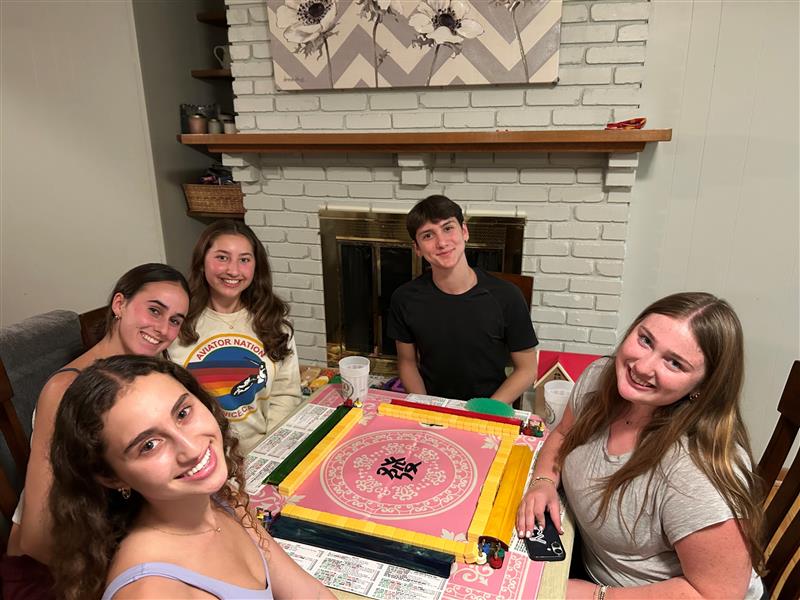
Mahjongg, the tile-based game that has entertained generations, is riding a wave of renewed popularity across the United States and beyond — and this time, it’s not just “grandma’s game.”
In the Kansas City Jewish community, the classic game is thriving with players of all ages. The trend has found its way into homes and gatherings, where long-time enthusiasts and newcomers alike come to play.
Mahjongg’s journey to American Jewish living rooms is well-documented. After arriving in the U.S. in the 1920s, the game was standardized in 1937 when hundreds of (mostly Jewish) New York women formed the National Mah Jongg League, whose annually published card helped create a distinct “American” version and fueled a massive, women-led community of play. That structure — one shared card for the whole country — still binds players today, allowing a Kansas City table to compete with the same hands as a table in New York or Los Angeles, according to Aimee Patton, a local mahjongg teacher and player in addition to her work at marketing agency VML.
While mahjongg never disappeared, its popularity surged after 2020 as people craved offline connection and intergenerational activities. Kansas City is part of the nationwide “mahjongg renaissance,” with new tournaments and places to learn and play (including Bam Bam, the metro area’s first dedicated mahjongg parlor) drawing beginners and veterans alike for classes, open play and new tile sets.
For Patton, the game is family legacy and daily practice. Her lineage runs deep: her grandmother played in the 1940s and ’50s, and her mother, Anita Mooney, started playing in 1969. As a rite of passage, Patton’s 20-year-old daughter, Amelia, is also learning how to play.
“It’s something that has always been around my home,” Patton said.
Patton brings this tradition into her teaching. She learned young — subbing in at age 12 — and has since taught dozens of players around Kansas City, first informally as she began teaching friends how to play with her in her 20s. Now, she teaches with a five-lesson curriculum that she developed to build offensive and defensive techniques and, equally important to her, community. In addition to sharing her knowledge with private groups of players, she recently began teaching intermediate and advanced mahjongg classes at Johnson County Community College (JCCC).
“About five years ago, someone asked me, ‘Do you give lessons?’ I initially said no. Then I started researching what they were doing in other cities,” Patton said. “I ended up putting together a series of five lessons so the group could play on their own after the fifth lesson.”
“When I teach private groups, I require at least four people so they can become a table,” she said. “I still get ‘mahj emergencies’ from the groups — texts and calls about rules or strategy — and I love that they’re still playing together.”
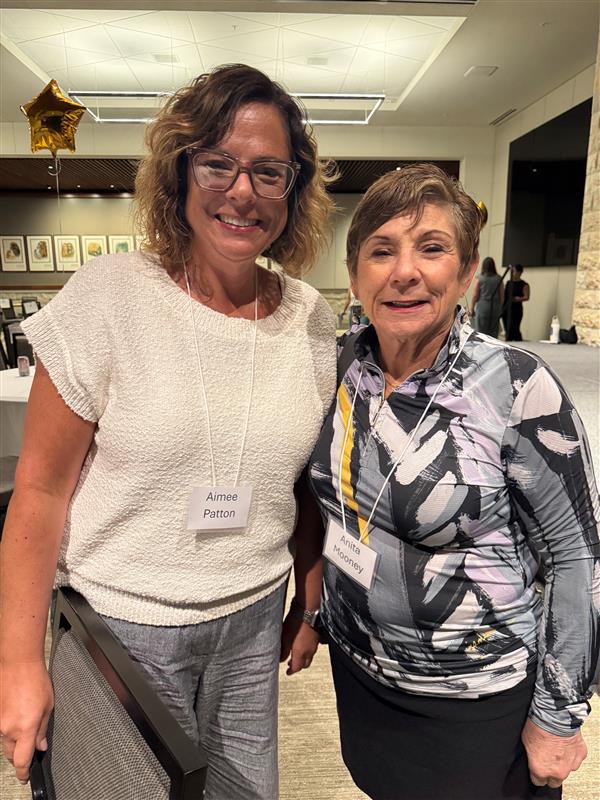
Aimee Patton and her mother, Anita Mooney, at last year’s B’nai Jehudah Sisterhood Mahjong tournament.
Patton teaches National Mah Jongg League rules so students “can hold their own in a tournament,” and also demystifies table stakes. “Playing for money changes the way you play,” she said, noting she uses scorecards at JCCC, where students cannot exchange money during play.
The family connection is vivid — she still plays on her grandmother’s and mother’s sets. In one Saturday group, Patton and a friend play with the same set their grandmothers once shared.
“It’s really special,” she said. “Now there are boutique sets — beautiful collectibles.”
Patton’s own story just entered print: she is the featured player from Kansas in the new coffee table book “The Tiles that Unite.”
“I feel like it is my whole life sometimes,” she said. She even took a bucket-list “mahj cruise” with her mom — “the most intense play I’ve ever experienced” — and competes in local tournaments, including synagogue events that donate proceeds to good causes, a hallmark of American mahjongg since the League’s early days.
Rachel and Lucy Warner: a mother-daughter chain
Rachel Warner, a kindergarten teacher in the Shawnee Mission School District, learned the game 18 years ago from seasoned preschool teachers at Congregation Beth Shalom, just as her grandmother had anticipated when she left Warner her set. Today, Warner plays multiple times a week with groups spanning “all ages and stages,” from young mothers to her beloved original mentors. She’s taught neighbors from a variety of religious and cultural backgrounds, and she happily notes how trendy the game has become — right down to stylish sets and Bam Bam, the local mahjongg boutique where she and her daughter Lucy have met new friends over sample tiles during open play sessions.
For 19-year-old daughter Lucy Warner, now a freshman at Mizzou, the spark came during wisdom-tooth removal recovery in late 2024. She started playing online, graduated to live play, and then began teaching peers: BBYO friends, a dance teammate and even her cousin in Chicago.
“When a hand comes together, it’s fun,” she said. “You can celebrate other people’s wins and really watch them grow.”
The best part for her, though, is family time.
“Playing with my Nana [Natalie Hammer] is really special when my cousin and aunt are in town,” she said.
Rachel Warner plays regularly and substitutes at multigenerational tables, and Lucy Warner and her friends (who she taught to play) are now teaching other friends. Lucy Warner shared that some of her friends taught a week-long Winterims mahjongg class at Hyman Brand Hebrew Academy in January. Rachel and Lucy Warner were guest teachers during the week and were excited to see how interested middle and upper school students were to learn the game.
Lucy Warner’s intergenerational arc mirrors the Kansas City landscape, where one can find everything from synagogue tournaments to open-play rooms — more pathways for teens to sit beside elders and learn. That binding force is l’dor v’dor — the unbroken chain of learning from generation to generation.