


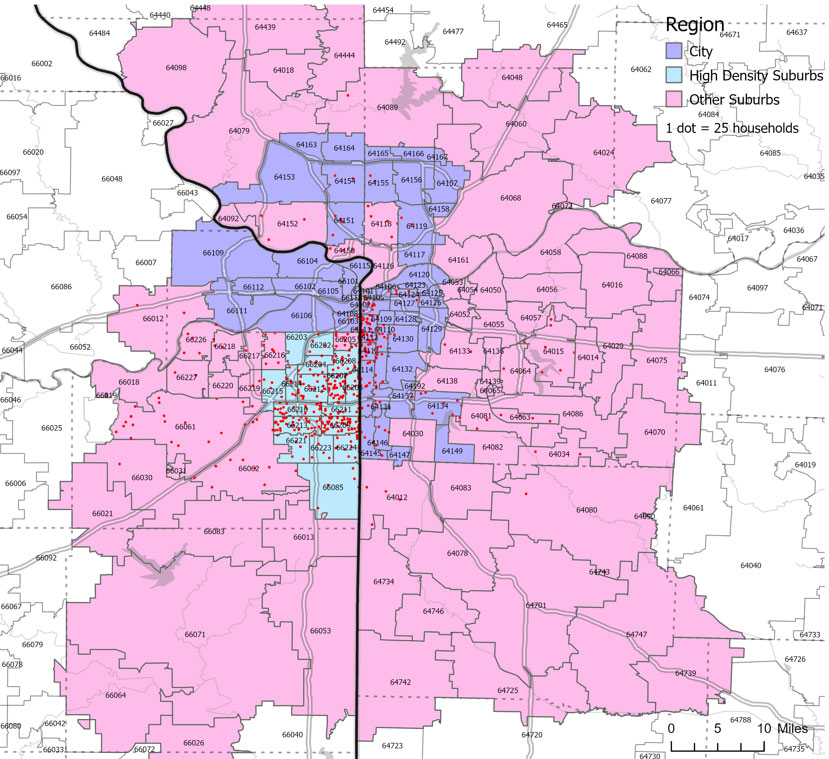
Across Greater Kansas City, Jewish life is not defined only by where synagogues, schools and community centers stand. Families live north of the river, in Midtown, in Olathe, in eastern Jackson County and far beyond the neighborhoods most closely associated with Jewish communal life.
For many of them, distance shapes crucial decisions about Jewish living — how often they attend services, where their children learn Hebrew and whether Jewish community feels accessible at all.
The question facing Kansas City’s Jewish institutions is not only where Jews live but also how to reach them.
Rabbis, educators and organizers across the metro are building a web of outreach that depends less on buildings and more on relationships, less on affiliation and more on presence. Many are organizing informal gatherings and low-pressure programs designed to reach Jews in neighborhoods where they live and work, especially as demand for connection intensifies post-Oct. 7.
Many Jewish leaders doing outreach work begin by identifying Jews who may want to get more involved in community events or Jewish practice, then connecting with them in unobtrusive ways. Some focus on reaching young professionals, while others strive to build ties with seniors living alone or families with young children. Unaffiliated, Reform, Conservative and Orthodox community members — some living in far-flung parts of the metro — have all been brought deeper into the fold through outreach programming.
“We’ve sort of made it our mission to reach people wherever they are,” said Bridey Stangler, who leads the PJ Library family engagement program through Jewish Federation of Kansas City. “Judaism doesn’t just happen in one part of town.”
Several community members in the Northland lauded PJ Library — a program of the Harold Grinspoon Foundation that sends free Jewish children’s books every month to around 1,000 local children — saying it helps keep them connected to Judaism.
“There’s no test here. If your life is made more rich Jewishly by subscribing to these books, then you’re able to receive them,” Stangler said, adding that the books support Jewish practice and Jewish identity in the home.
What Stangler sees in enrollment patterns reflects what community studies have shown: Jewish families are far more spread out across the metro than many people realize, including in Midtown, downtown, eastern Jackson County and southern Johnson County.
To reach them, PJ Library has focused on informal neighborhood gatherings in secular spaces such as parks, splash pads and libraries.
“The goal there is to help people see there are Jews living right there in their part of town,” Stangler said. “And gradually, those relationships develop into something where people are getting Jewish community together outside of the purview of PJ Library and the Jewish Federation.”
Post Oct. 7, “I think that people are looking for more Jewish fellowship,” Stangler said. “People really need the community and they don’t want to feel alone.”
At Kehilath Israel Synagogue in Overland Park, Rabbi Moshe Grussgott said his congregation draws families from downtown Kansas City and Olathe. One reason is a program that quietly removes one of the biggest barriers to synagogue engagement: tuition.
“Our Hebrew school is free,” Rabbi Grussgott said. “A lot of people don’t know that.”
The school meets Sunday mornings and Wednesdays and is open even to non-members.
“Sometimes people just want to do the Hebrew school, and they don’t necessarily want to become a member, but it has been a nice way of getting people involved on Shabbat also,” he said. “We have a couple of young families who grew up here and now live downtown, and when they do come to shul, they come out here.”
 At Torah Learning Center (TLC) in Overland Park, Co-Director Esther Friedman said the institution hosts programs designed to attract people from across the metro. One such program, Gather KC, holds popular events like an annual backyard Sukkot party at TLC, featuring plentiful portions of traditional foods, handcrafted cocktails and lots of community-building connections.
“We have people participating from all over the area,” Friedman said.
The center’s kosher pizza nights, she said, also regularly bring in families from far outside Overland Park.
Beyond food and family programming, Friedman said TLC’s outreach stretches across the region through its kosher Meals on Wheels operation and volunteer cooking programs.
On certain Sundays, families come to cook meals for others.
“People who volunteer for that come from all over the city,” Friedman said.
Friedman said TLC has long tried to reach Jews where they are, including through public holiday programs in areas without established Jewish institutions. TLC remains eager to expand programming in areas where Jewish families may not be able to travel easily.
“If they’re not coming here, we’ll go there,” Friedman said. “We’ll absolutely go and offer a Purim program, a Megillah reading, or get them to come to us.”
Their aim, she said, is simple.
“Our goal is to get more people involved in Yiddishkeit [Jewish way of life],” Friedman said, “whichever way it can be done.”
In Olathe, Rabbi Mendel Wenger of Chabad saw that many Jews were not traveling to participate in Jewish life, so he moved Jewish life to them.
“We moved to Olathe in November 2024 and settled here to get a feel for being part of the city,” said Rabbi Wenger, the city’s first resident rabbi. “People see over time that you’re dedicated to the city, and they feel a lot more looked out for.”
Over the past year, Wenger estimates he has met and interacted with more than 100 Jews in and around Olathe. Much of his outreach happens one-on-one, long before people attend formal programs.
“I still go to people’s houses, people’s offices,” he said. “We bring them challah and things like that, and those interactions help people realize that [Jewish] part of themselves that they have always had, but was never a priority.”
Echoing other metro Jewish leaders, Rabbi Wenger said many Jews appreciate the personal connection they build with him through his outreach work. Those relationships help community members connect to Jewish life, “but doesn’t feel overwhelming to them as they start to get more in touch with their Jewishness,” he said.
Chabad of Olathe’s programming has grown organically: a weekly “brunch and learn,” holiday barbecues in the park, Friday night dinners and a men’s gathering called “Brisket and Bourbon.”
“It’s to get young professionals away from the house, away from work, just to get them out a little and in tune with their Jewish identity,” Rabbi Wenger said.
This past Hanukkah, Wenger helped organize what he believes was the first public menorah lighting in Olathe’s history.
“We had a seven-foot menorah outside,” he said. “We made the blessing and spoke about Hanukkah and sang songs, then we went back inside to have some brisket.”
He is now working to reach Jewish seniors living in assisted-living facilities across the city.
“These are people in their 80s living in Olathe, sometimes the only Jews in their building,” Rabbi Wenger said. “They really appreciate Jewish life coming to them. It’s also a great opportunity to get others from Olathe involved by volunteering to bring Jewish joy to seniors.”
In Midtown and downtown Kansas City, another model is emerging that deliberately separates community-building from synagogue membership — a potential monetary barrier that can also be intimidating for more secular-minded Jews. For some, hesitation stems from concerns about aligning with a synagogue or rabbi’s political or cultural views; from the feeling that formal membership can be rigid or intimidating; or from the sense that joining means being locked into a major commitment.
In October, Julia Patterson, who works with Congregation Kol Ami through a Menorah Heritage Foundation Radical Inclusion Grant, launched the Kansas City Metro Jewish Collective, a grassroots group aimed at Jews living north of the southern Johnson County corridor.
“Some people are intimidated when they hear a synagogue is connected to something,” Patterson said. “They think, ‘If I go, they’re going to expect me to join.’ We don’t want people to feel like that.”
The group hosts game mornings, coffee meetups and holiday dinners in neighborhood spaces and local restaurants. A recent gathering at Tannin Wine Bar in the Crossroads District drew participants from different parts of the metro.
“People just want community,” Patterson said. “They want friendships. They want to belong.”
Patterson, who is in the process of converting to Judaism and raising a Jewish family, said many people she meets are simply looking for a low-pressure way to connect.
“We’re trying to create a community that feels open and flexible,” she said. “People can come, they can eat something, they can do something fun, and there aren’t any strings attached.”
She said outreach in a spread-out metro area often depends less on formal lists and more on personal connections.
“The Jewish community here is amazing at connecting people,” Patterson said. “Once you make one friend, your whole web grows.”
For Stangler, one of the most important parts of outreach is easing the hesitation many unaffiliated Jews feel about approaching institutions at all.
“Sometimes a person who is not affiliated gets wary when they hear that a congregation’s rabbi will be in attendance, because they say, ‘Well, I’m not a member,’” she said. “But our rabbis here are so community minded and so eager to engage people in their Judaism in any way.”
She said what distinguishes Kansas City is how broadly that attitude is shared.
“It’s a very holistic view that rabbis have taken of the Kansas City community,” Stangler said. “Very few cities come together the way ours do, to include everybody.”
As Jewish families continue to settle across the metro, that willingness to meet people where they are may shape the future of Jewish life here more than any single building ever could.
This is the last of a two-part series.