


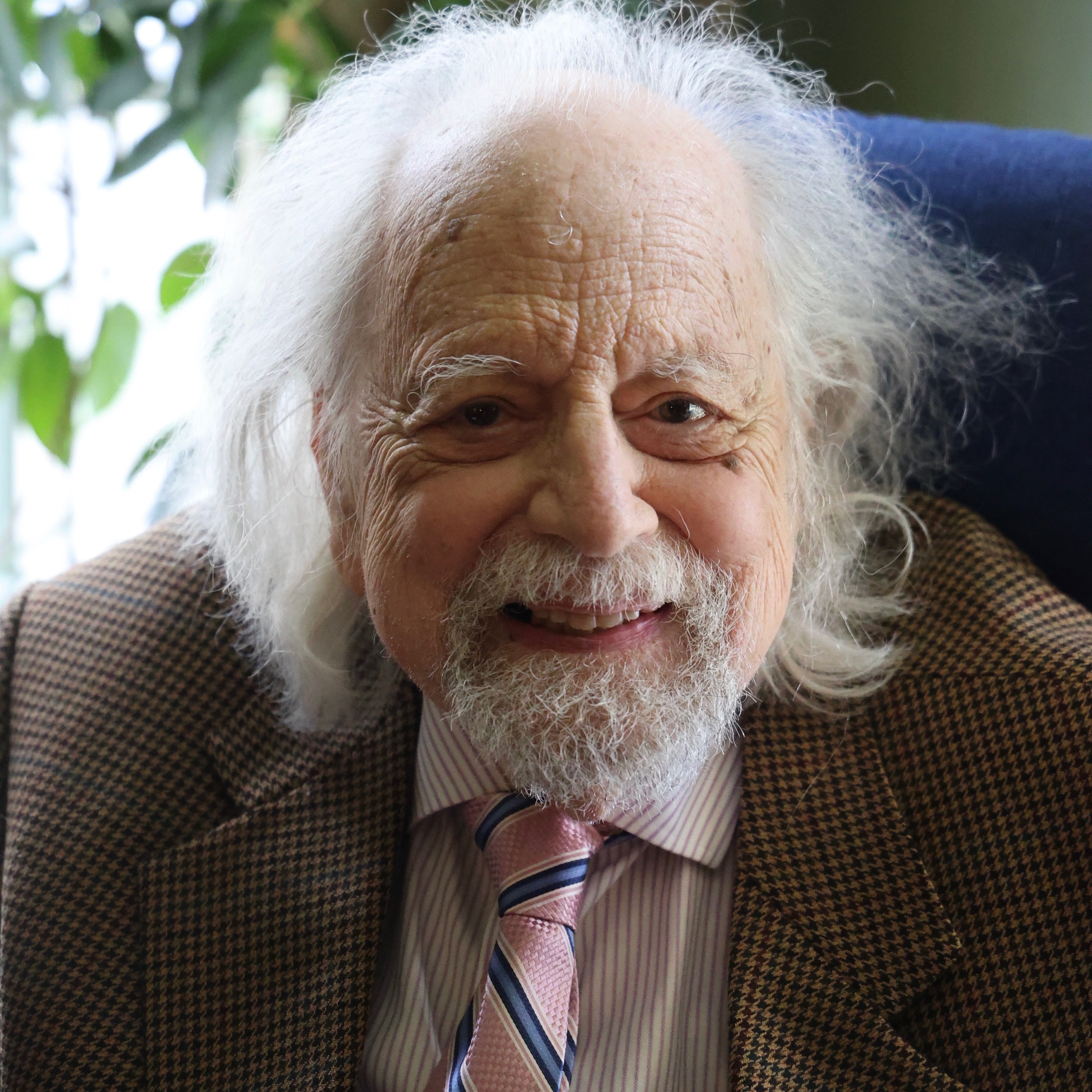
From making an impact in the Civil Rights Movement to serving in the United States Navy during World War II, Judge Howard Frederic Sachs has spent decades in pursuit of justice.
Sachs, who is 99 years old, is planning to retire shortly after his centennial birthday on Sept. 13.
It’s a deserved retirement, as Sachs has served as a federal judge for more than four-and-a-half decades and as an attorney for 28 years before that.
Sachs made history as the first Jewish judge in the eighth circuit since the 1800s when President Jimmy Carter appointed him in 1979. He served as U.S. District Court for the Western District of Missouri chief judge from 1990 to 1992 and became a senior judge in 1992. Sachs is currently the second-oldest senior judge still active (behind I. Leo Glasser, 101, of New York) and has no interest in making history by surpassing the late Wesley Brown, who served as a senior judge until age 104.
“I am stopping at age 100, partly because parties and lawyers may question anyone being competent that long, and partly because I am somewhat frail,” Sachs said.
Until the end of September, Sachs will continue working remotely from his Kansas City home, in which he’s lived since 1948. His work schedule largely consists of sentencing the convicted.
Sachs built a life inside that home with his wife, Susanne. They were married for more than 48 years when she passed away in 2009. In that home, the couple raised two sons, Adam Phinney and Alex Wilson, both of whom became attorneys. Alex, who followed his father into public service as an attorney for FEMA, retired before his dad.
Sachs is a lifelong member of The Temple, Congregation B’nai Jehudah. His family joined the synagogue in the 1880s, not long after its founding. Sachs would have become a bar mitzvah in the fall of 1938, but he said B’nai Jehudah didn’t offer it at the time.
“We only had confirmation,” Sachs said. “I remember about 10 Hebrew words, (yet) I am very interested in Jewish history.”
Despite this, B’nai Jehudah Rabbi Samuel Mayerberg, who later would preside over the Sachs’ wedding in 1960, asked him in the 1930s if he wanted to be a rabbi.
Sachs served the Kansas City Jewish community as the chairman of the Jewish Community Relations Bureau and as a president and honorary chairman of the local chapter of the American Jewish Congress, as well as through other roles at B’nai Jehudah. He also played a key role in researching and documenting Kansas City’s Jewish history, having worked on the 100-year history of B’nai Jehudah, “Roots In A Moving Stream.”
Sachs said that none of his family has left the Kansas City area, with local roots spanning back to the 1880s.
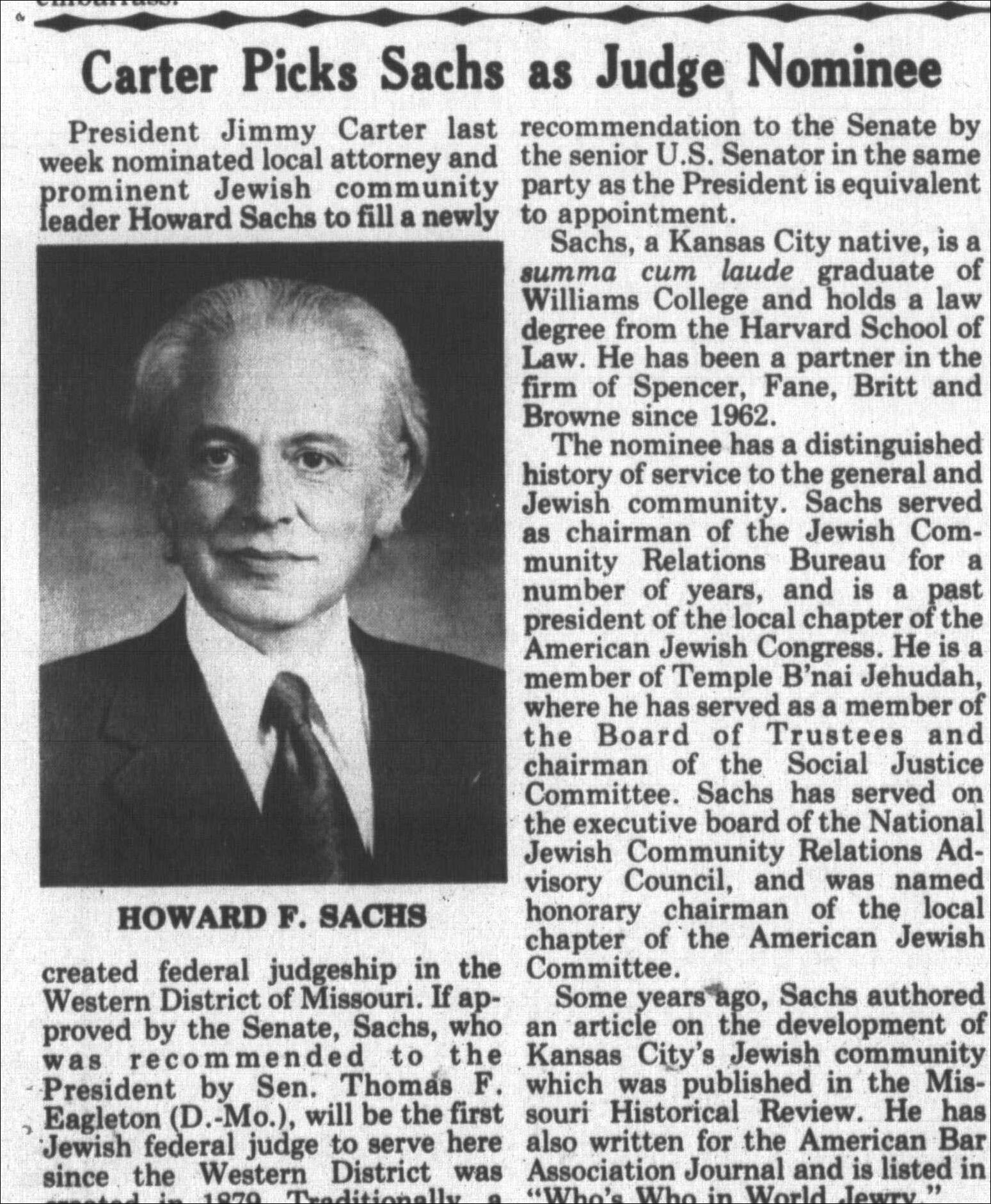
The May 25, 1979, article in The Chronicle announcing President Jimmy Carter’s appointment of Howard Sachs as the judge of the United States District Court for the Western District of Missouri.
Sachs’ father, Alex, was close friends with President Harry Truman. The elder Sachs was appointed Kansas City’s postmaster by Truman. Many decades later, Sachs himself was honored by the Truman Foundation.
“I met Truman in the Christmas break at college [in 1942] and ‘flattered’ him by saying a college professor commended his work,” Sachs said. “I attended a White House press conference in 1947 and had a visit with Truman at the Truman Library with my wife’s parents from Iowa. He took us on a tour.”
Before he was meeting presidents and serving as a judge, Sachs began his academic career at Bryant Elementary School with his best friend, the late Kansas City businessman and philanthropist Morton Sosland. Sachs later graduated from Southwest High School in Kansas City and headed east to Williams College in northwestern Massachusetts.
“[Williams] was small and Eastern and supposedly not-antisemitic,” Sachs said. “There was no Jewish fraternity, but all Jews were in a non-sectarian Garfield Club.”
In the midst of World War II, Sachs enlisted in the U.S. Navy, where he was part of radio tech school due to his experience in physics. Sachs was serving on the U.S.S. South Dakota in Tokyo Bay when Imperial Japan surrendered on Sept. 2, 1945 — 11 days short of his 20th birthday.
“I broke a cup 80 years ago to celebrate the expected surrender and went ashore at a Japanese naval base in September for Rosh Hashanah [five days after the Japanese surrender] and to collect souvenirs,” Sachs said.
Sachs returned to Williams after the war, graduated as the college’s valedictorian and remained in Massachusetts to attend Harvard Law School.
“I was interested in law, beginning with the Supreme Court controversies with President Franklin Delano Roosevelt and the court packing plan,” Sachs said. “Perhaps I wouldn’t have gone to law school, except for the G.I. Bill [being signed by Roosevelt].”
At Harvard, he learned from Civil Rights leader Zechariah Chafee. His law school classmates included Richard Kleindienst, who would go on to serve as attorney general under President Richard Nixon, and longtime U.S. Senator John Chafee of Rhode Island.
After Harvard, Sachs returned to Kansas City to work as an attorney for Spencer, Fane, Britt and Browne from 1951 to 1979. Sachs met his wife through their time with the Jackson County Young Democrats supporting Civil Rights Movement advocates Missouri Congressman Richard Bolling and former Illinois governor and 1952 and 1956 presidential candidate Adlai Stevenson II.
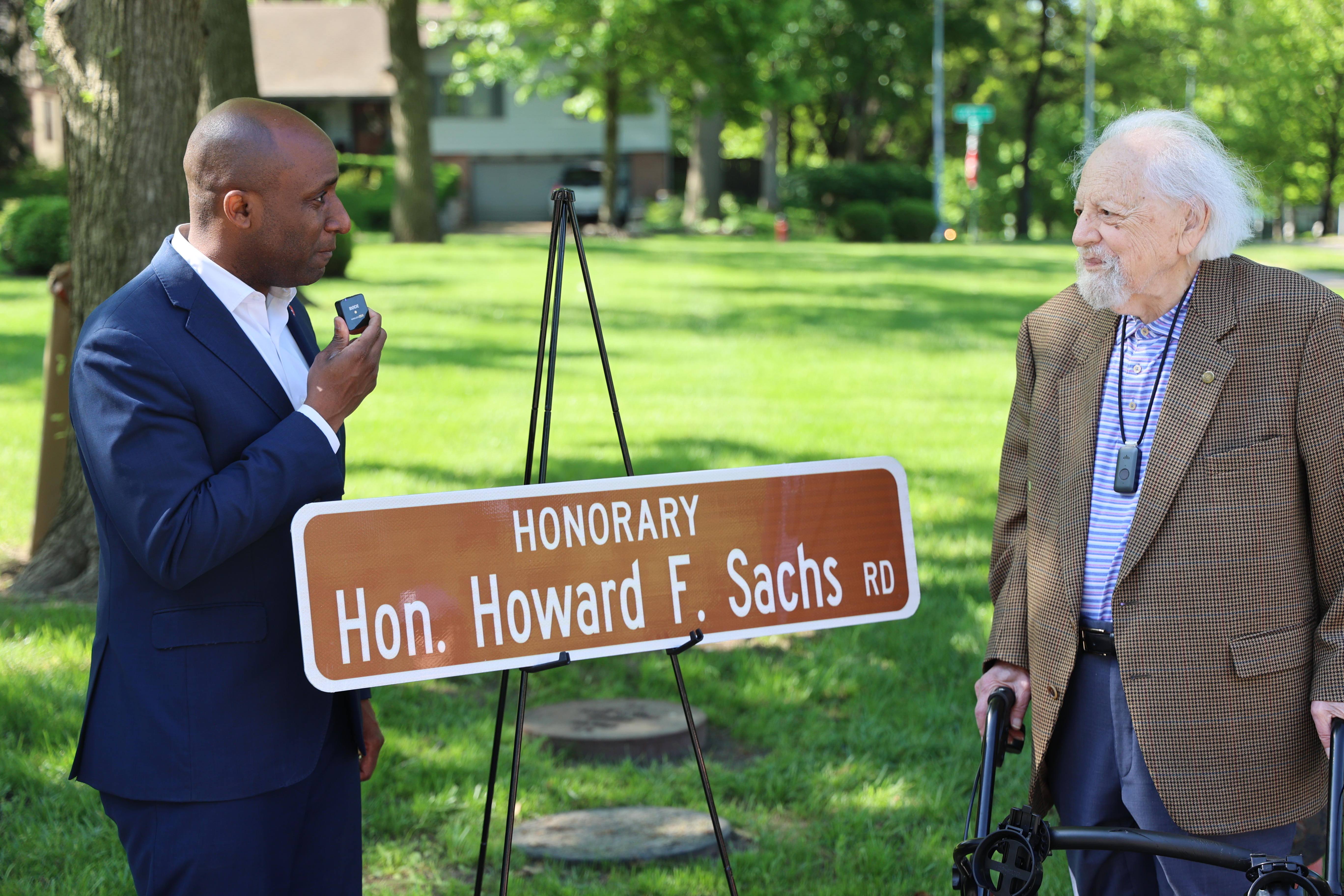
Kansas City Mayor Quinton Lucas (left) with Judge Howard Sachs at the dedication of Hon. Howard F. Sachs Road.
His civil rights work included advocating for the separation of church and state in terms of mandated prayer in public schools and tackling antisemitism and discrimination in the social clubs of Kansas City. That work resulted in the Kansas City Club accepting Jewish members.
Sachs served as the chairman of the legal committee of the Kansas City Commission on Human Relations and helped draft the first civil rights ordinance in the state of Missouri.
Sachs’ legacy is further cemented by his work for desegregation. He was crucial in helping legally desegregate Kansas City schools, theaters, bars and businesses.
In 1951, Sachs was completing a clerkship for Judge Albert A. Ridge when a case arose where three Black individuals were denied the opportunity to attend the Swope Park pool. Thurgood Marshall, then the chief attorney for the NAACP, worked on the case — Sachs knew there was something special about the future Supreme Court Justice.
“[Marshall was] a person with a great deal of presence,” Sachs told the Federal Bar Association. “He was not a major figure at the time, but he was on the verge of it.”
But meeting Marshall wasn’t the most impactful part of Sachs’ involvement. He assisted Judge Ridge’s decision, which determined that the Swope Park pool must be integrated.
Three years later and just 64 miles away, the Swope Park ruling that Sachs helped with was integral to the result in Brown v. Board of Education, one of the biggest victories of the Civil Rights Movement.
Despite his countless recognitions, legal precedents and righteous judgments, Sachs’ reason to stay on the bench until his centenary was simply “to be of service and relieve the other judges of part of their docket.”
As for what the esteemed judge will do after retiring, Sachs said he simply plans to keep reading and continue his tradition of attending weekly luncheons with his friends followed by visits to the library.