


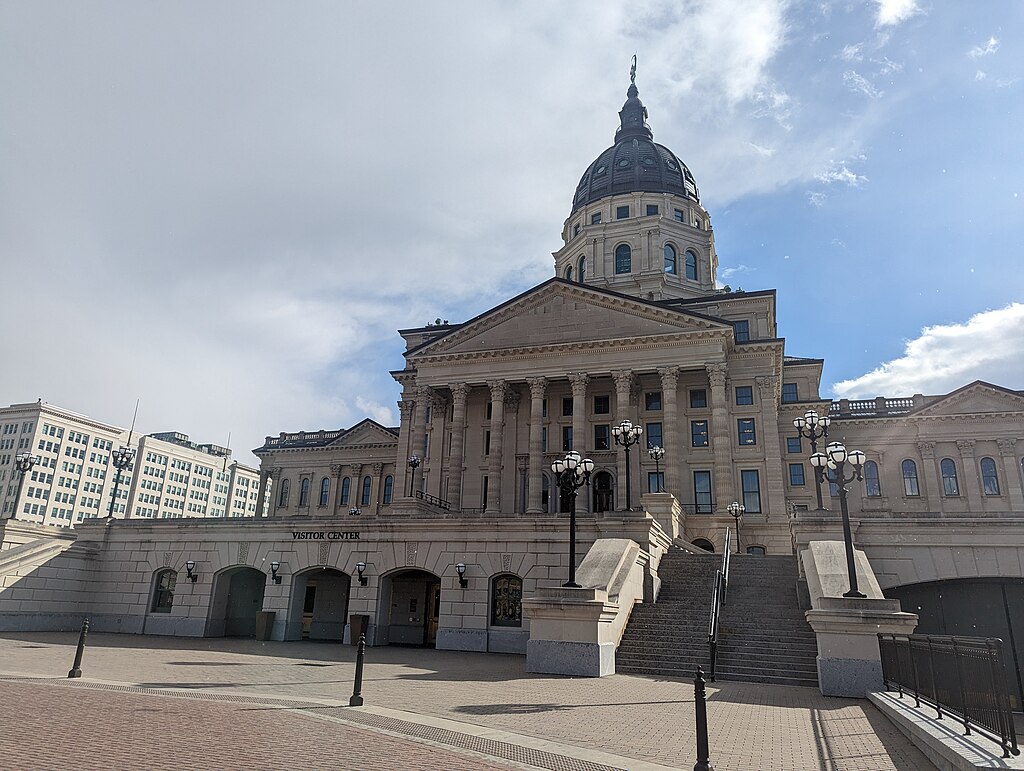
On Aug. 4, Kansans and Missourians will have the opportunity to vote in their states’ primary elections. In Kansas, a Jewish community member is running for governor, and a proposed constitutional amendment would modify the state’s Supreme Court justice selection process.
Kansas leadership
Kansans will be selecting their new governor, the successor to Gov. Laura Kelly. Among the gubernatorial candidates is Jewish community member and State Sen. Ethan Corson, a Democrat from Fairway, Kansas, who was endorsed by Kelly.
Corson is a Johnson County native and became a bar mitzvah at Congregation Beth Shalom in 1995. Since his election to the State Senate in 2020, Corson has been involved with or supported several state government initiatives combating antisemitism. Corson also voted for Kansas to adopt the International Holocaust Remembrance Alliance’s working definition of antisemitism in 2022 and to declare May Jewish American Heritage Month in 2023. In January of 2024, Corson was one of 17 senators who sponsored SR 1729, a resolution expressing support for Israel and condemnation of the Oct. 7, 2023, attacks by Hamas on Israel.
“I’m running for governor to ensure our public schools are fully funded, including special education, expand Medicaid and stand up to the failures of the federal government,” Corson told The Chronicle. “If elected, I would be the first Jewish governor of Kansas, and I would be honored to earn your vote. Voting is one of the most meaningful ways we can shape the future of our communities and ensure our values are represented... I encourage every Kansan to make a plan to vote and participate in this important election.”
Corson will be competing against Republicans Ty Masterson, Charlotte O’Hara, Nick Reinecker, Stacy Rogers, Philip Sarnecki, Vicki Schmidt and Scott Schwab; Democrats Cindy Holscher and Curt Skoog; and independent Sharilyn Ray. The winner of the election will replace Gov. Kelly in 2027.
Kansas constitutional amendment
Kansans will also be voting on a new state constitutional amendment which would give voters the power to directly pick Kansas Supreme Court justices rather than being chosen through merit-based nominations.
In April, Jewish community member and Kansas Supreme Court Justice Melissa Standridge shared with the Greater Kansas City Section of the National Council of Jewish Women how the current selection process works:
Each of the four congressional districts has one lawyer and one non-lawyer. The lawyers are elected by their peers, and non-lawyers are appointed by the governor. There is an additional lawyer who chairs the commission who is elected by the lawyers statewide. This group reviews all the nominations, and they select three candidates. The governor then selects the judge.
In the proposed amendment, voters would decide on the new judges.
“We can understand that voting ‘No’ for Amendment 4 reaffirms choosing Supreme Court justices on merit, as practiced for the last 68 years,” said Mary M. Greenberg, Ph.D., a community member and advocate. “Choice by merit means that each justice will be voted on in following elections to retain her/his seat. In contrast, voting ‘yes’ for Amendment 4 would mean changes. Court justices would be elected. The ban would end on politicians running for the court. Career politicians could run for court seats.”
“As Americans, we each owe it to ourselves to exercise our Constitutional right to vote,” she said.
More information about your local elections are available on your state’s website: sos.ks.gov/elections (Kansas) or sos.mo.gov/elections (Missouri).