

Due to popular demand, the Museum of Art + Light (MoA+L) in Manhattan, Kansas, is extending “Afterimage,” a solo exhibition by Israeli-American artist Rae Stern, through February 2026.
The exhibition, on display in the Byrnice + Gordon Hurt Gallery, is supported by the Kemper Family Foundation and the Jewish Art Fund of the Jewish Community Foundation.
Originally scheduled to close in October, MoA+L is extending “Afterimage” due to “enthusiastic audiences” and the critical acclaim it's received since its opening in July. The exhibition brings together a selection of Stern’s recent works that explores the layered connections between landscape, memory and belonging.
At its core, Stern told The Chronicle, “‘Afterimage’ is about the invisible gaps in our collective recollection and the evanescent fragment from which our histories are composed.”
Stern, an Israeli-American artist born in Haifa and now based in New York City, is known for blending new media technologies with traditional craft. Drawing on her background in the tech industry, she employs digital tools to manipulate a range of tactile materials, including ceramics, glass, paper, photography and textiles.
Stern is no stranger to the Kansas City Jewish community and art scene. In 2019, her exhibition “In Fugue,” which featured porcelain portraits of local Holocaust survivors, was displayed at the Belger Crane Yard Studios. Since then, she has stayed in touch with many community members and mentions community members Joan and Steve Israelite, Patricia Uhlmann, Dan and Miriam Scharf, Irene Bettinger, Matilda (z”l) and Marty Rosenberg and Bill (z”l) and Regina Kort as some of the many who “welcomed me warmly, checked in on me and offered advice when I had to deal with antisemitism.”
“Afterimage” is largely based on a local connection — it was sparked by an invitation extended to Stern to work with the archives of the Harry S. Truman Presidential Library. There, she encountered the diplomatic dossier of Charles F. Knox, an American official stationed in Israel during its formative years. Inspired by this discovery, Stern traveled to Israel to revisit the landscapes referenced in Knox’s records and created the artwork as a visiting artist at Englewood Arts, located in Truman’s hometown, Independence, Missouri. Stern said that after the Oct. 7 massacre, the Truman Library and Institute canceled the exhibition; it is now featured at MoA+L.
“Reading Knox’s personal letters to his loved ones provided a point of view I had not yet encountered,” she said. “Until then, most of what I knew came from Israeli and Palestinian perspectives. Here was an outsider writing his uncensored impressions without prior knowledge of the land, its people or its history.”
Stern read Knox’s letters from the Israeli War of Independence in 1948 as he witnessed Egyptian bombings of Tel Aviv and the influx of Holocaust survivors. He served as an aide to American ambassador James McDonald and “was often a fly on the wall in pivotal meetings… Though his stay in Israel was brief, his mentorship of colleagues in Israel’s fledgling Ministry of Foreign Affairs helped lay groundwork for long-term U.S.-Israeli relations,” Stern said.
Most artistically inspiring to Stern was a farewell photo album given to Knox that contained images to show colleagues in Washington, D.C., who had no familiarity with the land. Stern said that the album features historically significant sights as well as the people who inhabited the land, including the Muslim and Christian Arab populations.
“Viewing these images 75 years after they were compiled provided me with the opportunity to ask, ‘What has changed since these images were taken?’” Stern said. “I traveled back to Israel and visited the sites to visualize the change that had occurred in both the landscape and its historical contextualization.”
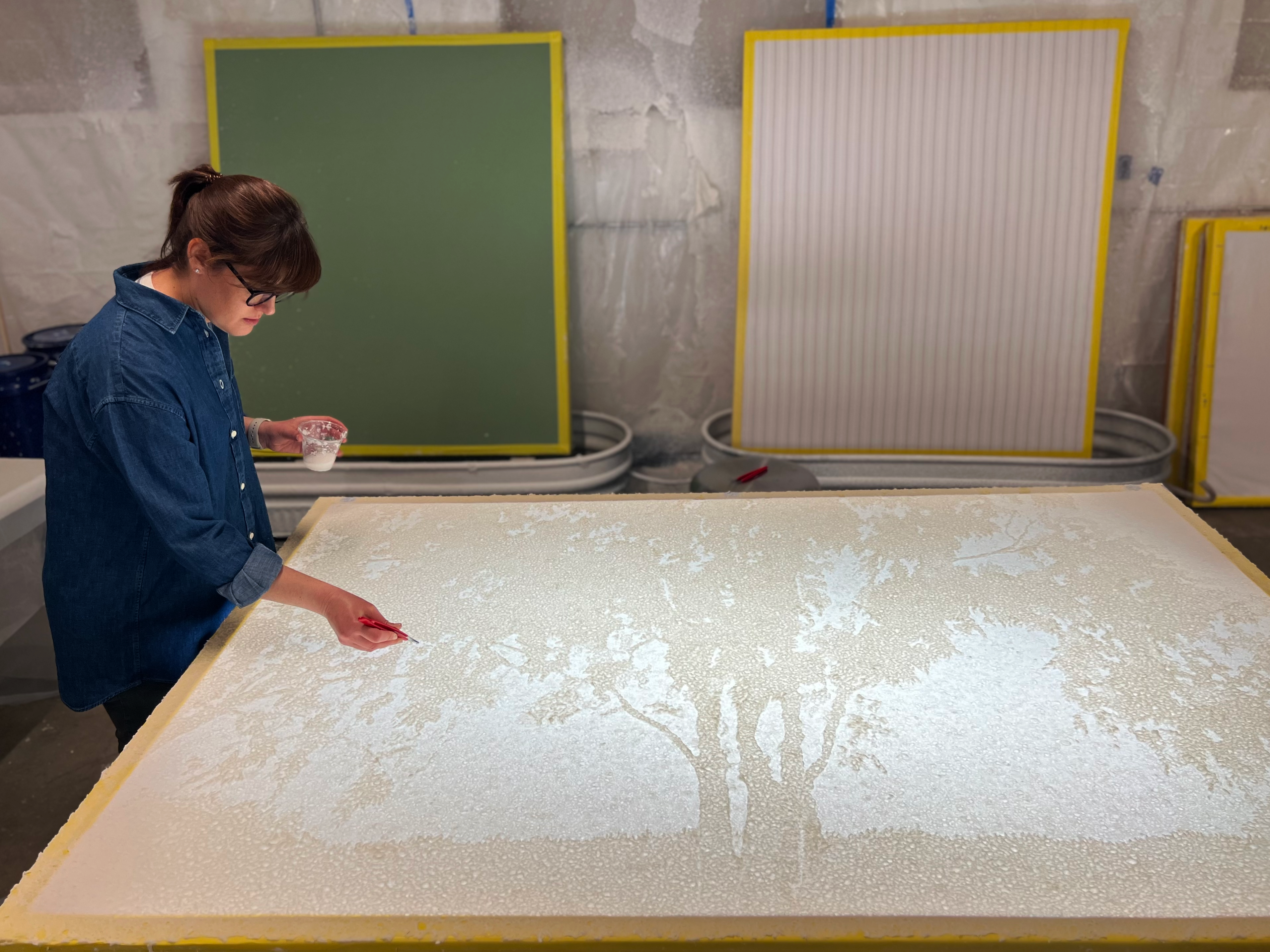
The term “afterimage” — a residual visual impression left after a source has disappeared — served as a guiding metaphor for the exhibition. Artworks consist of handmade paper, video, photography and glass.
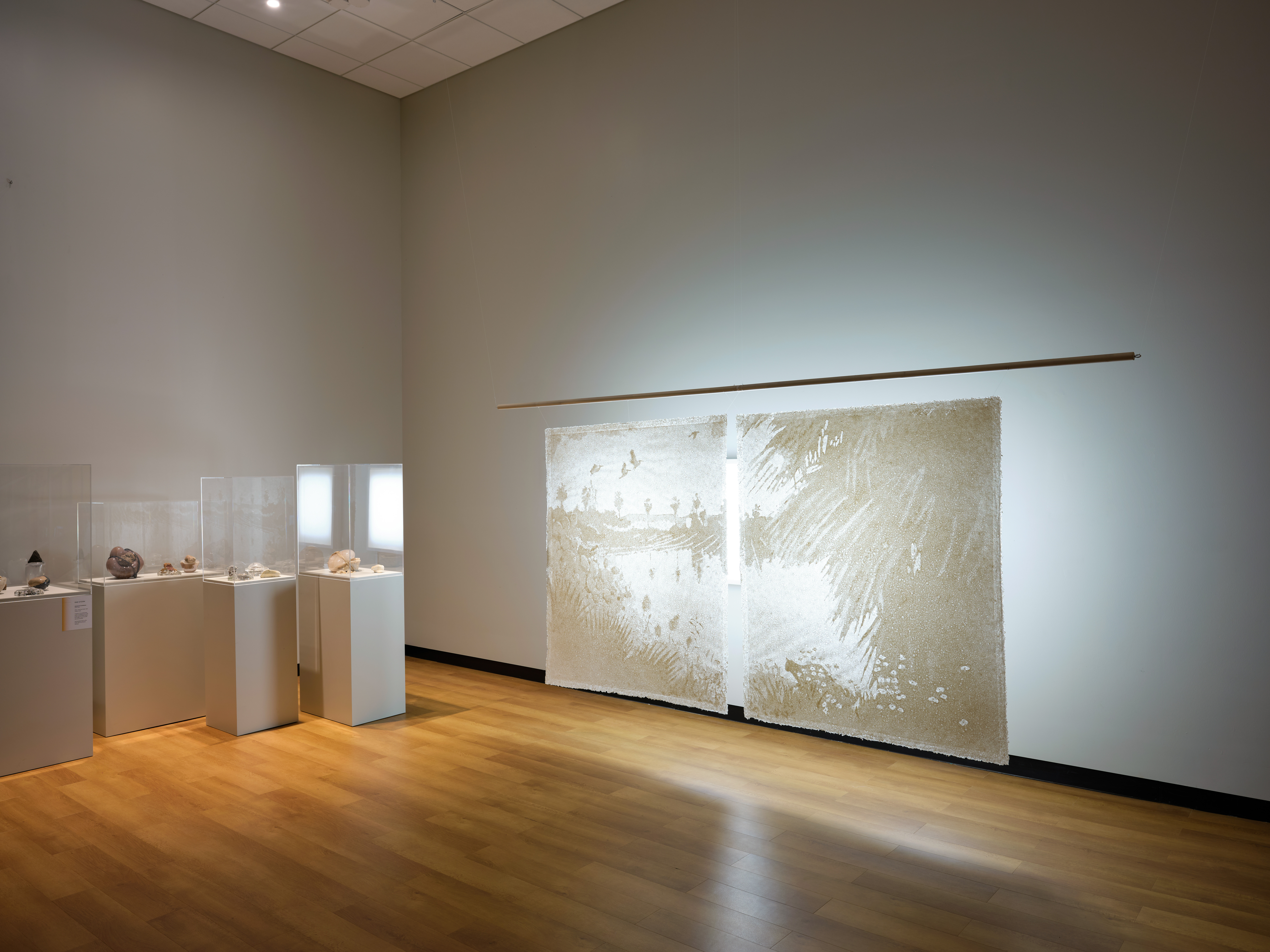
A portion of Rae Stern’s “Afterimage” at the Museum of Art + Light (MoA+L) in Manhattan, Kansas. (T. Maxwell Wagner)
“While creating the artwork in response to this exploration, I reflected on the nature of permanence and impermanence in these landscapes and on how framing shapes interpretation,” she said. “Though the artwork accepts ambiguity, my journey through these sites made clear how layered the land truly is and how little outsiders know about these layers of history, peoples and narratives.”
Stern said that “Afterimage” draws on both the Knox archive and her lived experiences as an Israeli-American.
“I have been traveling back and forth between Israel and the United States for over a decade, gaining the perspective of an expat in addition to that of a native to the land,” she said. “Based on this unique experience, I invite viewers to hold complexity, to acknowledge multiple perspectives and to consider how images, whether archival or contemporary, become evidence of both history and longing.”
In the wake of the years-long turmoil after Oct. 7, Stern stands firm with her belief that art has a “diplomatic power… to open dialogue where words may fail.”
Stern said she is grateful to Michael Abrams and Mary Kemper Wolf, who helped her after the cancellation by the Truman Library after Oct. 7 and championed “Afterimage” at the MoA+L. She said the decision of museum directors to present the artwork at this moment “was a courageous decision… It reflects a genuine commitment to sharing nuanced, challenging narratives with the public — without taking sides.”
“‘Afterimage’ exemplifies the kind of work we champion — art that invites curiosity, challenges perception and connects audiences to broader cultural and historical conversations,” said Erin Dragotto, executive director of MoA+L. “We’re thrilled to extend the exhibition and continue sharing Rae’s remarkable perspective with our visitors.”
Stern also highlighted the importance of Jori Cheville, director of curatorial affairs at MoA+L, who initiated the invitation and curated the exhibition.
“[Cheville’s] commitment shaped the project from the ground up,” Stern said. “She is a thoughtful and courageous curator who works quietly and with integrity.”
As an Israeli-American, Stern has dealt with antisemitism under the guise of anti-Israel sentiment, but this has not dissuaded her from her work.
“Since Oct. 7, 2023, I too have been added to the centuries-old line of Jewish artists whose life and career have been impacted by antisemitic prejudice, ignorance and cowardice of colleagues,” she said. “Nevertheless, living through these times has deepened my understanding of my cultural heritage, my pride in it and my sincere gratitude to those who prove themselves to be moral and trustworthy allies. Jewish culture has always contributed to our sense of community, and I hope that as we rebuild ourselves from these tragic events, supporting Jewish culture and arts will be prioritized among our shared goals.”
As she was working on the project, the murders of Sarah Milgrim (z”l) and Yaron Lischinsky (z”l) “became an eerie reminder of the dangers facing those who devote their lives to dialogue. Their loss brought into sharper focus the themes at the heart of ‘Afterimage:’ the fragility of connection, the cost of misunderstanding and the moral imperative to keep communication alive.”
More information about “Afterimage” and MoA+L is available at artlightmuseum.org. Stern’s website, which includes more examples of her artwork and background, is raesternstudio.com.