 Editor’s note: The following is an essay written by Jonathan Hermanson, the winner of the 2012 Margolis Scholarship Contest sponsored by B’nai B’rith’s Kansas City Lodge #184. Thirteen contestants competed for the $2,000 prize.
Sheltered in Johnson County’s Blue Valley School District for 18 years, it is hard to imagine in what situation anti-Semitism could be encountered. But within the past year or so, I’ve encountered three situations that have opened my eyes to how quickly misguided deeds can unravel relationships, and how my actions — both positive and negative — make a difference.
On the eve of my 17th birthday, my world was rocked, and instantly, within a few mind-altering moments, I found myself in a situation that has helped me begin to understand the importance of good relations between Christians and Jews.
It was “Christmas in January.” This was the theme our high school rival, Blue Valley Northwest, planned as their theme for our late January basketball meeting in 2011. It was supposed to mean that the BVNW student body dressed in holiday apparel. When we asked, “why?” they responded with a smug attitude, “because you’re Jewish.” While my school, Blue Valley North, has probably the largest amount of Jewish students, the number only peaks at about 10 percent in some graduating classes. Our counterparts from BVNW made it seem as if the entire student body at North was Jewish. This was just the beginning of their ignorance and unfortunately, some uninformed and hurtful actions.
The Christmas sweaters didn’t bother me, but the night of the game, some Northwest students entered the gym hailing Hitler as they walked with extended arms and stiff legs as if to resemble Nazi soldiers. For me, along with many of my Jewish and non-Jewish friends, the night was no longer about the basketball game. It became personal. As the game concluded, the Northwest student “Hitlers” marched proudly into the parking lot.
By then, my blood was boiling. I found the nearest disrespecting offender, threw a hard right jab and tossed him against the hood of an innocent bystander’s car. The kid was scared out of his mind, and I found myself yelling, “DO NOT DO THAT!” He got the message, sulked to his car, and exited the parking lot.
When my parents learned of the incident, they weren’t sure how to take it. In part, they were proud of me for standing up to such blatant prejudice. But more so, their message was, “This isn’t the way to solve prejudice!”
I walked away from my first encounter with anti-Semitism with conflicting feelings. In this ugly encounter, it became apparent to me that we do not live in a world where everyone gets along. Some are arrogant and disrespectful enough to insult people on no true grounds. But, while the “Hitlers” were wrong, so was I. And in my misunderstanding, I likely bruised a kid’s chest. I was very lucky nothing further came of the incident.
Upon further reflection, the incident could have been completely avoided if there had been open dialogue from the start. The BVNW students had a misinterpreted theme from the start. Dressing up like Rudolph the Red Nosed Reindeer in itself is not anti-Semitic. But surely, there should have been an educated adult who understood the rationale behind the Christmas wear and perhaps could have opened a dialogue to further relations. In my situation, because my “dialogue” after the game was limited and disrespectful, I took extreme measures “to fix the problem.”
That night, I went home and lay in bed for hours, trying to weigh the pros and cons of my actions. I knew that what I did was wrong. I understood that I should have tried to talk to the kids who were being idiots in the parking lot. Perhaps, if I would have talked to them and tried to get them to understand how their actions were hurtful, the next incident of prejudice and misunderstanding that this time made local news, wouldn’t have happened.
This year, BVNW opened a pep assembly with a series of skits to get the student body motivated to play BVN for the Kansas 6a “game of the year.” In one of the skits, some students at Northwest portrayed Blue Valley North by doing the Hora. (Ironically, the student who choreographed the skit was Jewish.) In reality, I don’t think this was an attempt of anti-Semitism, but just a way to rally the student body in a way they could relate to our school — “as a bunch of Jews.” Nonetheless, it was the wrong message. Our student body vice president caught wind of this and took it to 41 Action News. The news blew the incident way out of proportion and Twitter and Facebook exploded with reactions from the North and Northwest corners of Blue Valley.
Throughout this incident, the problem of misinterpretation and misunderstanding really never got resolved. If there had only been an open dialogue between Northwest, North and 41 News — talking about what is acceptable, what they plan to do, consequences of actions, etc. — perhaps we could avoid future missteps. I’m not sure we’re at that point yet.
It is baffling to me that problems keep arising for the same reasons. It is not that Northwest students hate North students because North students are Jewish, but that Northwest students (and maybe their teachers) don’t have a real understanding of how their actions could be misinterpreted. Maybe our “politically correct” society, where we have to be careful not to upset anyone, has gone too far, but without any respect, teaching, or open dialogue between Christians and Jews, or for that matter any groups of people who may not understand one another, bad relations in the form of misunderstanding and hurt feelings will reign in the background.
Some of us learn better than others. My most recent experience of prejudice happened while I was in Mexico with a number of my classmates on a spring break trip. While we were there, some friends and I encountered some students from Germany. One of my “well-meaning” classmates, who will soon enlist in the Marines, very loudly said in front of the Germans, and to his Jewish friends, “Dude, they’re Nazis, but I’m not going to let anything happen to you. I’ll protect you from those Nazis.”
My Jewish friends and I were mortified. Yes, we were a little bit scared because we didn’t know how these kids from Germany were going to react to the statements, but more so, we were taken aback at how prejudiced and insulting our friend had been “on behalf” of us. This time my rational sense took over my fear.
Upon hearing my friend make these statements, I stepped in and began to talk to these two young men on our behalf, making sure they knew we did not think they were Nazis. I had now experienced where misinterpreted information leads, and did not want anything bad to happen to my friend who was acting on my behalf. Nor did I want to offend some innocent Germans. To ease both my friend and the Germans, I introduced myself, including my religious background. The Germans understood our friend’s misconception, and everyone went on their merry way. Because of good communication and a dialogue, I was able to relate to these two “Deutchmen.”
In reality, all of these misconceptions stem from beliefs that came about years ago. Religion should be held for a spiritual realm. Jews can have their spiritual beliefs and Christians can have theirs, but the differences should not affect relationships in the present, where there are so many real problems that we can work together to solve.
Ultimately, my experiences over the past year have taught me that relationship-building happens one person at a time. In my first encounter, I worked against building a good relationship. The second time, even though I wasn’t directly involved, I believe the situation got out of hand because people got outraged even before a conversation could have taken place. Finally, in Mexico, I learned that keeping cool and opening a dialogue allowed for a potential misunderstanding to be defused. As small children, we were taught to respect one another. But as we grow up, we sometimes forget this virtue. In order to develop good relations between Christians and Jews, one at a time, we must try to remember those childhood teachings with each individual interaction.
Jonathan Hermanson graduated in May from Blue Valley North High School and will be studying biochemistry this fall at Tulane University in New Orleans. He is the son of Phil and Jackie Hermanson and the grandson of Marian Hermanson and Esther and Warner Bergh of Des Moines, Iowa.


 QUESTION: I understand that at this time of year the shofar is blown every day at weekday morning services. I thought the shofar was just blown on Rosh Hashanah and at the end of Yom Kippur. Can you explain this tradition?
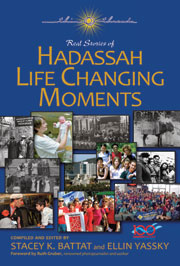 In commemoration of the 100th anniversary of Hadassah, the organization solicited “Hadassah life changing moments” — true, inspirational stories from its members on how the organization touched their lives — and chose 100 to include in a centennial book.
 Edith Pearlman’s collection of short stories, “Binocular Vision,” was selected as the best work of fiction of 2012 by the National Book Critics Circle. Although this 76-year-old author has been winning awards for her fiction since the beginning of her career, she is virtually unknown to the general reading public. This is truly a shame.
 Knowledge is quite empowering. And it is an especially powerful and at the same time humbling feeling to have the responsibility to carry that knowledge home in hopes of relaying information for the greater good.
 This past June, I had the opportunity to travel to Israel to attend the General Assembly and Board of Governors meetings of The Jewish Agency for Israel. As a representative of the Jewish Federation of Greater Kansas City, I have the honor to sit on the Jewish Agency board of governors, which brings together leaders from our devoted Jewish family from around the world to discuss and create solutions to address the biggest challenges facing our Jewish community here in Kansas City, in Israel and around the world. The Jewish Agency for Israel is a primary overseas partner of the Jewish Federations, and it was inspiring to see the commitment of representatives from Jewish Federations, religious movements and various other institutions which form the board of governors — a round table of the “Jewish collective.”