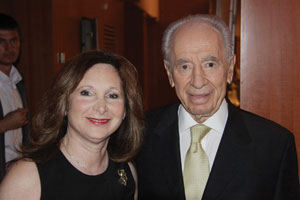
 Karen Pack loves Israel. That passion drew her to the Jewish Agency for Israel, the organization that for more than 80 years has served as the link between the Jewish people and Israel, working to ensure the future of a connected, committed, global Jewish people with a strong Israel at its center.
Last month Pack went to Israel, as a member of JAFI’s board of governors, and attended three conferences in Jerusalem — the JAFI Assembly, the JAFI Board of Governors meeting and the President’s Conference. She’s attended the JAFI meetings many times, but was privileged to attend the President’s Conference, led by Israeli President Shimon Peres, for the very first time. As always she returned from Israel energized and full of ways the local Jewish community can continue its support of the Jewish state.
The three conferences, Pack explained, are very different and distinct. For example the President’s Conference is an invitation-only event and JAFI’s Board of Governors meeting is, as it suggests, open solely to board members. But the General Assembly is open to “anyone interested in the business of the Jewish people,” and is indeed attended by a wide-ranging group of people including members of Keren Hayesod, which serves the needs of Jewish communities outside the United States, The Jewish Federations of North America, the World Zionists Organization, ORT and Hadassah. At each meeting Pack had the opportunity to attend large events featuring world renowned keynote speakers and small sessions with a variety of experts on topics relating to Israel, the needs of the Jewish community in Israel and around the world, the global economy, technology and peace and politics in the Middle East.
A meeting veteran — she’s been to at least five JAFI Assemblies — these assemblies still make an impact on her.
“It was an awesome experience to sit in a hall and hear directly from President Peres, Prime Minister Binyamin Netanyahu, Tzipi Livni, the leader of the opposition, and Natan Sharansky, who is the chair of the Jewish Agency,” she said.
These meetings give Pack a chance to network with Jews from all over the world, who hail from such places as Paris, Buenos Aires and even Moscow. At these times she is reminded that the “very real message is we are all concerned about the same issues.”
Indeed a lot of issues were discussed during those meetings. Three of the most prominent were the delegitimization of Israel, of connecting with the next generation of Jews — in Israel and world wide — and peace with the Palestinians.
“It is critical that both sides in the Middle East return to the negotiating table,” Pack said. “In one session it was stated that 70 percent of the people in Israel support a two-state solution.”
Of course the biggest concern surrounding a two-state solution, Pack said, is exactly how that can be accomplished.
“How can the prime minister’s office negotiate with (Palestinian President) Abbas when he has reached out to Hamas, which is a recognized terrorist organization,” she said. “We were also told that Gaza is booming in building and other areas. Every type of material is being brought in from Egypt. The good and the bad.”
At the JAFI meetings, major discussions were held about its new strategic plans. JAFI will continue to help with aliyah and assist Jews in need around the world. But it will put a greater emphasis on Jewish identity.
“Natan Sharansky spoke with a focus on the importance of cultivating the bond between Israel and the Jewish people, making Jews proud to link themselves to Israel and making Israel accessible to all Jews,” Pack said.
One way JAFI is hoping to strengthen the Jewish community of the future is by bringing Israel to Jews everywhere.
“The Jewish Agency is doing that in the form of Jewish connections and education. We are bringing teens and young adults to Israel through Birthright. And we are bringing Israel to our college campuses and our communities through shlichim (emissaries),” Pack said.
Kansas City currently hosts two emissaries — Lilach Nissim, who began working at the Federation last fall and will return for her second year following a vacation in her homeland, and Noa Nave, who is currently working with Jewish Community Center campers.
Strengthening Jewish identity, she said, is a serious issue worldwide, not just in the United States.
“This is the greatest challenge we currently face as a people. We need to ensure the future of a connected, committed global Jewish population with a strong Israel at its center,” Pack explained.
She said the purpose of having this discussion at the highest levels is that through assimilation, intermarriage and today’s modern society, “people are no longer connecting to a central message.”
“For example we know our young people care about values. But, they haven’t had the education to recognize that those are Jewish values and that we are a Jewish family, regardless of geography. The Jewish Agency, with a very passionate Natan Sharansky at the helm, has taken this on because young Jews today are willing to fund the crisis, but not everyday Jewish life. We’ve become so comfortable with everyday Jewish life in this country that we’ve overlooked the responsibility to make sure we can remain Jewish in a free society.”
In fact, Pack is afraid that we’ve taken our comfortable Jewish life in the United States for granted for so long that in the long run it could mean “that we won’t have a population to support the needs that the Jewish community will have going forward.”
The lack of connection among the Jewish people of the world, according to Pack, combined with the constant vilification of Israel in the United Nations and across the world, is contributing to an extremely serious problem that needs to be resolved. That, she said, is the main reason that JAFI has taken on this new worldwide mission.
“We’ve been talking about these things for years, but it has taken someone like Sharansky, who wasn’t allowed to have his Judaism for much of his life, to centralize the focus on peoplehood and bringing us back together as a people. Without that, how can we meet these challenges if we aren’t a strong and educated people?”
With shrinking funding, Pack said, it will be a challenge to pay for the continued creation of Jewish identity, aliyah, caring for people at risk and Jewish education, but these are all critical.
“Numbers tell the story and our numbers of engaged are shrinking. We need to create and maintain the necessary resources to make sure this happens. If we don’t there will not be a Jewish community to meet these needs in the future.”



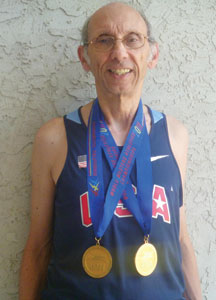 FIVE-TIME GOLD MEDALIST — Earlier this month Alan Poisner participated in the World Masters Athletics Championships in Sacramento, Calif., where 4,500 athletes from all over the world competed in track and field events. Competitors ranged in age from 35 to 100. Poisner competed in the 75-79 age division where he won two gold medals, in the 5,000-meter racewalk on a college track and in the 10,000 meter road racewalk at a local park. Competitors came from all over the world. He also won a gold medal for being on the top team in the 10K race where they count the top three fastest times (Poisner’s was the fastest for the United States).
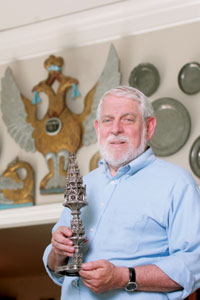 Michael Klein began collecting Judaica quite by accident. Now the owner of between 450 and 500 objects, his collection started with the gift of four antique spice boxes his parents purchased for him while visiting Israel close to 40 years ago. Now his Judaica is the inspiration for a new exhibit, “Between Thee & Me — Artists Respond to the Judaica Collection of Michael Klein and the Van Ackeren Collection of Religious Art at Rockhurst University.”
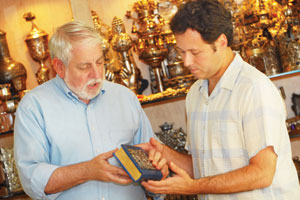 Klein has been reconnecting with history himself since his parents gave him the antique spice boxes that started his Judaica collection.
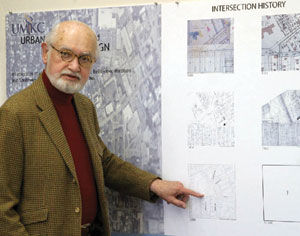 Architects describe Theodore Seligson as a legend in the field, and the Temple B’nai Jehudah member still shapes architecture, planning and design in Kansas City.
 A fund to support Jewish art, originally set up about 20 years ago, is being resurrected in the community. Known as the Jewish Art Fund, it is housed at the Jewish Community Foundation and is governed by a committee led by Michael Klein.
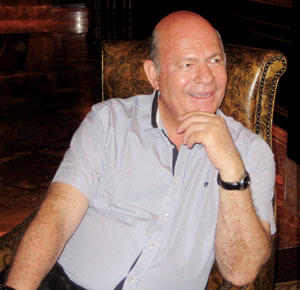 Yoel Lavi, the mayor of Ramla, Kansas City, Mo., Israeli’s sister city, was in Kansas City last week for a “friendly visit.” The cities have had a relationship since 1995. While here he met for the first time with Mayor Sly James. His U.S. trip will also include stops in Detroit and Chicago.
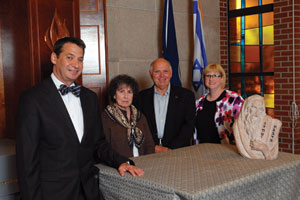 Congregation Kol Ami began a new era on July 1 when Doug Alpert stepped to the bimah to lead Shabbat worship. That evening it was announced that Alpert had officially become the synagogue’s new spiritual leader. Alpert succeeds Cantor Paul Silbersher who retired last month after serving the congregation since it was founded in June 2003.
 If you’ve noticed a lot of self-serve frozen yogurt shops popping up around town in the last year of so, you’re not alone. One of the more popular ones in Overland Park, Yogurtini, is owned by a Jewish man.
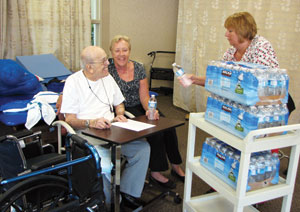 An errant raccoon in a Johnson County Water District No. 1 pumping station and the resulting water main break recently forced a boil order for most of the county just as the Independence holiday weekend was beginning. Among the 400,000 persons affected by the sudden unavailability of drinkable tap water were 228 residents at Village Shalom.