


There is really no issue that can’t be more fully explored through film: love, loss, family, war, peace, politics, religion, assimilation, suicide — even sumo wrestling. The Kansas City Jewish Film Festival, taking place March 5 through March 13, will provide a varied offering of “great films with a Jewish twist,” exploring themes of interest that will appeal to audiences of all types. Presented by the Jewish Community Center of Greater Kansas City, the line-up includes contemporary comedy, drama, indie films, documentaries, and family selections — each a recent winner or audience favorite at festivals internationally.

“This collection of films reflects the Jewish Film Festival’s revitalized mission,” says Victor Wishna, KCJFF producer. “We want to offer our diverse community a chance to engage Jewish values through films that examine issues of identity, culture and history. Whether it’s a documentary on American policy during World War II, or a crowd-pleasing Israeli comedy about amateur sumo wrestlers, there will be something here to entertain virtually everyone.”

The 2011 edition marks the return of the festival to a full week of seven films, all to be screened at the Jewish Community Center’s 500-seat White Theatre. Movie fans may purchase a Festival Pass — which includes early seating at every film and a special pass-holders-only pre-film reception on opening night.

An award-winning film from Argentina opens the KCJFF at 7:30 on Saturday, March 5. “Anita” claimed the Audience Favorite prize at festivals as diverse as the Pittsburgh Jewish Israeli Film Festival and the Los Angeles International Latino Film Festival, and relates the touching and ultimately uplifting story of a young Jewish woman with Down syndrome who tries to find her way home through Buenos Aires in the wake of the 1994 AMIA Jewish Community Center bombing.

The week that follows will bring a selection of wonderful family-friendly films — “The Yankles” and “The Little Traitor” (both Sunday, March 6) — as well as “Nora’s Will,” a darkly comic tale of a Mexico City family set on the eve of Passover (Monday, March 7). The powerful new documentary “Against the Tide” offers a never-before-seen look at the response to the Holocaust, or lack thereof, by the U.S. government and the American Jewish establishment (Sunday, March 13).

Another highlight takes place Saturday, March 12, when a screening of “The Klezmatics: On Holy Ground,” a funny and poignant portrait of the popular style-blending musicians, follows the live CenterSeason performance by New York spoken-word artist Vanessa Hidary, “The Hebrew Mamita.” Patrons are invited to make an entire evening of it and enjoy fresh-brewed coffee between shows, compliments of The Roasterie.

The Festival will conclude Sunday, March 13, with a rather big evening: “A Matter of Size,” which opened the Jerusalem Film Festival and was recently optioned for an American remake, tells the story of four Israeli friends who embrace their own largeness as founders of the country’s first sumo wrestling club.

The Kansas City Jewish Film Festival is produced in partnership with the Harry Portman Charitable Trust, the Louis and Frances Swinken Supporting Fund of the Jewish Community Foundation, the Norman and Jean Burstein Glazer Memorial Fund, the Louis and Dorothy Davidow Cultural Arts Fund, and the Helen and Sam Kaplan Fund of Country Club Bank.
Tickets and Festival Passes may be purchased now online at kcjff.org, by calling (913) 327-8054, or in person at the White Theatre.


Three films scheduled March 5 & 6

‘ANITA’
Saturday, March 5, 7:30 p.m. plus Opening Night Dessert Reception, Spanish with English subtitles
Additional Pre-Film Reception for Festival-Pass Holders Only
In the wake of the 1994 bombing of the Buenos Aires Jewish Community Center, a young Jewish woman with Down syndrome searches the city for her mother, receiving help and companionship in unexpected quarters through the simple force of her ingenuous personality and open heart.

‘The Yankles’
Sunday, March 6, 1 p.m., English
In this fun-for-the-family feature, a washed-up major leaguer gets a second chance — as coach of a yeshiva baseball team. After a rough start, he finds a home with “The Yankles,” and with his help, the team strives for success on the field, while their coach works to rebuild his reputation and his relationships with those whom he wronged in the past.

‘The Little Traitor’
Sunday, March 6, 6:30 p.m., English
Family Night: Appropriate for ages 7 and up, with free babysitting available for younger children. Reservations required.
Starring Alfred Molina and featuring Theodore Bikel, this is a tale of the unlikely bond between a kindly British soldier and a spirited Jewish boy set against the backdrop of the birth of the state of Israel — based on the acclaimed Amos Oz novel, “Panther in the Basement.”

Cynthia Levin is in her 32nd season with the Unicorn Theatre. As producing artistic director, she has served as a director, actor, designer or producer for more than 200 productions. Yet when “Two Jews Walk Into a War …” opens Saturday, March 5 (previews are March 2, 3 and 4), it will be the first time she has actually directed a play that is so Jewish. (See below for complete schedule.)

Levin said the play was inspired by a true story and is about two Jews named Ishaq and Zeblyan.

“There were a couple of plays written in the last five years based on them. This one is fictionalized. It is an incredibly interesting story since there were thousands of Jews that lived in Afghanistan until the Taliban came in and wrecked all the synagogues and beat people up because they didn’t want any Jews. But these two guys stayed,” Levin explained.

Ishaq and Zeblyan are the last two surviving Jews in a dilapidated old synagogue in Kabul during the Taliban regime’s final days. The only thing that binds them together is that they hate each other’s guts. The play, written by Jewish playwright Seth Rozin, premiered in Florida and then in New Jersey. Partial support for this production is being provided by the Herb and Bonnie Buchbinder Donor Advisory Fund of the Jewish Community Foundation of Greater Kansas City.

“Seth has created a comedy about these two men because they hated each other. They never got along. Both of their families came from the camps. They talked each other into moving to Afghanistan instead of America or Israel, so they blame each other for their plight,” Levin said.
Levin said that the play opens when the learned man, the scholar who was there to keep the peace and keep the religion alive, passes away.

“These two men are left with each other. How are they going to work together to keep this synagogue and try to keep a Jewish presence there when they don’t even want to talk to each other?” said Levin, who is the 2006 recipient of the Pinnacle Award for Excellence in the Arts from the Johnson County Library Foundation and the 2007 recipient of the Human Rights Campaign Equality Award. This season she will also direct “Distracted” at the Unicorn.

“It’s very funny. It’s got incredible humor but it’s also got incredible poignancy attached because they begin to talk to each other about religion, philosophy and spirituality,” she said. “The discussions are funny but at the same time they get you thinking. It’s really a thought-provoking and highly entertaining play.”

Levin and playwright Rozin have been colleagues for about a dozen years but have never worked together on a play. (The play’s scenic designer Evan Hill is Jewish also.) Levin and Rozin are founding members of The National New Play Network (NNPN), which is the country’s alliance of non-profit professional theaters that are similar in size and programing to the Unicorn. The organization champions the development, production and continued life of new plays.

Though the play has been done before, the director said they have made a lot of revisions on the version that will be performed at the Unicorn. Levin, who grew up as a Conservative Jew, has enjoyed working on the play and said it is something she can relate to.

“How many plays are about a Jewish story that isn’t about the Holocaust? I look for these plays in contemporary literature all the time,” she said.

She said she knows a lot of the stories that come to light in this particular play.

“The play talks about the Torah and certain biblical passages and keeping kosher and all the things that they struggled to do. These are a lot of things that I relate to in my background,” she said.

It’s been “extremely fun” for Levin to have the opportunity to each those involved with the production about Judaism.

“It will also be fun to bring this to the audience,” she said. “How many people really know very much about the Jewish religion beyond bagels and lox and that some guys wear yarmulkes on their heads? They know very little here in the Midwest, unless they live in certain neighborhoods and have certain friends. So I am excited about educating our audience a little bit about the culture.”

She thinks the Jewish audience will definitely enjoy the play.

“It’s extremely personal on a lot of levels for me and I think that Jews are going to love it. They are going to get some jokes that no one else is going to get. Then our gentile audience is going to love it because our actors are learning something every day,” Levin said.

Ticket information

“Two Jews Walk into a War” will be performed on the Unicorn’s Jerome Stage located at 3828 Main Street, Kansas City, MO 64111. Previews are March 2, 3 and 4. The play runs March 5-20. Performances Tuesday through Thursday are at 7:30 p.m., Friday and Saturday at 8 p.m., and Sundays at 3 p.m. Talk back performances, where patrons are encouraged to stay after the show and discuss the play with the actors and director, are scheduled for March 8, 13 and 15. To purchase tickets, call (816) 531-7529, ext. 10, online at www.UnicornTheatre.org or in person at the box office.

Words of wisdom: It’s nice to be nice.

Samantha Levine, The Chronicle’s February Salute to Youth honoree, may or may not have heard that saying. However one thing is for sure, she lives it.

“Samantha Levine is nice,” said a girl in B’not Lev, Samantha’s BBG chapter, during a recent conversation about local Jewish teens.

And vice versa.

“In fact, she’s not friends with anyone who isn’t nice.”

Samantha, the 18-year-old daughter of Julie and Terry Levine, is currently Kansas City BBYO’s council president. As such, she leads about 200 area teens in programming, leadership training, social action and community service opportunities. She was nominated for the honor by BBYO Director Debi Tozer.

“Many people would describe Samantha as a charismatic, focused and exceptional young lady. Samantha is responsible, organized, smart and compassionate,” Tozer said. “She is respected by her peers and the adults she works alongside. She is an amazing role model and of great benefit to BBYO as well as the community.”

Samantha said her mother suggested she consider joining BBYO when she was 14, but she came to love it on her own.

“I just love the people,” she said.

She’s been active in the teen organization both locally and nationally. She’s held several leadership positions in her chapter, including serving as president. She’s been to regional convention and attended a national Kallah in Pennsylvania where she met Jewish teens from all over the United States. Most recently she attended BBYO International Convention in Los Angeles.

She said the experience has taught her a lot.

“I think I’ve learned to be confident and how to be serious and also how to have fun at the same time,” the high school senior said.

As a leader Tozer described Samantha as an all-star. The same could be said about her achievements in her chosen sport, Tae Kwon Do, where she’s earned a black belt. In fact of all the honors and awards she’s earned over the years, Samantha said her proudest accomplishment is earning her black belt.

She took up the sport about five years ago.

“Tae Kwon Do gives you a lot of confidence and gets you into shape,” she said.

The confidence she’s gained from Tae Kwon Do has given her the courage to seek out those BBYO leadership positions and excel at Blue Valley North High School, where she’s a member of National Honors Society, National Art Honor Society and sings in the choir.

When she goes away to college next year, she expects she’ll probably keep up her Tae Kwon Do by joining a club on campus. She thinks she’s narrowed her college choices to either the University of Kansas or Indiana.

“Right now I’m leaning more toward Kansas,” she said. “It’s closer to home and I know that they have a good art program. I figure it will be a lot easier to handle being away from home because it’s only a 45-minute drive from here.”

Being close to home could give Samantha more opportunities to eat her favorite Jewish food, her grandmother’s (Fran Small, who she calls Mimi) matzah ball soup.

“My grandma knows how to make it delicious for every Passover seder,” Samantha enthusiastically reports.

The Levines belong to The Temple, Congregation B’nai Jehudah. As Samantha sorts out which college she wants to attend, she said another thing in KU’s favor is the success of KU Hillel. That’s because staying involved in Jewish life is important to her.

“There’s a big Jewish population there so I think it could be a good choice. But Indiana could be good, too,” she said.

“Since I’ve had such a great experience being involved in Jewish life in high school I really want to continue that on through college,” said Samantha.

One of her fondest memories in her young life so far is of a National Conference of Synagogue Youth trip to Israel she took in the summer of 2009. She especially enjoyed the opportunity she had to experience Shabbat while in Tzfat.

“I remember we sat outside during the service on top of a hill when the gorgeous sun was setting. Tzfat is such a mystical, historical city and to spend it with about 50 other Jewish teens was truly special. It was the most spiritual Shabbat that I have ever experienced,” said Samantha, who also participates in JSU (Jewish Student Union), which meets weekly at BVN.

While she plans to make her final decision about college soon, she is enjoying her final year in high school. One of her favorite subjects is art and she recently took a class where she could concentrate on building her portfolio for college.

“It was really cool because I got to explore painting and drawing and all different kinds of things. I’ve also done ceramics and photography but I think my favorite thing is painting.”

“It’s cooler than drawing and it has permanence to it and it’s therapeutic,” she said.

A career in art could be in her future and her resume will show that she’s already been recognized for her artistic talents. She used those talents to show her support for her mother, who is also the person she most admires.

“She has been a warrior through battling her breast cancer, and I have always admired her strength and courage,” Samantha said.

Last year a team representing Julie Levine participated in the Susan G. Komen Race for the Cure to raise funds for breast cancer research. To show unity, the team decided they would wear matching t-shirts and Samantha was recruited to design it.

“Mine won the award for the most creative,” she said.

This charming coming-of-age tale is set in 1947 Jerusalem just months before Israel becomes a state. The screenplay, written and directed by Lynn Roth, is based on the novel “Panther in the Basement” by world-renowned author Amos Oz. The film screens at 6:30 p.m. Sunday, March 6, at the White Theatre as part of the 13th annual Kansas City Jewish Film Festival.

Proffy Liebowitz (Ido Port), a militant, precocious and sensitive 11-year-old Sabra, wants nothing more than for the occupying British to leave the Promised Land. Proffy (short for professor) and his two friends form a secret club and spend their summer holiday plotting ways to terrorize the unwanted British troops.

The British have imposed a nightly curfew to curb the violence instigated by the Irgun and Haganah resistance movements. One night Sergeant Dunlop (Alfred Molina from “An Education”), a kind-hearted British officer longing for home and the girlfriend he left behind, picks up Proffy for breaking the curfew law. Rather than arresting him, he takes Proffy home with a stern warning. He knows full well that disciplinary measures will be taken by the boy’s parents.

Proffy decides it might lead to gaining information on the British plans by meeting regularly with Dunlop. An unlikely friendship develops between these two foes. Proffy teaches Dunlop several Hebrew words and even gives him the Book of Samuel that he studied in his fifth-grade class. They have a winning chemistry and spend time discussing a wide range of topics as well as playing chess and snooker pool.

Proffy likes to spy on the British from his rooftop with binoculars. His attention is diverted when he watches Yardena (Anat Klausner), the beautiful young woman across the street, undress in an open bedroom window. Proffy becomes obsessed with various attributes of a woman’s anatomy.

The plot thickens when Proffy’s two pals get suspicious of their friend’s allegiance. They see Proffy go into the British headquarters and saluting Dunlop. Proffy is accused of betraying the Jewish people with traitorous acts. He is brought to “trial” before his Holocaust-surviving parents and a contingent of neighbors. The interrogator is played by the famous Theodore Bikel.

When the summer ends, Proffy returns to school. His sixth-grade class welcomes Rachel (Dafna Melzer), a new student from Cyprus. Proffy’s parents have to go to Tel Aviv for a Holocaust memorial service and Proffy has the good fortune of having Yardena serve as his baby sitter.

A concluding segment hits a high point by featuring the UN resolution of Nov. 29, 1947, broadcast live over the radio. The movie then fast forwards 30 years with an ending that will surely bring tears to your eyes.

Besides a wonderful story and great acting, the movie is a visual treat with the breathtaking panoramic views of Jerusalem. Other strengths include the Middle Eastern musical score and the costume designs.

This movie has played at more than 30 Jewish film festivals around the world. It provides a historical background to make it educational and informative. The dialogue is partially in Hebrew with English subtitles. It is not rated, but suitable for the whole family with a perfectly-paced running time of 89 minutes. It gets my vote as the best film of the 2011 festival and a rating of very good (3 1/2 stars out of 4).
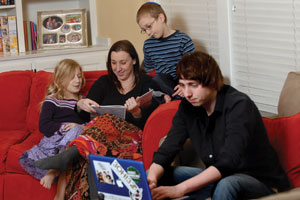
Ever watched “19 Kids and Counting” or “Kate Plus 8” and wonder just how these families deal with so many kids? As the mother of three biological children, one adopted child and an assortment of foster children, Rose Marchick will be happy to tell you if you can get her to sit down long enough to tell her story.
Marchick and her husband, Clint Pitts, are foster parents. As such, the Duggers or Kate Gosselin may actually have it easier than the Marchicks because these reality show families know how big their families are. The size of the Marchick family can change at any minute because it specializes in emergency foster placements.

Emergency placements are “kids who are removed from their home in an emergency situation and are in a foster home for three to five days during an investigation. The Marchicks also take in regular placements, who are children who will be in a foster home for at least a couple of months.

Since the Marchicks became foster parents six years ago, they have taken care of more than 50 children ranging in age from 1 day to 3 years. But it’s been a slow week for the Marchicks, with “only seven children” living in their home on Monday. That included their three biological children ages 7, 8 and 15; their 10-year-old special-needs daughter who was adopted when she was 3; and “only three foster placements.” They’ve had as many as 11 children in the home at one time.

“It’s been a really quiet two weeks around here, so I’ve been organizing drawers and kind of pacing,” Marchick said.

Repairing the world

Marchick’s Judaism has drawn her to the life of a foster parent because “kids need homes and you do what you need to do.”

“I adamantly believe that our purpose in life is to do everything we can do in our situation for the world,” she said.

Someday Marchick would like to go to another part of the world and work in an orphanage. But she knows while she has young children her place is where they can be kept safe and well cared for. So she chooses to make sure that other kids are safe and loved as well.

“If it means I get up at 2 in the morning and don’t get back to sleep, but a kid goes to a home and has someone tuck him in after being pulled away from his parents, that’s OK. If it’s my convenience or their safety and security there’s no issue,” she continued.

She is a true believer in tikkun olam, repairing the world.

“I really believe the foundation of Judaism is doing active deeds,” she said. “I tell my kids every day that the most important thing is making a difference by doing something. Every kid that comes here has been warm, safe and loved while they are here.”

A devoted caregiver

Marchick is so committed to being an emergency foster parent that she literally sleeps with her cell phone in her hand. She said it’s not unusual for it to ring in the middle of the night, either.

“I keep it on vibrate so it doesn’t wake up my kids, because a lot of times I have a kid sleeping in my room. But I want to hear it in case there is an emergency,” Marchick said. “It’s in my hand or on me physically at all times. I could go two weeks without an emergency kid and then get a call for a sibling group of four.”

One of the reasons Marchick is so popular with the foster agency is that she is always willing to keep families together.

“We refuse to split siblings. With all the upheaval in their lives, they need each other,” explained Marchick, who first became certified as a foster parent while living in Indiana. When they moved here a year and a half ago, they had to be re-certified by the state of Kansas.

“There are case workers in and out of here all the time. Our life is just an open book,” she said.
They live in a five-bedroom home that is filled with “lots of bunk beds,” to accommodate the ever-changing size of the family. There are rules about who can share rooms, often determined by the children’s ages and gender.

Finances are tight and Marchick said she will always do without something for herself if it means getting something one of the kids needs. She said foster children often arrive in the middle of the night with no belongings except the pajamas they are wearing. “They often don’t even have shoes on,” she said.

If Marchick doesn’t have something in storage to fit the child/ren, she will make a trip to an all-night WalMart to get whatever is needed.

In fact Pitts, who works 80-hours plus a week as a restaurant manager, said “there’s never a dull moment” around their home.

As Kate Gosselin has been quoted saying, “It’s a crazy life, but it’s our life,” Marchick can say the very same thing. On an average week she washes about 40 loads of laundry. She holds a doctorate in psychology and even finds time to teach two days a week at a community college.

She grocery shops twice a week and said “you can imagine what that bill is like.” But that doesn’t keep her from letting the kids invite their friends to stay for dinner, where she feeds an average of 10 to 12 people on any given night.

“We always invite more for Shabbat,” said Marchick, who said as strict vegetarians it’s very easy to keep kosher.

Although most of the foster children are not Jewish, Marchick said it doesn’t seem to be an issue for any of them. The two youngest Marchick children attend the Hyman Brand Hebrew Academy while the other children attend a variety of schools.

Next to the dinner table is a color-coded chore chart to help keep the family organized. Each child has a color that matches, among other things, his or her towel, cup and toothbrush.
Marchick doesn’t want to be considered a saint by any stretch of the imagination.

“I’m tired, but that’s life. Anything we’re doing, we’re just doing. It’s not difficult compared to others. It’s not a death march and it’s not living in Darfur with bullets flying over your head. So what do any of us have to complain about?”

Marchick believes her children have all grown from being foster siblings.

“They would give anything to anybody who needed something,” she said.

As a medical doctor, Andrew Kaufman has been helping people all his professional life. He’s also done his fair share of volunteering for causes, especially in the Jewish community, that weren’t medically related. So it comes as no surprised that Dr. Kaufman was inspired to start volunteering his time as a neurosurgeon in Ethiopia after he heard another Jewish physician speak in Kansas City.

Three years ago the Jewish Federation hosted a visit by Rick Hodes, M.D., an American doctor who has lived and worked in Ethiopia for more than 20 years. As the medical director of Ethiopia for the American Jewish Joint Distribution Committee, Dr. Hodes has been in charge of the health of Ethiopians immigrating to Israel.

Dr. Kaufman had considered volunteering his services in underdeveloped countries before, but finally took action following Dr. Hodes’ presentation. A semi-retired neurosurgeon for Midwest Spine Care, Dr. Kaufman recently returned from spending a month in Addas Abbaba, the capital city of Ethiopia. It was his third visit to the country, the first two spent in the city of Gondar working in cooperation with the JDC.

“It’s the epicenter where all the black Jews from Ethiopia came from originally,” Dr. Kaufman explained.

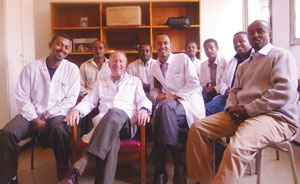
There are no neurosurgeons in Gondar, so Dr. Kaufman taught general surgeons how to do simple neurological procedures. But this time he wanted to spend more concentrated time working with neurosurgeons, so he connected withthe Foundation for International Education in Neurological Surgery (FIENS), which sends volunteer neurosurgeons to developing countries to teach neurosurgical techniques and procedures, to help establish neurosurgery residency programs, and to lend their skills in the operating room. While in Ethiopia, Dr. Kaufman basically functions as a faculty member in neurosurgery at the Black Lion Hospital, the main university hospital of Addis Abbaba University Medical School.

He operated with the surgical residents, the local neurosurgeons and performed solo surgeries as well.

“Much of the time I simply supervised what they were doing,” explained Dr. Kaufman, who no longer performs surgery in Kansas City. He sees consultations two days a week.

“It’s as rewarding as anything I’ve ever done in my professional career,” said the doctor, who received his degree in medicine from Case-Western Reserve University, and completed his residency at Yale-New Haven Medical Center. Very active in the Jewish community, he is a returning member of the Village Shalom board of directors, having previously served from 2000-02. His community involvement also includes terms on the board of directors of Mid-America Coalition on Health Care, Menorah Medical Center Foundation, The Jewish Community Foundation, the Jewish Federation of Greater Kansas City and Temple B’nai Jehudah. He also has served as president of the Metropolitan Medical Society Health Care Plan and the R.A. Bloch Cancer Management Center. He and his wife, Lynn, have two grown daughters.

Dr. Kaufman said he truly loved the time he’s spent in Ethiopia. Through the efforts of volunteers like himself, he’s proud that there will soon be more neurosurgeons in Ethiopia. Up until 2008 there were only three neurosurgeons in the entire country serving 76 million people. By contrast Dr. Kaufman estimates there are 30 neurosurgeons in Kansas City for about 1.8 million people.

“Here’s a country that has hardly any neurosurgeons and we’re going to have 22 neurosurgeons in just a few years. They will be able to treat substantial problems that are curable,” he said.

Until now every neurosurgeon in the country has been located in Addas Abbaba.

“But now we have residents from various areas of the country so we hope to get some neurosurgery out to other areas of the country by the time all the current graduates have completed their studies,” Dr. Kaufman said.

Besides training new surgeons, he’s gotten satisfaction of helping the six Ethiopian neurosurgeons “upgrade their skills and their surgical repertoire.”

“I taught them new ways of doing operations that they were doing in a much more tedious fashion. I taught them ways of doing them quicker so they can do more operations in a day,” he said.

Dr. Kaufman explained that his work in Ethiopia differs from the type of medical mission people often see featured on television or in newspapers. For instance he doesn’t bring a lot of equipment with him to Ethiopia.

“We teach them a lot in contrast to a typical medical mission where groups of five people or even 30 people will go to a country and take equipment. They’ll do 30 or 40 or 50 operations in the course of the week and then they go home,” he said.

Dr. Kaufman believes it’s more valuable to teach the doctors there how to do the operations.

“I think the dividends are multiplied and I think there is much more capability for improving the capabilities of the country. So I enjoy teaching them how to do things with the limited equipment that they have,” Dr. Kaufman said.

“I can already see, compared to my previous visits, new ways of thinking and new ways of operating that are going to pay dividends in the future,” he continued.

Because there are so few neurosurgeons in Ethiopia, Dr. Kaufman said there is a long waiting time for what we in the United States would call urgent surgery. He is hoping training more neurosurgeons will help address that problem.

He noted that the medical problems he sees in Ethiopia are drastically different than what he sees here. For example, brain tumors there are three to four times the size of tumors usually seen here.

“Patients in Ethiopia don’t seek medical treatment until they are in dire straits,” he explained. “We see very unusual infectious diseases involving the brain that are virtually unknown in this country.”

He also said that head trauma in Ethiopia is completely different than what’s normally seen here. The biggest head trauma there is known as stick injuries, caused by very rigid tree branches that are used to assault people. Being gored by a bull is also a common injury. Pedestrians being hit by automobiles are the fourth most common head injury.

He said doctors also see a “huge number of congenital anomalies in children.”

“This is a problem that early in my career I used to see with reasonable frequency but it’s now very rare in the U.S. because we give pregnant women vitamins that contain folic acid which prevents most of these birth anomalies,” he said.

A menorah sits outside the Chabad Jewish Center at the University of Kansas once again. The structure was vandalized sometime on Friday evening, Feb. 4, or Saturday morning, Feb. 5. The pieces were recovered four days later on Feb. 9.

Rabbi Zalman Tiechtel, who co-directs the center along with his wife, Nechama, said while the structure has been put back together outside the Chabad House, it needs extensive repairs.

“That includes rewiring, welding repairs to the metal and repainting,” the rabbi said.
The investigation is still ongoing and Rabbi Tiechtel said Lawrence police do not want to disclose where the pieces were found. At press time no arrests had been made.

“One thing is clear. The menorah was left unattended at a location in Lawrence, and was found thanks to the media publicity,” the rabbi said.

Rabbi Tiechtel said they managed to get the menorah put back together before Shabbat last week (Feb. 11) because it was “very important to us to have it back up before our weekly Shabbat dinner for tens of students. We wanted to restore it as soon as we could.”

KU Chabad does not have the funding in place yet to pay for the electrical repairs.

“The entire menorah needs to be rewired, as the vandals tore it all apart,” he said. “We hope to raise these monies and have it lit up soon.”

KU Chabad is also increasing security to make sure the menorah won’t be vandalized again.

“Without disclosing too much for security reasons, I will share that the menorah has been rebuilt and installed in a way that it is extremely difficult for anyone to move it,” he said.

Chabad at KU is currently doing a comprehensive review of its entire security plan.

“We are in close contact with local city and county law enforcement, as well as with the FBI and Department of Homeland Security. We have created a strong security committee and are taking all necessary steps to ensure a secure and safe place for all, without compromising on Chabad’s signature open and welcoming embrace,” Rabbi Tiechtel said.

The campaign established last week to raise funds for a new menorah will instead assist with the electrical repairs for the menorah as well as the beefed up security.

“This security overhaul is a very costly project,” Rabbi Tiechtel said.

The campaign is being spearheaded by Kansas City native Megan Singer as well as Leah Levy and Rachel Kraig. All three are seniors at KU.

Yia Yia’s, the PB & J restaurant group’s venerable Euro-bistro, opened at its free-standing Leawood location (119th and Roe) in December 1993. Since then, the Leawood corridor — which could be considered located in the heart of the Jewish community — has seen numerous restaurants have come and go. Even PB & J has changed. Over the years Coyote Grill at Mission Center and Paradise Diner at Oak Park Mall, two beloved PB & J spots, were closed. The restaurant group no longer runs Paulo and Bill’s or Grand Street Café, and now runs restaurants in several other cities well beyond the Kansas City area.

But Yia Yia’s in Leawood remains a PB & J mainstay — and a Leawood restaurant icon of sorts. It would be easy to overlook a place like Yia Yia’s, given the binge of upscale spots that have opened in the area in the past 10 years or so. But Yia Yia’s still warrants attention from serious gastronomes.

The restaurant occupies a beautiful space. The entrance is isolated from the rest of the place — keeping the mood tranquil in the dining area on busy nights. The large dining room rests atop mosaic tile floors and within stone columns and fabric-covered wall panels. Tables and booths are comfortable and spacious, and there is ample room between one table/booth and the next. An appealing outside patio has always been a dining hot spot in the nicer weather.

One evening our waitress confessed that she had recently started working at the place. She was charming and attentive throughout the meal, though, and her only slip was an unduly strained and verbose explanation of the seafood special — a whole sea bass. We had to ask her to repeat the description, and were surprised to learn that she had described merely one entrée, rather than two or three. Before taking our orders, she brought out a basket of wonderful, warm sourdough bread, along with complimentary babaganoush for dipping, which was frankly a little bland and underwhelming.

We shared an outstanding plate of Gnocchi ($9.95), as an appetizer. The gnocchi was perfectly cooked — firm but not overdone — and sat in a delicious gorgonzola cream sauce, with tender pieces of roasted chicken, chunks of gorgonzola, spinach and walnuts. A nearly perfect dish. We were somewhat less fond of the Short Rib Ravioli ($12.95). The meat pulled from the ribs was tender and moist in the ravioli pocket, which was coated with a very light hazelnut brown butter. Tart, dried cranberries were an unusual component, however, that did not marry well with the dish. I tried the Cream of Mushroom Soup ($4.50) one night — the soup of the day — and found the creamy, pureed mushroom soup to be flavorful and fresh, though the slightly grainy consistency was a little distracting. I did also add a dash of salt. Our waitress kindly brought (on her own initiative) an additional wedge of the bread to dip into the soup. Yia Yia’s makes a fine Caesar salad ($6.95), a well-chilled and unusual take on the classic, with ample anchovy and garlic flavor, but also a Dijon mustard flavor, to some extent.

Yia Yia’s does some nice things with poultry. Roasted chicken is, to some, the comfort food gold standard. There is something about tender and juicy chicken, wading in the chicken’s own juices, along with fresh herbs and roasted cloves of garlic. Yia Yia’s offers Campo Lindo Farms Natural Chicken ($17.95), a free range rendition from a notable family farm about 35 miles north of Kansas City, in Lathrop, Mo. Served on the bone, the terrifically moist one-half chicken was sitting in its own juices, and was surrounded with red onions, olives, roasted garlic, red chiles and capers. The large hunks of Yukon gold potatoes served alongside were cooked to a perfect, crispy finish. The Spiced Roasted Duck Breast ($22.95) was beautifully sliced and moist — cooked just before the point at which the duck might have been dry. It was flavored with Albarino (a white wine grape distinctive for its fruity apricot and peach notes), apples and chilies, and served with a decent toasted almond basmati rice.

But it was not just the poultry. Yia Yia’s has a decent way with fish and beef, as well. Fresh Atlantic Salmon ($22.95) was also perfectly cooked and moist, with a hearty grilled flavor. Yia Yia’s has always excelled with its seafood offerings. The wait staff is wholly accommodating, and will gladly leave off the sherry-shrimp cream served atop the salmon, and will substitute the shrimp ravioli served alongside for another accompaniment, if requested. My wife opted for the Flat Iron Steak ($19.95) one night, a generous 10-ounce portion sliced and fanned on a long, narrow plate, and served Southwestern style, with roasted sweet corn and grilled scallions. She ordered her steak medium well To this day, I cringe when she requests it north of medium — though she has made some progress, over the years. She used to ask that it be prepared well, well done (yes, she would say it twice). I was pleased when the steak actually came out closer to medium rare. It was flavorful and well-prepared, if not spectacular — probably rendering it our least favorite of the sampled entrees. It had been a pretty tough group of entrees, however, within which to compete.

Seventeen years from now, it is hard to imagine that the Yia Yia’s formula would become outdated: European comfort food prepared with fine ingredients, and served by attentive wait staff in an inviting atmosphere. Hard to imagine what Leawood will look like by then, but Yia Yia’s will surely still be alive and kicking.

Food:  3 1/2 stars
Atmosphere: 3 1/2 stars
Service: 3 1/2 stars
Out of four stars.

Fundraising campaign aims to replace symbolic structure quickly

The menorah that sits outside the Chabad Jewish Center at the University of Kansas was vandalized sometime between late Friday evening, Feb. 4, and Saturday morning, Feb. 5.

“We had a lot of people here for Shabbat and we know for sure it was here at 10:30 p.m. Friday night and it was gone at 10 a.m. the next morning,” said Rabbi Zalman Tiechtel, co-director of the center along with his wife, Nechama.

Anytime a religious institution is vandalized, Rabbi Tiechtel explained that the act is usually considered a hate crime. He believes, however, that intent must be taken into consideration before this vandalism can really be classified as a hate crime.

“We’re located right in the center of a college town right off campus. Friday night is a time for partying and in the past we’ve had minor incidents where students have done stupid things,” he said.

More importantly, Rabbi Tiechtel said the vandals didn’t leave anything on the property or leave any graffiti.

“Based on that, we’re thinking it’s just a prank from some wild students. But we don’t know. The investigation is still pending.”

KU Chabad was established in the fall of 2006. Rabbi Tiechtel said the 6-foot-tall metal menorah was broken into two pieces horizontally and many of the branches were taken from the site.

“It’s not easy to take it apart. You need two or three people and you have to cut some wire as well. It’s stuck in the ground so you can’t take the menorah itself,” Rabbi Tiechtel explained.

While the original menorah cost about $1,000, Rabbi Tiechtel estimates it will take $2,000 to replace it.

“We want a bigger, better and brighter menorah,” Rabbi Tiechtel said. “We want one that’s 8 feet or maybe even higher.”

A fundraising campaign is already being spearheaded by senior students Megan Singer, a Kansas City native, and Leah Levy and Rachel Kraig, both of Skokie, Ill. Singer said it’s important for Chabad to have a menorah.

“It’s a symbol that every person who goes down 19th Street sees. The menorah stands outside the Chabad House to show it’s a place where any Jewish person is welcome. If there is not a menorah outside the Chabad House, it will not be easy to find,” Singer said.

Rabbi Tiechtel said a student committee is exploring many options for a replacement menorah, including having it made in Lawrence and getting some KU students involved in the design or construction.

KU Chabad is using this opportunity to gather the community together.

“We believe that the greatest way to fight negativity is with positivity. It is so important to us that such an act should not breed even further negative feelings,” the rabbi said.

“We’ve gotten tremendous feedback and received very nice notes from other congregations in town and members of the community,” he continued.

KU Chabad hopes a new menorah is in place soon.

“Many people who don’t come to Chabad regularly look at it every day and it means something to them, too,” Rabbi Tiechtel said. “We don’t want to wait too long. We don’t want the darkness to be there any longer.”


Jewish Family Services Help@Home program is having a great problem. Its growth and success has necessitated a need for Help@Home to recruit more volunteers. (See below.)

“It’s been a wonderful program that keeps growing,” said Dawn Herbet, JFS’ director of older adult initiatives. “Just in the last year we’ve added 57 households.”

Help@Home is all part of an initiative that started about three years ago when JFS decided to enhance its programming for older adults. Its first venture was the JET transportation program, which can also trace much of its success to volunteers. A little more than two years ago, in October 2008, Help@Home was launched.

Herbet explained that Help@Home, which was designed following successful program models in Israel and the United States, supports the healthy aging of older adults in their own homes. It does this by providing high quality, dependable home repair services and greater access to a variety of other services which help maintain independence and provide for peace of mind.

In just three years Help@Home has grown to service 88 member households. To join, one must be an adult 65 or older or have a physical or mental disability. The service provides its members the tools and services for them to remain independent, comfortable and in control of their daily lives for as long as they choose to stay in their homes.

Because no one will be denied membership to Help@Home because of financial needs, membership fees are charged on a sliding scale and run $7.50 to $75. Generous grants from funders including the Jewish Heritage Foundation of Greater Kansas City, the Menorah Legacy Foundation, the Jewish Federation of Greater Kansas City the Legacy Fund of the Jewish Community Foundation and United Way, also fund the program.

Herbet said JFS uses a very confidential process to determine the member’s fee. The application form is also easy to complete, she said.

The monthly Help@Home fee pays for all labor costs, regardless of how many times a member uses the service.

“You can use us one time, you can use us four times, or you can use us 12 times in a month. There is no additional labor fee. The only additional fee is if we need to buy supplies to do the job,” she said.

Help@Home has a full-time community handyman, Seroj Terian, and an on-call handyman who are available to do minor home repairs and computer troubleshooting. The phone is answered 24 hours a day to handle home emergencies.

Herbet said Help@Home also has a partnership with John Knox Village to offer home-safety assessments. An occupational therapist makes sure members’ homes are safe to help avoid such things as falling and slipping. Following the assessment, Help@Home helps members decide how to handle any modifications. The handymen can take care of minor modifications.

Major modifications will require members to hire a contractor. In that case Herbet said Help@Home has a referral list.

“We have researched them and we are comfortable referring them out to our members,” Herbet said.

One of the reasons the program has grown is because members are happy with it and talk about it to their friends. Members are comfortable calling Help@Home, Herbet said, even if it’s the middle of the night.

“That’s because they know if they don’t know who to call we have somebody on call to answer the phone who they know who can tell them what to do,” she said.

Aaron Rabinovitz is one member who is very satisfied with the Help@Home program. At age 78, he said that he is healthy compared to many of his contemporaries, but sensible enough to know that there are things, such as climbing ladders, that he no longer should do. So while he misses being able to fix anything he wants anytime he wants, he’s glad that Help@Home is there when he needs it.

“There’s certain things that I can’t do anymore that I used to be able to do and it’s awfully nice to be able to call Help@Home and set up an appointment and get some of these things done. The truth of the matter is they have a very fantastic individual who is extremely bright, knowledgeable and a very handy handyman. Besides that, he’s a nice person,” Rabinovitz said.

Rabinovitz said that his children also had issues with him doing certain things around the house, so they are happy with the service as well. Herbet said that’s another plus to Help@Home.

“The program really does give peace of mind to our members’ families. For those who have family members who might not live here or just can’t always get to the house to help their parents, that’s why we’re here. We are someone the loved ones can call,” Herbet said.

Volunteer Mike Woolverton said Help@Home is a great way to help the community and yourself at the same time.

“I’m a great believer in the chesed spirit and I like the opportunity to give back to the community,” Woolverton said.

He was raised in southern Missouri and spent a lot of his childhood around elderly people.

“They watched out for me and took care of me and I swore that once I got old enough I would do something to repay them and this is my way of repaying them,” said Woolverton, who volunteers as a computer technician and teacher. Retired from the U.S. Air Force, he was laid off from his job in 2009 and would like to find a part-time job that would allow him to continue to volunteer. Besides Help@Home he also teaches at the Heritage Center.

Be a volunteer

People who are handy around the house, good with tools or good with computers are being recruited as Help@Home volunteers.

“It’s a wonderful opportunity to go into someone’s home and have an impact on their lives,” explains said Dawn Herbet, JFS’ director of older adult initiatives.

JFS is recruiting people who can volunteer as little as one hour a week, or as much as 12 hours. JFS is seeking at least 10 people to supplement the three volunteers currently working with the program.

Volunteers will help the handyman or may do some minor repairs on their own. To learn more about volunteering, contact Adrienne Kizer at (913) 327-8257 or .