

When Congregation Kol Ami decided in July to leave its building of seven years, its evolution as a spiritual community entered a new phase.

“With every challenge, an opportunity presents itself,” said Rabbi Doug Alpert. “For Kol Ami, we now have the opportunity to identify and build on our many strengths, and realize our full potential as a spiritually inclusive Jewish community.”
In a letter to the congregation, Kol Ami’s President Brian Greenwald agreed.

“This is an exciting time for our community,” he said. “We are out of debt and on our way to a new beginning.”

Beginning in September, Kol Ami will rent space from All Souls Unitarian Church at 4501 Walnut, across from the Kemper Museum of Modern Art on the Country Club Plaza. In addition to regular Friday night worship and High Holy Day services, the congregation will also meet for worship, Torah study and Social Justice activities some Shabbat mornings each month. A full schedule of High Holy Day and Shabbat worship can be found on the congregation’s website, at www.kolamikc.com.

Over the summer, the congregation has shared Shabbat worship in members’ homes, public spaces and parks, which, according to Rabbi Alpert, has allowed the community to connect in new ways.

“It has been an absolute joy to see the warmth and energy of our worship,” Rabbi Alpert said, “with people opening up their homes to create special spiritual experiences and celebrate the bonds of a connected and committed community. Kol Ami members have also been working behind the scenes to get our communication up and running, to plan for the future of our worship, and to search for a new location that preserves our sense of an intimate and welcoming community without breaking our bank account.”

“Rabbi Alpert frequently uses the word ‘kehilah’ to describe Congregation Kol Ami, which is Hebrew for ‘community,’ said Greenwald. “But that word also seems to convey how the community feels, and this one feels really good. Letting go of our building was a difficult decision, but it was the right one. We’ve got a rabbi we love, we’re moving forward without debt, and we’re a vibrant community dedicated to joyfully exploring Jewish life together.”

SPECIAL WELCOME — Kansas Citians Alana Gaffen and Mai Bonomo are making aliyah and were on a special flight of 350 North American olim (new immigrants) that landed in Israel Tuesday. Immediately after becoming an Israeli citizen, Alana and Mai will be joining the Israel Defense Forces as part of a record high 127 soon-to-be IDF soldiers. The special Friends of the Israel Defense Forces–Nefesh B’Nefesh flight was organized in cooperation with the Ministry of Immigrant Absorption, the Jewish Agency for Israel, Keren Kayemeth Le’Israel and Tzofim Garin Tzabar.

The soon-to-be-soldiers, along with the other olim were greeted in Israel by PM Benjamin Netanyahu as part of a special ceremony at Ben Gurion airport.

Nefesh B’Nefesh is celebrating its 10th anniversary this summer, marking a decade since its inaugural charter aliyah flight in 2002. The milestone comes as the organization prepares to welcome more than 2,500 North American and British Jews making aliyah this summer on two charter and seven group aliyah flights, in cooperation with the Ministry of Immigrant Absorption and The Jewish Agency for Israel. In 2012, Nefesh B’Nefesh will bring 4,800 newcomers to Israel.

JAZZ-ROCK CONCERTS — Jazz-rock band Marbin will be in town soon for two different performances. The first show is at 8 p.m. Thursday, Aug. 16, at the Buzz Pub & Perk in Overland Park. The second is at 5 p.m. Sunday, Aug. 19, at the Longbranch Saloon in Lenexa. Marbin boasts a unique blend of rock, jazz and blues — even a hint of bittersweet, melodic Eastern European folk that draws on guitarist Dani Rabin and saxophonist Danny Markovitch’s Israeli origins. Marbin, an all-original and all-instrumental band, is touring across the country for most of the year. Marbin has played with or recorded with many well-known, well-respected musicians including multiple Grammy Award-winners Paul Wertico and Steve Rodby (both members of the Pat Metheny Group), Allan Holdsworth, Mike Clark (Headhunters), Jamey Haddad (Paul Simon), Jeff Berlin (Yes), Scott Henderson (Tribal Tech), Jimmy Haslip (Yellowjackets) and Virgil Donati (Planet X).

JEWELRY EXHIBIT — Local artist Leah Carol Reichman’s One-of-a-Kind Jewelry Designs are being exhibited at The Buttonwood Art Space, 3013 Main Street in Kansas City, Mo., now through Sept. 7. In addition there will be two receptions at the gallery: from 5 to 9 p.m. First Friday, Sept. 7, and again from 10 to 3 p.m. Saturday, Sept. 8. The artist describes her jewelry designs as organic shapes, created by hand using semi-precious gemstones, silver and gold. “The ideas behind the design work is coordinating shapes and colors to form wearable art: earrings, necklaces and bracelets.” She said each piece is unique and she always tries to entertain the viewer as well as provide good feelings and enjoyment to the individuals who buy them. RSVP to the receptions by emailing Kathy@ButtonwoodArtSpace or calling the gallery at 816-285-9040. The show is sponsored by Kansas City Volunteer Lawyers & Accountants. The gallery is open Monday through Friday from 9 a.m. to 5 p.m. or by appointment. For more information, visit www.ButtonwoodArtSpace.com

Three gowned and gloved women speak quietly with a man. “Any issues,” one asks.” He responds that there are stents and stitches from a recent surgery, a few clear bandages that will need to be removed. “But no problems,” he adds. “This should go quickly.”

“This” is a Tahara, the Jewish ritual process of preparing bodies for burial. The gowned and gloved women are members of the women’s committee of the Chevra Kadisha (there is a men’s group as well). And the man from whom they’re receiving last-minute instructions could be Marc Williams, Neil Shanberg or Jim Taylor, funeral directors at Louis Memorial Chapel, owned by the Henry Epstein family.

There is no repayment for Tahara — the final mitzvah given to a deceased Jew. It is performed by the members of the Chevra Kadisha, translated as “Holy Society,” who do so for a variety of reasons. The task begins and ends with prayer, asking that those present do the work with humility and modesty, and then, after closing the casket, asking for forgiveness for any offense and wishing the family of the deceased “comfort among the mourners of Zion.”

Playing a vital role

The Kansas City Jewish community is aging and this spring the Chevra Kadisha was busier than ever performing Taharas. The members of the Chevra are all volunteers, led by Dr. Rosa Solomon. Rabbi Daniel Rockoff, spiritual leader of Kansas City’s Orthodox synagogue Congregation Beth Israel Abraham & Voliner, is its rabbinic leader.

“Throughout history, groups within every community have accepted this holy task with honor and a sense of modesty, if not outright secrecy. Members of the Chevra never call attention to themselves, nor do they discuss any particulars of a Tahara process they have performed,” says Rabbi Rockoff.

“One of the most beautiful aspects is that other than the prayers recited, the whole ritual is performed in near silence. It follows the Jewish tradition of providing the dead with proper kavod acharon, final honor and respect.”

New recruits are always needed to replace those who are no longer able to continue to serve. It usually takes less than an hour to perform a Tahara, but volunteers need to be flexible because it’s impossible to plan in advance.

“Almost all Taharas are done in the mornings, which can be challenging particularly for the men,” explained Diana Newman, who serves as chairman of the calling committee. “We do have a few volunteers with more flexibility than others, but I wish there were more. Pulling a team together can at times take hours … I would love to see the volunteer list increase in number; people with flexible schedules would be very welcomed,” she adds.

Any Jewish person in Kansas City is welcome to join the Chevra. A recruitment meeting is planned for the near future. The origin, meaning and rationale of the Hebrew prayers recited during a Tahara will be explained and discussed.

The Chevra includes volunteers from a variety of congregations here in Greater Kansas City. As longtime volunteer Mindy Wajcman points out, volunteers need not be religious, nor do they need to know Hebrew, to participate. Dr. Solomon, who is a member of BIAV and worships at Torah Learning Center, is more than happy to answer questions from potential volunteers.

Rabbi Rockoff notes that the Chevra Kadisha certainly doesn’t want to call attention to itself, but it is vital that the community understand the important work it does.

“We need to be able to educate people about the importance and beauty of this ritual, and we also are always looking for new recruits to join this special group,” he said.

Why join the Chevra?

Dr. Solomon joined the Chevra in the mid-1970s while she was still in dental school. She was mentored by Naomi Berger, who was the rebbetzin of BIAV, and Chana Weinstock, the group’s volunteer leader.

“They instilled in me the special quality of this work, which is referred to a chesed shel emet,  a true kindness, pure and simple. This continues to motivate me to this day.”

Craig Kaplan, a member of Kehilath Israel Synagogue, has been a member of the Chevra Kadisha for more than 18 years.

“I view this as an honor, by doing something for someone and not expecting anything in return. There is an inner peace one experiences when preparing someone for burial properly and according to halachah (Jewish law),” Kaplan explained. “It provides the person being buried with dignity, the family with the knowledge that their loved one was properly prepared according to Jewish rules and tradition and the person doing the Tahara with comfort in being honored to be able to provide these things. It is one of the best ways one can give back to the Jewish community.”
Newman was asked to be part of the Chevra Kadisha about 25 years ago.

“I was hesitant to accept at first because I am one of those people with weak stomachs and wasn’t sure how I would react. What if I had to step out or couldn’t handle it?” she said.

A person considering joining the Chevra always goes to a Tahara as a fourth member to observe because of this possibility.

“However, when I went the first time, I was part of a group of three and actively participated in the Tahara. I have to say it was one of the most moving experiences of my life,” said Newman, a member of BIAV.

“I feel a responsibility to the other women I am with and, most importantly, the women whose body and soul we are attending,” added Elisa Pener, a veteran member of the Chevra. “In addition, I feel an incredible presence around me as I perform this task.” Pener, a registered nurse who works at both Hyman Brand Hebrew Academy during the school year and Camp Ramah in Wisconsin during the summer, is a longtime member of Congregation Beth Shalom.

Joseph Megerman grew up watching his parents Drs. Charles and Esther Megerman perform many mitzvot, including serving the Chevra Kadisha. Just 35, Megerman joined the group nearly eight years ago.

“Besides being a tremendous mitzvah, it really gives you perspective,” he said. “Young people aren’t always certain how they fit in to the larger community or how they can help. The Chevra is among the purest forms of k’lal Yisrael. It is the best combination of being a people and a religion.”

“Young people have energy, strength and enthusiasm. All are an asset in this endeavor,” he added.

Shira Newman, 25, is one of the Chevra’s youngest members and got involved through her mother Diana.

“I believe that many young people have a misconception about what we do. In actuality, it is one of the most beautiful acts that is performed in Judaism,” Shira Newman said. “As a member, you are able to do the highest mitzvah possible, because you are being completely selfless.”

The Tahara process

Rochel U. Berman’s book, “Dignity Beyond Death” explains the origin of Tahara, as well as instructions in how to perform the ritual.

“It is traditionally believed that G-d performed the work of the Chevra Kadisha for Moses,” Berman writes. “In Ecclesiastes we read, ‘As he came, so shall he go.’ Just as newborns are washed and dressed as they enter this world, so are the deceased cleansed, purified and dressed as they depart.”

The remaining steps of the process include cleaning, ritual washing, dressing and placing the deceased in the casket. Anything needed for the Tahara — whether it’s a cotton ball or a small cup of water — is handed around the body, never over it. The right side is washed first, then the left. The volunteers leave the room, ritually wash their hands again, empty the bucket used for washing and refill it along with two more for the actual Tahara — the purification part of the ritual. Boards washed in the clean water are placed beneath the deceased. Since the mikvah cannot be used, the water is poured in a continuous stream to reach every part of the body, with each woman reciting “Tahara-he” three times. After re-covering the deceased with a clean sheet, the volunteers dry and dress the deceased in natural fiber shrouds.

Called tachrichim, these shrouds consist of drawstring pants, two long-sleeved shirts (the top one has lace down the front for women), a bonnet (for women) and head covering. Long ribbons of the same material are tied around each leg and around the torso. The ribbons are tied with slipknots, as are the pants and shirts. And the long ribbon around the torso is tied with three loops, signifying the Hebrew letter Shin. Those dressing the deceased recite “aleph, bet, gimel, daled,” before tying each slipknot, notes a member of the Chevra Kadisha. “The body represents the Hebrew letter yud,” Berman adds. “When you add the shin, you have one of G-d’s names.”

After being placed in a casket, soil from Eretz Yisrael — a lasting connection to the Holy Land — is sprinkled over the heart, genitals, eyes and mouth (the last two also covered by broken shards of pottery as a symbol of the frailty of human life). The linen sheet is wrapped around the body; the lid is placed on the casket and it’s wheeled from the preparation room to a holding room. After final prayers, and a request for forgiveness from the members of the Chevra, the funeral and burial can proceed.

Men follow the same steps with several small differences, says a 29-year veteran of the men’s group who prefers to remain anonymous.

“While women tie the bindings under the knees to represent a skirt, men tie them at the ankles. And a man’s outer garment has embroidery instead of the lace that the women have,” he notes. He also describes the “choreography of the Tahara” as a “silent dance, taken on by three men without talking. Yet there’s a fourth man in the room, so it’s truly magical.”

He also notes that men are buried with their tallis. “We cut one set of fringes,” he adds, “making the tallis unkosher since it’s no longer being used. Occasionally, if I know the family of the deceased, I’ll give them the fringes.”

The final act is to wash hands outside of the funeral home, without a blessing and without drying the hands.

“The water represents the tears of Israel,” writes Berman.

For more information about the Chevra Kadisha, contact Dr. Solomon at .

Carol Katzman has been a member of the Chevra Kadisha for 17 years, two-and-a-half years here in Kansas City.

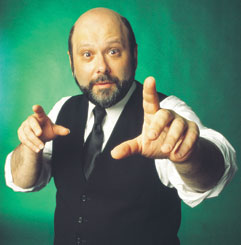
When the Kollel honors Ward Katz on Tuesday, Aug. 21, be prepared to be amazed. Yes you will be amazed at all the great things Katz has done for the community. But the entertainer is expected to blow your mind, or at least read it.

Marc Salem is a mentalist and a mind reader. The late Mike Wallace was skeptical of that description before he interviewed him several years ago on a segment of CBS’ “60 Minutes.” Then he saw him in action.

Salem didn’t disclose on the “60 Minutes” profile how he reads people’s minds and he doesn’t now, either, because “it takes away from the mystery.”

One of the reasons he reads minds so easily is because he’s an expert in reading body language. That’s also why he told Wallace it’s practically impossible to lie to him.

“We could all do it (read minds) if we used our observational skills better,” he told Wallace.

Whether he was playing as a child, working as a professor or performing, he has been doing some sort of mind games his whole life.

“I still consider myself a student of the mind, not a master,” he told The Chronicle in an interview last week.

On Aug. 21, Salem said people can expect to see “jaw dropping entertainment for the whole family where they’ll be amazed at the possibilities of the mind.”

“Nobody is ever embarrassed but I do guide and connect with people’s thoughts … not unlike a teacher or an advertiser or a psychologist or one who reads non-verbal cues, all of which I do,” he said.

But it’s all done in an entertainment context.

“If you want a lecture, come to one of my classes. This is an evening of entertainment,” he said.

But after the show, Salem will direct fans to his website (under the heading Read People and Detect Lies), where there is a bibliography of books he and others have written for those whose curiosity has been sparked to learn more.

Salem, who described himself as an observant Jew, said the show is a lot funnier than people imagine ahead of time when they think of mind reading.

“If I do have a sixth sense, it’s my sense of humor. And I also think when they leave they will be seeing the world a little bit differently. They’ll see that their own perception has changed and the way that they view the world will be a little bit different as they view the world will be a little bit different as they view non-verbal communication. I think the show becomes a metaphor for how to see life.”

Salem earned a doctorate in developmental psychology from New York University and taught college psychology for two decades at the University of Pennsylvania and at Manchester University in England. He still teaches on occasion, most recently last year, but does not mix teaching with performing.

“When I teach I’m very serious about it so I don’t work and perform at the same time. I’m on an unlimited leave of absence, but in my soul I’m a teacher, so I miss it a lot,” he said.

As an entertainer he has performed around the world, astounding and entertaining millions. His show “Mind Games” concluded two extended runs on Broadway to both critical and popular acclaim. The Sydney Opera House, the Edinburgh Festival and Singapore’s Esplanade have also hosted extended runs of “Mind Games.”

Salem can be considered a jack of all trades. In addition to being an academic and a performer, he’s a producer, has written books and worked in television. He has helped lawyers with jury selection and trained police departments in nonverbal communication techniques, emphasizing information retrieval and reliance on intuition.

“I do what I enjoy doing, which thankfully is stuff that is interesting to me and sometimes to other people,” Salem said.

In television he was a director of research at Sesame Street for 10 years, studying the development and nature of the mental process. He was also involved in several episodes of the series “Lie to Me” which aired on the Fox network from 2009 to 2011.
Salem said while it might seem that academics and entertainers are on two different ends of the spectrum, he doesn’t see it that way.

“Marshall McLuhan, the media theorist, once said anyone who thinks there is a difference between entertainment and education doesn’t know the first thing about either. Every television show, whether they want to or not, has a curriculum built into it, and every curriculum has an element of entertainment built into it, not that a teacher has to be a big bird, but if it is boring pedantry then you’re not going to capture people’s imaginations or their minds,” Salem said.

Salem said there’s not that much difference between what he does when he teaches and when he entertains.

“There both standing in front of a group of people being pretty much myself and telling them what’s on my mind and what’s on their mind. I believe that a good teacher can teach anything,” he said.

“If one is dull and boring, one will shut them off, particularly as time continues to go on,” he continued.

Salem, who provided Purim entertainment at KU Chabad in Lawrence earlier this year, said Jewish groups are his “tzedakah of choice.” He doesn’t limit his charity work to Jewish groups, performing for a wide assortment of charitable causes.

But don’t get the impression that Salem only performs for charitable events and small groups.

“Ninety percent of my work is legitimate theater and corporate. Then there’s my tzedakah work,” he said.

An Evening of Celebration and Magic

The Community Kollel of Kansas City will present Ward Katz with the 2012 “One Nation” award, given to those with a commitment to Jewish learning and community involvement on Tuesday, Aug. 21.
The evening will begin with a gourmet sponsor’s dinner at 6 p.m., followed by a brief tribute and presentation to Katz that begins at 7:30 p.m. Marc Salem will follow the award presentation with his mind games, which are expected to both amaze and baffle the audience.
To register for this event online, visit www.kckollel.org. Patrons may also call Rabbi Binyomin Davis at 913-481-5842, or email for reservations.

Old family photos adorn each wall of Marv’s Delicatessen, but the décor isn’t what makes the restaurant in Leawood’s Park Place unique. This delicatessen’s specialty is kosher-style food.

Lokshen kugel, corned beef sandwiches, knishes — it’s all on the menu. But Marv isn’t the one running the show here. Steve Kerner named his new restaurant after his late father, Marv Kerner, who was an investor in a deli in Chicago when Steve was growing up.

“We’d go to the deli every day as kids, even before school,” Kerner said.

He decided on the deli’s name because his father was a major influence on him in terms of food and restaurants. Also, “he was a big deli fan,” Kerner said. “I think he’d be super proud. It would remind him of good memories of the family at the table at the deli.”

His mom has taken an interest in the restaurant as well.

“She calls every day and asks if we’re using seltzer water in the matzah ball mix,” he said.

Kerner, who also founded Ingredient, has lived in Kansas City for 20 years and has also cooked at many different fancy hotels in his career, including the Ritz Carleton and the Four Seasons. He calls Marv’s a “big city deli.”

“My roots are in Chicago, but we have New York deli undertones,” he said. “We tried to create a big city feel, like it’s been here awhile. Everyone has the memory of their grandma and how she cooked. We want to recapture that.”

There are a few items with pork on the menu, but the salami, bologna and hot dogs are strictly beef. Vienna Beef is one of Kerner’s big suppliers. So far, corned beef and pastrami are the most popular items on the menu. For those with a sweet tooth, the deli also serves milkshakes, phosphates and root beer floats.

Kerner prides himself on the variety of items the deli makes fresh, including knishes, kugel, blintzes and kreplach.
“It’s kind of unusual (fare), but we sell a fair amount of it,” he said.

He picked the Park Place development at 115th Street and Nall Avenue because “it’s in the sweet spot for the Jewish community but also has heavy lunch traffic. It’s the epicenter of the Jewish Community Center, two big temples and Village Shalom.”
Since the restaurant opened at the end of June, Kerner said business has been good.

“We’ve gotten very positive feedback on creating something that’s missing in the Kansas City market. (The community is) really behind us,” he said. “(The goal is) to create a place where families can come and schmooze with friends and enjoy the traditional cuisine they grew up on.”

The deli will cater events, and starting Aug. 18, it will also serve brunch on Saturday and Sunday. Special items for that will include matzah brei and salami with eggs.

Ultimately, Kerner would like to open additional locations, but for now he’s “making this the best deli it can possibly be,” he said.

Marv’s Deli, 11554 Ash, is open Monday through Saturday, 7 a.m. to 9 p.m. and Sunday, 7 a.m. to 8 p.m. Menus are available at www.marvsdelicatessen.com

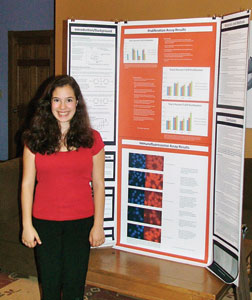
Most high school students read about science research in text books. Recent high school graduate Sarina Farb, 18, has already conducted her own research.
For the past two years the Lecompton, Kan., home schooler has researched the effects of Bisphernoal A, commonly referred to as BPA, and Bisphernoal S, BPS, on breast cancer cells.

Sarina worked with University of Kansas professor Kristi Neufeld, in the university’s science lab.

BPA, found in plastic and cash register receipt paper, has hormone-like properties. Studies have linked BPA to an increased risk of breast cancer tumors. In response to these studies some companies opt to use products that do not contain BPA.

“I found out that all of the replacements were BPS,” Sarina said.

For instance the Lawrence Public Library and Community Mercentile in Lawrence have switched to receipts that contain BPS.
Sarina said she could not find research on the hormonal properties of BPS and its effects on breast cancer cells So she set out to conduct the research herself.

Sarina contacted Neufeld to gain access to a lab at KU.

Once in the lab, Sarina injected various levels of estrogen, BPA and BPS in breast cancer cells. She said her goal was to determine the effect each compound had on the breast cancer cells.

“I used different amounts (of each compound) that were environmentally relevant,” Sarina said.

Sarina’s study concluded that BPA-free options are not a safer option when it comes to breast cancer prevention.

“BPS actually caused more breast cancer growth than the BPA, sometimes more than the estrogen itself,” Sarina said.

Sarina presented her findings at the Kansas City Science Fair this spring where she received first place in the Senior Monocular Biology contest and was named the Pioneer in Science Grand Award Winner.

Sarina competed in the Intel International Science and Engineering Fair in Pittsburgh where she received a third place prize from the National Endocrine Society.

Sarina also won the local and regional Kansas Biogenius Challenge and got first place at the Junior Science and Humanities Symposium.

“I really don’t know what the future will bring but I know I definitely want to continue scientific research,” Sarina said.
Sarina plans to continue her science studies at Grinnell College, where she received a full-ride scholarship.

“I found out in December,” Sarina said. “First I found out that I was accepted and two days later I found out that I got a full scholarship.”

Sarina is the daughter of Joe and JoAnn Farb. She is the granddaughter of Bernie and Judy Fremerman and the late Jack and Shirley Farb.

Sarina’s parents said they are proud of her accomplishments in the science competitions.

“It’s been fun,” JoAnn said. “I’m really excited that she’s going to be able to go to a school like Grinnell.

For six weeks ending Monday, Aug. 6, 12 teens and their four adult leaders slept in a classroom at Congregation Ohev Sholom, showered and enjoying the facilities of the Jewish Community Center, and most importantly, volunteered in the greater Kansas City area and Joplin.
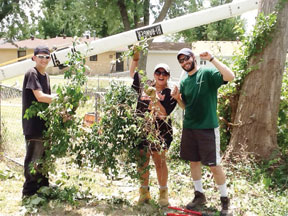
As part of the American Jewish Society for Service’s (AJSS) summer program, the teens in the Kansas City area were one of three groups who were volunteering in different parts of the country. They devoted six weeks of their summer vacation to do tikkun olam, while learning about themselves and others. All of the teens are in high school — two are from Canada and 10 from other regions in the United States.

“This is a very unique experience,” said Mara Herling, one of the staff members who also participated in the program when she was a teen. “We take a group of people who are all Jewish, but practice differently, and make them a cohesive group who volunteer together.”

“Some of these participants are already active volunteers in their communities,” she added, “while others have never volunteered. But they form a community and come back after a long day of work knowing that they helped someone … they made a difference in the community.”

AJSS was founded in 1950 by three rabbis who were inspired by the civil rights movement. According to its website, the aim is for “teens to experience tikkun olam, immerse themselves in communities different from their own, and make a difference in the life of others.”

If Jared Soffer, age 17, is typical of the other students, then the program is succeeding. Soffer, who is from New Jersey, had never been to the Midwest before. He joined the program because two of his cousins participated in previous years and had a great experience.

“I wanted to do community service in the country,” he said, “while also learning about Judaism.”

He had many experiences that have been meaningful to him. The five days they spent volunteering in Joplin was “exciting.”
“You hear about it on the news,” he said, “but when you see it and speak to the people, it is different.”

As part of the program the students focus on doing community service, but they also have educational experiences. Besides traveling to Joplin to volunteer in the tornado-ravaged city, they also traveled to Omaha to spend time with the Jewish community there and to see the sites.

“It is a cross-denominational program,” said Shifra Mincer, the program director for the Kansas City trip. She stressed that the community service is combined with an educational component.

The participants visited places of interest in the area, including the World War I Museum and Union Station. They also learned about their Judaism by participating in Reform, Conservative and Orthodox Jewish worship services. On top of that, they spent time with local families … one weekend of home stays with BIAV members and another weekend doing home stays in Omaha.

Their volunteer activities, besides their work in Joplin, included clearing land for Habitat for Humanity, working at Cultivate Kansas City, bringing produce to Hope Faith Ministries and volunteering in the local Jewish community’s Mitzvah Garden.

“I enjoy the service part of the program the best,” Soffer said. “It makes a difference in the community, but it is also good to meet the people.”

He has enjoyed meeting the other participants.

“I enjoyed meeting new people from different parts of the country,” he said. “I have new connections and friends for life.”

The group spent a great deal of time learning about food, how it is grown, harvesting it and seeing how it is used by food pantries. They spent time on a farm in Kansas, learning about corn. They spent many hours working in the Mitzvah Garden and then bringing the produce to the designated food pantries, where they sorted and prepared the food for distribution.

“We did a lot of gardening and harvesting,” Soffer said. “But we also go to the food pantries and work with the people who are helping others. We see how the food we harvested affects people.”

The group’s hard work was appreciated by those who worked with them.

“What a fantastic group to work with,” said Batsheva Glatt, the educational programs coordinator at the Mitzvah Garden. “Not only did they do hard physical labor in the Mitzvah Garden during the hottest summer on record, but they also helped deliver the produce to our partner organizations. They were delightful. I would love for them to come back in the future!”

It’s an experience that changes these teens forever.

“It is so wonderful to see the changes the participants go through,” said Herling. “The personal growth and self-awareness that develops through the program is amazing. It is a life-changing experience impacting their world view and prospective, which is the most important part of the program. It is incredible to watch and is why I love this program.”


CHEERING SIYUM HaSHAS — Kansas City native Rabbi Bernhard Rosenberg was among the 90,000 or so people who packed MetLife Stadium in East Rutherford, N.J., Wednesday, Aug. 1, to celebrate the completion of the page-a-day Talmud cycle in the largest-ever Siyum HaShas. It was a night he will never forget.

“It was an unbelievable sight to see men, women and children engrossed in Torah learning with the vigor and enthusiasm seldom experience by a Jew,” Rabbi Rosenberg said.

“The highways, the trains and subways were packed with Jews awaiting such an emotional experience of Torah learning. It was as if B’nai Yisrael was standing at Mount Sinai to receive the Ten Commandments.”

TALMUD APP FOR iPAD AVAILABLE — ArtScroll Mesorah Publications has released a much-anticipated iPad App for the Schottenstein Babylonian Talmud. Developed for offline use by an innovative team of more than 40 scholars and technicians, ArtScroll’s Schottenstein Digital Edition of the Talmud retains the integrity of the original printed form while introducing state-of-the-art learning enhancements to deepen and broaden any Talmud learner’s study. Users of the Talmud App can choose from three different pricing and download options available now through the Apple App Store, with the first seven pages given away free for users to experience the digital learning. Gedaliah Zlotowitz, ArtScroll’s vice-president for sales and marketing said, “People should understand that this is neither a scan nor a PDF of the Talmud. Each page is highly interactive in a way no print edition could be. We spared no expense in producing a quality product and made it easy to acquire with differing price packages, including a Daf Yomi cycle option for just a few dollars a month. You can even purchase a single blatt  or a few blatt if you are going on the road and don’t want to carry a heavy print volume.”

The iPad App for the Schottenstein Babylonian Talmud is the first of several projects for development under the Wasserman Digital Initiative, dedicated by Stanley and Ellen Wasserman. ArtScroll co-founder Rabbi Meir Zlotowitz said, “The Talmud is just the beginning. Our long term goal is to help tens of thousands of Torah learners become more proficient in the major classic sources such as Rashi, Ramban, the Midrash Rabbah, and much more.” The Artscroll digital Talmud App will be an ongoing project for the company, with new features and enhancements to be added automatically and at no cost through regular updates. It is compatible with version 1, 2, and 3 of the iPad and, when completed in the summer of 2013, the ArtScroll Schottenstein Digital Talmud will occupy only 3 gigabytes of memory. The average single volume is 70 megabytes. Within two months of the initial iPad App release, ArtScroll expects to offer an App for the iPhone, as well. The App, with the first seven folio pages of the Talmud, can be downloaded free at: www.artscroll.com/theapp.

ISRAELI DRAMA NOW AIRING ON HULU — TEL AVIV (JTA) — The Israeli television drama “Prisoners of War,” which inspired the American TV drama “Homeland,” will be available on Hulu.com.

“Prisoners of War,” which began airing in March 2010 and is now in its second season, centers on the lives of three Israeli soldiers who have returned home after more than a decade in captivity in Lebanon.

The New York Times reported that two of the show’s first 10 episodes are available on Hulu.com, which streams TV shows and movies. New episodes will appear every Saturday.
Hulu is not available in Israel.

“Prisoners of War” was named 2010’s Best Drama Series at the Israeli Academy Awards for Television.

“Homeland,” which began airing last October, focuses on a CIA agent who believes that a returned American prisoner of war may be aiding terrorists.

Labor Day deadline

Labor Day is in just a few weeks folks (maybe we can soon look forward to a drop in temperatures?) and that means we have to adjust our deadlines. Please make sure everything you send in for publication in the Sept. 6 issue is in our office no later than noon on Thursday, Aug. 30. Monday, Sept. 3, is a legal holiday and the office will be closed, so we cannot guarantee anything that comes in past deadline that week will make it in the paper. We appreciate your cooperation.

Kansas City is a barbecue town. There are more than 100 barbecue restaurants in the metro area and a slew of sanctioned contests including the granddaddy of them all, the American Royal. But none of those contests are kosher.

For the very first time there will be a kosher barbecue contest here. The Vaad HaKashruth of Kansas City is sponsoring the Kansas City Kosher BBQ Festival and Competition Sunday, Aug. 19, at The Temple, Congregation B’nai Jehudah. (For more information, see below.)

The idea began brewing late last summer after BIAV’s Rabbi Daniel Rockoff and Vaad board member Marty Rosenberg learned about a kosher barbecue competition in Memphis. Rosenberg’s son, Eli Rosenberg, a television reporter for ABC-24 news in Memphis, served as a judge at that competition.

“I can’t remember how and when we decided to actually sponsor a kosher barbecue competition, but we all thought it would be something neat to do here, since we are one of the barbecue capitols of the world,” said Rabbi Mendel Segal, the Vaad’s executive director.

The Vaad’s board, Rabbi Segal said, thought such an event would be something “really, really great for the Vaad to do.”

“One of our major goals is to have a successful event to promote kosher food and be a place where people who keep strict kosher can go with their friends and bring the whole Jewish community together,” Rabbi Segal said.

Such an event is also good for the Vaad’s image.

“We’ve gone through a lot of changes over the past two years and this would really be a good way to re-brand ourselves and get ourselves out in front of the community and try to set a structure to be able to fundraise in the future,” he said.

It’s been a lot of hard work for the Vaad, comprised of all volunteers except for Rabbi Segal. They set out to establish rules, recruit teams and plan a family-friendly event that would appeal to the entire Kansas City Jewish Community.

The competition

The event is still a couple of weeks away, but the Vaad already met one of its goals: to recruit a minimum of 15 teams.
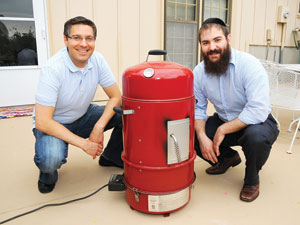
“We’ve got representatives from all over the place, which is really neat,” Rabbi Segal said.

In fact 16 teams will compete. Most of the competitors are local and those teams include Red Hot Orbits; STP BBQ-Smoked to Perfection; Three Jokers and a Smoker; The Instigators; Kollel Kulinary; Three Brothers BBQ; Kosher on a Budget; Decapitated Barbie-Que; In Control; Rayah Neehoah, Cholesterol Shmorlesterol and CBS Queens of Que. Another team, TLC Holy Smokers is composed of residents from Overland Park and Morisstown, N.J. Three other teams are traveling from out of town to compete: Village Green LLC (Louisville, Ky.); Farbreng It (Highland Park, Ill.); and Northern Smoke (Brookline, Mass).

Trophies will be awarded to the first-, second- and third-place winners in three categories: brisket, beef ribs and chicken. A trophy will also be awarded to the overall grand champion.

The Vaad is strictly supervising the food and all equipment used in the competition.

“Each team will make their own rubs and sauces and marinades,” Rabbi Segal said, with the certified ingredients.

The judging panel is not yet complete but it includes a panel of experts, most of whom are not Jewish. In addition, the Vaad has found a way to include local clergy in the judging. For a fee of $360, “that’s only 10, 36-dollar contributions,” Rabbi Segal said, a member of a congregation’s clergy staff may judge. So far Rabbis Daniel Rockoff (BIAV) and Herbert Mandl (Kehilath Israel), the Vaad’s Rav Hamachshir and chairman respectively, will serve as judges as well as B’nai Jehudah’s Rabbi Arthur Nemitoff and Beth Shalom’s Rabbi David Glickman.

No entrance fee

The Kosher BBQ Festival is free and open to the public. Fees were charged for competitors and vendors.

“We would like for this to be a fundraiser in the future, but for now are happy to cover our costs,” explained Rabbi Segal.

“We’ve gotten some sponsorships and donations to help defray the costs,” he continued.

The event is free because, Rabbi Segal said, the Vaad really wanted to encourage as many people as possible to attend.

“Even though this would be a way to generate some extra income, we figured it would be better, at least this time, to just encourage people to come,” he said.

Kosher food

All the equipment being used by the competitors is brand new; supplied by the Vaad and paid for by the competitors’ fees. Even though B’nai Jehudah is a Reform congregation that doesn’t have a kosher facility, that doesn’t matter because the event is being held outdoors.

“We were looking for a place that had a great outdoor area at a good location and Rabbi Alexandria Shuval-Weiner suggested B’nai Jehudah. The congregation’s board discussed it and decided to let us use their space,” Rabbi Segal said.

As is typical with barbecue competitions, teams may not sell any food, drink or other items during the event. But barbecue will be available for sale, smoked by Steve Ellenberg. Other food, including hot dogs, chips, watermelon and drinks will be sold as well.

Rabbi Segal believes many people will be interested in purchasing smoked meats such as whole smoked briskets, sliced smoked briskets and slabs of beef ribs. Zadie’s seasoning (Roasted Garlic Italian, Hickory BBQ, Cajun BBQ, Mexican, Lemon Pepper) can also be pre-ordered as well as special kosher Jack’s Stack Original BBQ Sauce. All preorders may be picked up at the festival and may be paid for by credit card or check.

Adding to the festival atmosphere will be children’s activities, a concert from Sheldon Low and hot dog and pickle eating contests.

Kosher BBQ Festival schedule of events

The Kansas City Kosher BBQ Festival and Competition will be held from 11:30 a.m. to 4:30 p.m. Sunday, Aug. 19, at The Temple, Congregation B’nai Jehudah, 12320 Nall Avenue in Overland Park.

There is no entrance fee. However, the Vaad suggests bringing two cans of healthy food per person to be donated to food charities. There is a fee for concessions. The live music and kosher pickle-eating contest are also free.

The festival will be as cashless as possible. Credit and debit card payments will be accepted with email receipts available. Cash and checks will be accepted as well, but the Vaad prefers not to accept cash at this event.

Parking is free. Outside food and beverages cannot be brought inside the event, which will take place rain or shine. Pets will not be allowed on the grounds.

• 11:30 a.m.
Kid Zone opens (and remains open until 3:30 p.m.)
Food concessions open and will remain open until 4:30 p.m.
Registration opens: Kosher Pickle Eating Contest and KC Kosher Co-op Hot Dog Eating Contest

• Noon
Live entertainment begins featuring: Klezmer Music by Gregory Sandomirsky, associate concertmaster emeritus at the Kansas City Symphony.
BBQ judging begins

• 12:30 p.m.
Kosher Pickle Eating Contest (youth and adult)

• 1 p.m.
Live performance by Sheldon Low

• 2 p.m.
Hot Dog Eating Contest (youth and adult)

• 3 p.m.
All winners announced: best chicken, best ribs, best brisket, and grand champion

Many congregations require tickets to be admitted to High Holiday worship services for a variety of reasons including making sure that their members get that very important benefit of membership. Other congregations welcome anyone to just walk in and pray. Here’s the rundown on the various High Holy Days worship policies in the Kansas City area.
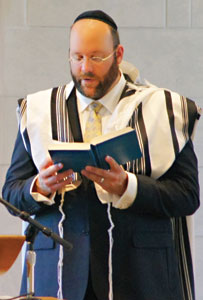
Selling tickets

Congregation Beth Shalom sells tickets to non-members for the High Holidays, but only if they are guests of members. Executive Director Elaine Levine noted that those tickets sell for $200 each and the policy is the same as last year.

At Congregation Ohev Sholom, members may purchase tickets for other members of their family, if they wish.

“High Holiday tickets are not available to non-members,” said Steve Berman, Ohev’s executive director.

“All members of the Jewish community who are currently unaffiliated are encouraged to visit the congregation, meet our members, talk with our leadership and consider joining,” Berman added.

Congregation Beth Torah recently revised its High Holiday ticket policies. For the first time the Reform congregation will begin selling tickets to non-members for its High Holy Days worship services.  (See complete story below)

Pray for free

When Temple Israel of Greater Kansas City was formed in the spring of 2011, it decided to open up its High Holiday services to the entire community. At a board meeting last week, the board decided to reaffirm that policy.

“We want to remain true to what we are: open, warm, welcoming and inclusive. We are not going to ask people to pay to pray,” said TI President Erin Margolin.

Non-members who wish to attend TI’s services, which are held at Congregation Ohev Sholom, should contact Marcie Pell at 913-634-0432 and ask for free tickets. Tickets are necessary to ensure the availability of space. Although TI is not charging for tickets, Margolin said “donations will be greatly appreciated.”

Tickets may also be requested from the TI website: http://www.templeisraelkc.org/contact.

Congregation Kol Ami has a similar policy according to acting president Brian Greenwald. Kol Ami will be holding its High Holiday services at All Souls Unitarian Universalist Church, 4501 Walnut Street in Kansas City, Mo. Neither members nor non-members need tickets to attend.

BIAV, the city’s only Orthodox congregation, also admits anyone who wishes to worship, no matter what day it is.
“We do not issue tickets, or have reserved seating. Everyone is welcome,” said Barry Rubin, BIAV’s administrative director.

As is its tradition, Chabad — at its sites in Overland Park, the Plaza, Lawrence, Kan., and Columbia, Mo. — has an open door policy and does not charge any membership or “pay to pray” fee.

“All are welcome free of charge. Our policy has remained the same for the past 42 years,” Rabbi Mendy Wineberg said.

The same is true for the Torah Learning Center.

“We do not charge membership all year and High Holidays are no different,” noted Rabbi Simcha Morgenstern. “Many of our ‘members’ are official members elsewhere that study with us. So, we rely on generous donations and income from programming.”

In Lawrence, the Lawrence Jewish Community Congregation is also open to all, regardless of the ability to pay.

“Donations are requested, but not required,” said Erin Levy, LJCC’s office assistant. “This has always been our policy.”

The Temple, Congregation B’nai Jehudah allows people in the following categories to obtain guest admittance cards: Out-of-town guests of members; members of other URJ congregations with prior arrangements; armed forces personnel on active duty; college students upon presentation of a college I.D.; people who have been in the community less than 12 months; and relatives who are members in good standing at another local congregation with prior arrangements.

Tickets are not sold and cannot be obtained by non-members who do not fit the above categories.

“We do not sell ‘tickets,’ so if you have lived in the Kansas City area for five years, you cannot attend evening or late morning services. However the early morning family services are open to the community,” said Jeanne Kort Adler, B’nai Jehudah’s executive director.

Membership drive

Kehilath Israel Synagogue is welcoming a new senior rabbi, Rabbi Shmuly Yanklowitz, this year and President Steve Osman said, “We want others to come see what we have to offer.”

“As such, we are working on a new member drive directed at people who are either new in town or have been unaffiliated for several years. As always, if someone is visiting from out-of-town and would have had tickets at their own synagogue, we reciprocate with tickets to K.I. All military personnel and college students are always welcome,” Osman said.

He said that K.I. tries to be flexible and understanding of anyone’s situation — member or non-member. Generally members have to meet certain membership requirements to attend services (as is the case at many other congregations).

“We have not ‘sold’ High Holy Day tickets in the past. Members may also receive tickets for visiting out-of-town guests or children,” Osman continued.

For tickets and more information about K.I’s policies, contact Elizabeth Peden, K.I. executive director, at 913-642-1880.

The New Reform Temple is still reviewing its High Holiday admittance policy and plans to have it in place by the middle of August. For more information contact the NRT office at 816-523-7809.


Beth Torah to sell High Holiday tickets

While anyone can attend worship services at any congregation 365 days a year, admittance is often available only to members in good standing for Rosh Hashanah and Yom Kippur. But as the congregational affiliation rates continue to drop both in Kansas City and across the country and budgets continue to tighten, congregations are facing the challenge of how to handle requests from non-members who would like to worship on those days.

Congregation Beth Torah recently made the decision to sell High Holiday tickets to former members requesting tickets and other members of the community.

“There has been much discussion for the past several months at our board meetings about this issue,” said Beth Torah President Michelle Cole. “It is something we have looked at off and on over the past few years. We have talked to several other congregations in other cities and most charge for tickets.”

Cole said because of tight budgets, it’s not possible to continue giving free tickets to former members who no longer pay dues but wish to attend High Holidays services every year. This new system will allow them to attend services in a fee-for-service type system.

Another change to Beth Torah’s ticket policy is for those people who have never been members of the congregation and wish to attend only on the High Holidays. For one High Holiday season only, they can request free tickets.

“That means they can receive free tickets in 2012,” Cole explained. “But beginning in 2013, if you received free tickets in 2012 and still haven’t joined the congregation by the High Holidays, you will be charged for tickets in 2013. But if you didn’t get free tickets in 2012 and wish to try us out in 2013, you can still receive free tickets.”

Cole said she really doesn’t know how this new ticket policy will affect the congregation’s membership or bottom line. It’s possible some members could decide to drop their membership and simply decide to purchase High Holiday tickets. Then of course they wouldn’t receive other benefits reserved for members, such as a rabbi’s services for life-cycle events or religious school. On the flip side, people who already were not members may choose to pay for the privilege of attending the services on those days only.

“Obviously, we would prefer that people join our community and participate year round. That is the ultimate goal for any temple. However, there are many people that are ‘twice a year Jews’ and would rather just pay for the tickets than the annual membership,” Cole said.

Cole noted that Beth Torah’s policy for people coming from out of town who are members in good standing at another congregation and are visiting the area during the High Holidays is not changing. It is common for Reform congregations across the country to provide free reciprocal tickets to those people. That policy is followed by The Temple, Congregation B’nai Jehudah as well.