Screenwriter Dode Levenson does a lot of different things trying to keep his life interesting. He’ll be here Saturday, April 13, to showcase his latest project, the 2012 romantic comedy “One Small Hitch.” The movie is screening at the Kansas City FilmFest at the Alamo Drafthouse Mainstreet Theater twice this weekend.
So far the movie has done well at film festivals, winning praise at five festivals already. The awards include Best Picture Comedy nods at the California Independent Film Festival, Sedona International Film Festival and Cinequest Film Festival; Best Production Design recognition at the Hollywood Reel Independent Film Festival and was voted as Best Feature Film at the Omaha Film Festival.
Here’s the synopsis:
“On a flight home to Chicago for a family wedding, childhood friends Josh and Molly innocently agree to fake a wedding engagement to make Josh’s dying father happy. Things quickly get out of hand with their two boisterous families, and a series of events causes them to pretend to be a couple and start planning a phony wedding. When the playacting begins to foster real feelings, the two must make some serious decisions: split up and return to their lives in Los Angeles, or make a life as a couple back in Chicago.”
Levenson wrote the first draft of this screenplay about five years ago. At the time he was engaged and going through his own wedding preparations. Nothing in his entire life prepared him for that process.
“You meet somebody. You fall in love. You want to spend the rest of our life with them. And then all of this other activity comes up, the caterers, where are you going to get married, where are you going to honeymoon. Everybody wants all the details and it’s just this incredible wave of love and good will, but it can be a little overwhelming,” he said.
So the creative juices in his head started flowing as he wondered, would watching the process of getting married be enough to push people who weren’t really in love to get to the point to actually decide to tie the knot?
“It’s an incredibly powerful experience to go through the planning of a wedding, of everybody’s agenda. I thought it would be interesting to think about that experience. But then I came up with how do you fake it?” Levenson explained.
With a fake engagement plot line in mind, Levenson tried to figure out what circumstances would warrant a couple to decide to fake a wedding.
“That’s how I backed into the plot of ‘One Small Hitch,’” he said.
He then incorporated a second thought. What happens if the man or the woman, for one reason or another, couldn’t have one or both of their parents attend this special moment in their lives?
“So the plot of ‘One Small Hitch,’ is two old friends who grew up together and one finds out the dad is dying. The dad is completely accepting of it. He said, ‘Look, don’t be sad for me. I’ve traveled the world, I’ve raised a family, I had a business. My one regret is I’m not going to meet the woman who will one day become your wife.’ In a weak moment the son says, ‘What if I told you that you already have.’ And he pawns off his best friend’s kid sister as his fiancé in order to make his dying father happy. I thought that was sweet,” Levenson said.
“It’s combustible,” he added.
Originally both of the lead characters were Jewish. He changed his mind, making the male Jewish and female Irish Catholic.
“I think people can relate to the intermarriage challenges everyone faces in the modern world. I just thought it would also add to the pressure on the two of them and (help them) find out how they really feel about each other,” he said from his home in California.
He’s had several films produced. He said this one is the closest to what he actually wrote.
“I credit John Burgess, the director and producer, for being faithful to the material and for making it the film we will see Saturday,” he said.
He said the two work together well.
“It made us both laugh and grow close together as we collaborated and made this script into this tangible film experience that seems to make a lot of people happy,” he said.
Levenson said he hopes to work with him again in the future.
“I’d love to do another romantic comedy because he’s got that touch,” he said.
Ties that bind
Levenson’s ties to Kansas City run deep. The son of Rabbi Paul Levenson and Marlyn Katz Levenson, he moved here as a small child in the early 1970s when his father became the assistant rabbi at The Temple, Congregation B’nai Jehudah. He still stays in contact with many of the friends he made while attending the Hyman Brand Hebrew Academy, Meadowbrook Junior High and Shawnee Mission East High School. He also still keeps in touch with his sixth-grade teacher, the 101-year-old Stella Jacoby and others he met while an active member of BBYO (he was president of Hatikvah AZA) and USY.
Levenson’s father, who became the first rabbi at the now defunct Temple Beth El after leaving B’nai Jehudah, will join Dode Levenson here Saturday night for the screening. He is now rabbi emeritus of Temple Chayai Shalom in Easton, Mass., and serves as a chaplain for several Boston hospitals.
Dode Levenson is also still close with the Gershon family — Paul and Susie and their children Andy and Amy. Levenson and Andy Gershon, now a well-known music executive in New York, were best friends growing up. Wanting to stay in the area and graduate high school after his father the rabbi took a new position in Massachusetts, Levenson said he begged his parents to let him stay with the Gershons.
“I ended up having the best senior year a kid could have,” he said.
Following his graduation in 1982, he attended the University of Massachusetts at Amherst and studied communications and journalism. While there he wrote two books, “Jewish Trivia” along with Jane Lenarsky and Barbara Wachman (1985) and “So You Think You’re Jewish,” with Jackson Katz (1988).
After college, he traveled extensively and even moved to Jerusalem, where he worked for the Jerusalem Post. He loved the life of a journalist and living in Jerusalem, but, he said, “I wanted to color outside the lines. I wanted to make things up.”
Since that’s frowned upon in journalism, his first thought was to become a novelist. But then he read that you could make money in Hollywood as a screenwriter, even if a movie never gets made from the script.
“So very naively I thought I would move out to Los Angeles, sell a couple of movies because it didn’t seem that hard, and use that money to finance my novel-writing career,” he said with a laugh.
He moved to Los Angeles in the late 1980s.
“I learned very quickly that the craft of screenwriting is a very serious one and once I got into it I just thought it was the most fun. I got a break early on with Roger Corman’s company, who made genre pictures and started the careers of Jack Nicholson and Martin Scorsese making low-budget films,” he said.
Of course he wanted to work on big-budget films, but discovered the best way to learn the craft and elevate it was with low-budget ones.
“That was exactly my path. I did a Stephen King film, I did a neurotic thriller. I became really versatile because I just wanted to work,” he said.
His first real spec script was “a big, high concept family comedy’ written for Will Smith and Martin Lawrence called “Homeboy.”
“That’s the one that really launched my career in earnest with the studios.”
He’s also sold multiple shows to MTV and partnered with animation giant Film Roman (“The Simpsons,” “King of the Hill”) on the post apocalyptic comedy series “Doomsday,” which is executive produced by Howard Stern. Right now he’s in active development on a hip-hop bowling feature called “Rolling Thunder” for Universal/Republic pictures.
But the project he has enjoyed the most so far is “One Small Hitch.”
“I haven’t loved the other films I’ve done as much as I love this one,” he said.
Screening details
“One Small Hitch” screens at 6:10 p.m. Saturday, April 13, and at noon Sunday, April 14, at the Alamo Drafthouse Mainstreet Theater in the Power & Light District as part of the Kansas City FilmFest. Visit www.kcfilmfest.org to learn more about the films and http://drafthouse.com/kansas_city/mainstreet to purchase tickets. The FilmFest concludes Sunday, April 14.



 After years of collaborating with different musical groups at the interfaith Martin Luther King Jr. Day service put on by the Southern Christian Leadership Conference, Linda Matorin Sweenie decided she’d like to bring that mix of music to the Jewish community.
 Three members of the Jewish community — Ali Felman, Jessica Glueck and Slater Sousley — were among the 18 winners of the 2013 Arts Council of Johnson County Shooting Stars Scholarships. These scholarships were presented April 7 at the Nerman Museum of Contemporary Art and Yardley Hall at Johnson County Community College.
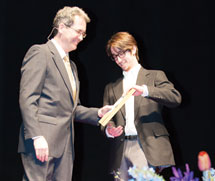 Slater Sousley is the first-place scholarship recipient from Hyman Brand Hebrew Academy in the category of two-dimensional visual art. He was nominated by Kelly Reichman, who was one of nine teachers that evening who was awarded a teacher honorarium. This is actually the third time a HBHA student has won this award under Reichman’s tutelage.
 If you are a sports fan who often wonders if this player or that player is Jewish, read on. You’ll want to add Sporting Kansas City’s Benny Feilhaber to the list of who’s who among Jewish athletes. Feilhaber, a midfielder, joined the soccer team in the offseason and has helped the team to a 3-1-2 start this season and second place in Major League Soccer’s Eastern Conference standings. You can see him and all the other Sporting KC stars play at Sporting Kansas City’s fourth annual Jewish Heritage Day at Sporting Park on Sunday, May 5.
 Things are rockin’ for the University of Missouri’s Alpha Epsilon Pi fraternity in more ways than one. The chapter is the largest it’s been in years and its members are doing well academically. On top of that, the brothers are hoping the fraternity’s biennial philanthropy event to raise money for the fight against cancer, scheduled later this month, is the biggest and best ever.
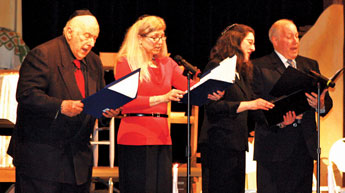 A MOVING TRIBUTE — There were a few tears in the audience more than once Sunday during the community’s annual Yom HaShoah Holocaust Memorial Service at the Lewis and Shirley White Theatre. This year’s event, chaired by Sharon Mandelbaum Barber, the daughter of the late Shirley Mandelbaum and survivor and MCHE co-founder Jack Mandelbaum, commemorated the 70th anniversary of the Warsaw Ghetto Uprising and the 50th anniversary of the dedication of the Memorial to the Six Million, which now sits on the grounds of the Jewish Community Campus. Rabbi David Glickman of Congregation Beth Shalom reminded the full house of more than 500 people that commemorations like Sunday’s are more important today as we move further away from the actual events of the Shoah. Barber noted that those survivors who settled here believed the United States was a land of freedom and opportunity. “They didn’t ask for sympathy or charity. They rolled up their sleeves and worked hard.” She continued to note that it is now the responsibility of the children and grandchildren of these survivors to carry on their legacy, always being mindful of the blessings and responsibilities of freedom.
 YOM HAZIKARON — This year’s community Yom HaZikaron Memorial Service will feature Yoona Kolfina, a lone IDF soldier from Belgorod, Russia. It is taking place at 7 p.m. Sunday, April 14, at the Jewish Community Campus. Kolfina joined the IDF Karakal unit and served as a combat lone soldier, as well as a paramedic during her army service. Her speech, along with a moving memorial service, will be an unforgettable experience.
 This is a big year for State of Israel as it celebrates the 65th anniversary of its birth. The Kansas City Jewish community will celebrate it not once, not twice, but three times during the month of April.
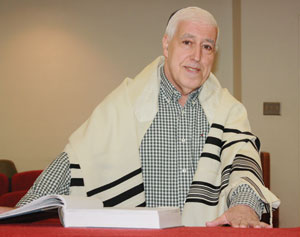 From the mellah (Jewish quarter) in Fez, Morocco, to Congregation Ohev Sholom, Charles Choucroun has had an interesting and varied life. But his deepest commitment is to Judaism. He shows it in a variety of ways including leading the morning minyan six days a week — Sunday through Friday — at his Conservative congregation for more than 20 years.
 Last September, former Kansas Congresswoman Lana Gordon found herself stepping back into state government as the interim secretary of labor. In February, the state senate unanimously confirmed an appointment that took away the “interim” part of her title.