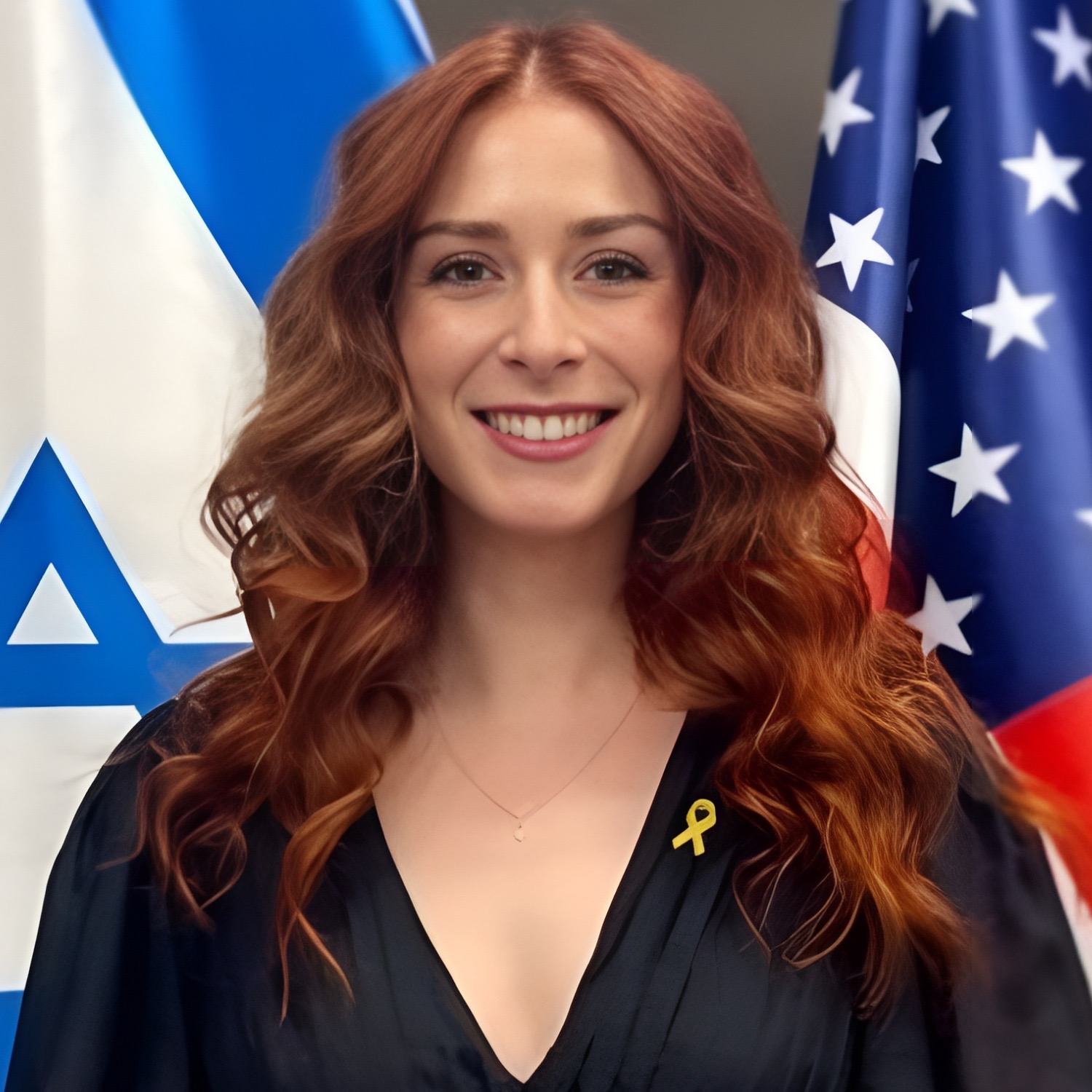
In Prairie Village’s Porter Park, a newly-planted Yoshino cherry tree honors city native Sarah Milgrim (z”l) and her environmental advocacy.
At the University of Kansas, a scholarship established in Milgrim’s name is ensuring the next generation of student activists can pursue the altruistic activism she believed in. And beside a stream bearing her name on KU’s campus, students gather each day to sit, contemplate and learn about her efforts to foster peace between Israelis and Palestinians.
One year since Milgrim, a 26-year old Israeli embassy staffer, and her boyfriend, fellow embassy staffer Yaron Lischinsky, 30, were ambushed and fatally shot on May 21, 2025, by an accused anti-Israel terrorist in Washington, D.C., Milgrim’s influence as a force for global good is being felt across Greater Kansas City and far beyond.
Jewish communities are honoring her by continuing the work to which she dedicated her life: building bridges toward co-existence, confronting anti-Jewish racism and doing outreach to minority and vulnerable communities.
“I see her legacy as inspiring other people to continue her work,” her father, Bob Milgrim, told The Chronicle. “It’s one thing to remember what she did. But it’s a whole different thing to actually start doing something — to continue the work, to continue the dialogue, to try to bring people together. If you’re inspired, you should act.”
As director of Civil Society Affairs at the Israeli Embassy, Milgrim reached across divides and worked with LGBTQ, African American, Hispanic, Asian and Indigenous communities. Before the embassy, she worked with Tech2Peace, a joint Israeli-Palestinian organization promoting coexistence, and wrote her master’s thesis on what happens when young Israelis and Palestinians who have never met are brought into the same room.
Milgrim’s parents still intend to present her findings at a Tech2Peace seminar in Madrid, to be attended by Israeli, Palestinian and Spanish university students.
“She believed that people could work together and find peace,” her mother, Nancy Milgrim, said. “She understood the similarities among all the different groups in Israel, but she also respected everyone’s differences.”
After the Oct. 7 attacks, Sarah Milgrim reached out to LGBTQ organizations whose members had joined anti-Israel demonstrations — patiently, without condemnation, trying to open a conversation. In the days before she was killed, that commitment guided her actions.
“She already had flights booked to go to Israel, and then they had asked her to stay on at the embassy for another [week or more] to host a group of LGBTQ individuals from North America who the embassy was flying to Israel for Pride Month,” Nancy Milgrim said.
“That’s what she did,” Bob Milgrim said. “She tried to make everyone aware of what Israel was really all about.”

Sarah Milgrim outside of the U.S. Capitol.
Milgrim was about to be engaged to Lischinsky, with the couple’s flight booked for Israel and future plans awaiting both.
As they were leaving the American Jewish Committee’s ACCESS Young Diplomats Reception at the Capital Jewish Museum in Washington, a gathering focused on humanitarian efforts in Gaza and the Middle East, authorities say they were gunned down by a bigoted killer who shouted “Free, free Palestine” and “I did it for Palestine, I did it for Gaza,” while carrying a keffiyeh.
The loss of Milgrim, a powerful voice against anti-Jewish hatred, was devastating. But the people who love her — and many who never met her — are not standing still.
“There’s a very powerful verse in the Torah — v’hachai yiten el libo — ‘and the living shall take to heart,’” said Rabbi Zalman Tiechtel, director of KU Chabad. “It’s not enough to remember our loved ones. We have to take everything they embodied and make it alive.”
At the University of Kansas, Milgrim was an active member of both KU Hillel and Chabad. “Sarah’s Stream” at Chabad is intended to be more than a memorial; it is meant to be a tranquil place where students visit each day and discover Milgrim’s story, seeing in her an example of how they, too, can make a difference.
Two plaques mark the site and explain to visitors that Milgrim embodied both courage and faith.
“Some knew her. Some didn’t. But they’ve heard of her, and it’s very meaningful to them,” Rabbi Tiechtel said. “Even last night, people were sitting around by the waterfall, just reflecting and talking and connecting.”
The kindness Greater Kansas City’s Jewish community has shown toward the Milgrims, including Sarah’s older brother, Jacob, has helped give her family strength.
“From the very first hours, everyone swarmed around us to help,” Nancy Milgrim said. “People brought us food, visited, checked in on us. Everyone could not have been more supportive. People still reach out, and many of them are people we don’t even know.”
Kansans and Missourians have honored Milgrim in many ways: The city of Prairie Village dedicated a tree to Milgrim — a lifelong environmentalist — at Porter Park on Arbor Day (April 25), with the mayor and city council members present. Kansas Gov. Laura Kelly visited the Milgrims’ home and later spoke alongside Nancy Milgrim at a Hanukkah menorah lighting in the Capitol rotunda. The Jewish Community Relations Bureau | American Jewish Committee announced a scholarship in Milgrim’s name for students pursuing work in human rights and combating antisemitism, with the Milgrim family on the award committee. And in December, communities around the world took part in “Sarah’s Week of Service,” a global initiative centered on environmental stewardship, social action and human connection.
Rabbi Doug Alpert of Congregation Kol Ami, who officiated at Sarah’s funeral, said “there has not been a day that has gone by since the 24th of Iyar, 5785, that I have not thought about Sarah.”
Inspired by her work as a “rodefet shalom” — a pursuer of peace — Rabbi Alpert is taking a year-long course of study in conflict resolution, leading toward his certification as a rodef shalom.
“This has made me think of Sarah’s commitment to a concept known as the ‘third narrative,’ a vision that seeks to rise above the noise of vengeance and violence, and instead focuses on our shared humanity,” Rabbi Alpert said. “Sarah’s work and her memory are constant companions in my own studies of conflict resolution and peacebuilding.” In honor of her Yahrzeit this month, he will make a donation to Tech2Peace.
Milgrim’s work toward peace between Israel and Palestinians has inspired many across Greater Kansas City and the U.S. to continue her efforts.
“I know we do have people in our Jewish community who do seek a better path forward; both to get past the polarization within our community and to connect with Palestinians who also are seeking paths of peace,” Rabbi Alpert said.
Rabbi Samuel Stern of Temple Beth Sholom in Topeka, who is involved with the Movement Against Antizionism initiative — which treats anti-Zionism as a hate movement — said Milgrim “carried into the world the moral seriousness this state still produces in its young people.”
Rabbi Stern did not know Milgrim, but he spoke with leaders and officials “who watched her become exactly the kind of young Jewish leader rabbis pray for.”
“Sarah lived the universal ethic that Jewish tradition demands of us, and she lived as a proud, particular Jew bound to her people,” said Rabbi Stern, who provides education aimed at countering anti-Zionist campaigns in civic, campus and faith settings. “You can love humanity and love your own. You can build bridges and stand on them.”
He added, “For me as a rabbi, her legacy will imbue our work with meaning. We do not honor her by retreating from coexistence. We will honor her by doubling down on the full-throated, unapologetic bridge-building Zionism she embodied.”
Israel’s leaders, too, have shown compassion, care and loyalty toward the Milgrims as the Jewish state honors their fallen daughter.
During a visit to Israel in September, the Milgrims were welcomed by President Isaac Herzog, met with government ministers and the Speaker of the Knesset, and sat with Prime Minister Benjamin Netanyahu, who had made a point of coming to the Israeli Embassy in Washington during a visit just weeks after Sarah’s death to meet the Milgrims privately.
“When you see him on TV, it’s very political,” Bob Milgrim said of Netanyahu. “But when he met with us, it was very personal. We felt like he genuinely cared and was genuinely sorry about what happened to Sarah. He talked about his brother for a long time and related his experience to our experience.”
(Netanyahu’s brother, Yonatan “Yoni” Netanyahu, was killed in action during Israel’s 1976 hostage-rescue mission in Uganda, Operation Entebbe.)
On this past Yom HaZikaron, Israel’s Memorial Day, a video filmed at the Milgrims’ home was part of Israel’s national streaming ceremony. The depth of Israel’s embrace of the Milgrims was evident during a memorial service at Israel’s Ministry of Foreign Affairs, a video of which was sent to the Milgrims.
“We didn’t know until that morning that Sarah’s name and Yaron’s name were engraved on the wall of those who have fallen while on duty in the foreign service,” Bob Milgrim said, referencing the Ministry of Foreign Affairs service. “Sarah’s is the last name on the wall.”
Nancy Milgrim said losing Sarah has forced their family to forge a new path forward.
“We need to make a new plan, because our life didn’t turn out the way we had planned,” she said. “So now we’re trying to make a new plan that includes honoring Sarah and remembering her — and making sure people don’t forget her.”
Rabbi Stern said he finds hope in Sarah’s parents, “who have chosen public witness over private grief, and whose courage spurs the rest of us into our better selves.”