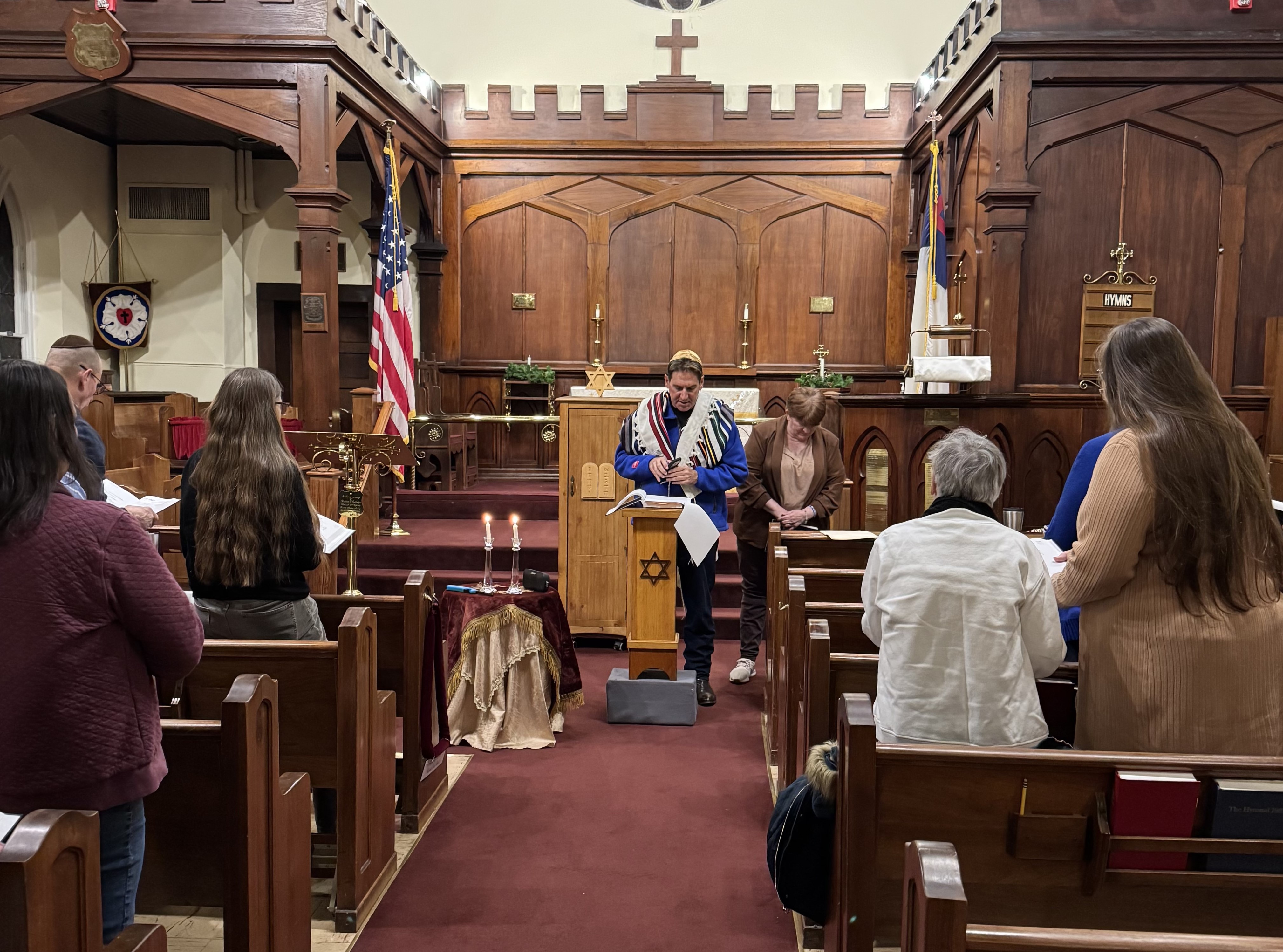
On a recent Friday evening at Fort Leavenworth, inside the Memorial Chapel that has stood on post for more than 150 years, a small but growing group gathered for something that had long been missing: Jewish communal life.
There were soldiers and civilians, families and children, and a number of non-Jewish attendees watching closely, curious to learn during the service. Some followed along in prayer books. Others listened. Everyone stayed for the meal.
At the center of it all was Jonathan Freiden, a Leawood, Kansas, resident who, since September, has been working as a volunteer to rebuild Jewish life on the storied U.S. Army base from the ground up.
“It’s literally one by one,” Freiden said. “That’s how you build a community.”
Freiden, 51, serves as Fort Leavenworth’s Jewish Designated Religious Group Leader, or DRGL, a formal role jointly endorsed by the Jewish Welfare Board (JWB) and the military, created to support religious communities at U.S. military bases that lack full-time clergy, he said. In the Army, where there are only a handful of Jewish chaplains, volunteer DRGLs like Freiden often become the primary facilitators of Jewish life.
For Freiden, the role is both personal and purposeful. A longtime Kansas City-area business and nonprofit leader, he said he had always wanted to help an underserved Jewish community, but never found the right moment earlier in life. A member of Kehilath Israel Synagogue and The Temple, Congregation B’nai Jehudah, he also served on the board of Temple Adath Joseph, in St. Joseph, Missouri, where he has helped support the congregation’s preservation efforts, including helping care for its historic cemetery.
“This was my way to give back,” he said of his volunteer work at Fort Leavenworth. “To combine Judaism, community and service where there was a real need.”
That need was clear when he first arrived.
Home to the Army’s Command and General Staff College, Fort Leavenworth is often described as the intellectual center of the Army. Officers from across the U.S. and allied nations come to study there — Israelis have done so previously — creating a dynamic, talented and constantly rotating population.
The post was established in 1827 by Colonel Henry Leavenworth. Located on the Missouri River, it was originally created to protect settlers and traders on the Santa Fe Trail. Today, according to recorded estimates, the base’s population includes around 3,700 active-duty personnel, about 2,800 civilian personnel and more than 1,000 students, along with personnel from the on-site U.S. Disciplinary Barracks.
The amount of Jewish community activities at Fort Leavenworth has ebbed and flowed historically, but in recent decades, the little Jewish programming there has gradually faded.
There are more than 15,000 Jews currently believed to be serving across all branches of the U.S. armed forces. Freiden estimates there may be 75 or more Jewish soldiers and family members stationed in and around Fort Leavenworth, about two dozen of whom he has connected with directly.
“When I got there, there was really nothing [for Jewish personnel],” Freiden said. “If you wanted services or community, you had to go to Kansas City.”
For some, that meant driving nearly an hour to attend synagogue in Overland Park, Kansas. For others, especially younger personnel or those without transportation, it meant attending services online — or not attending at all.
Freiden began his new mission just before the High Holidays last year, organizing an initial Rosh Hashanah gathering without knowing whether anyone would attend. People did. Then more followed.
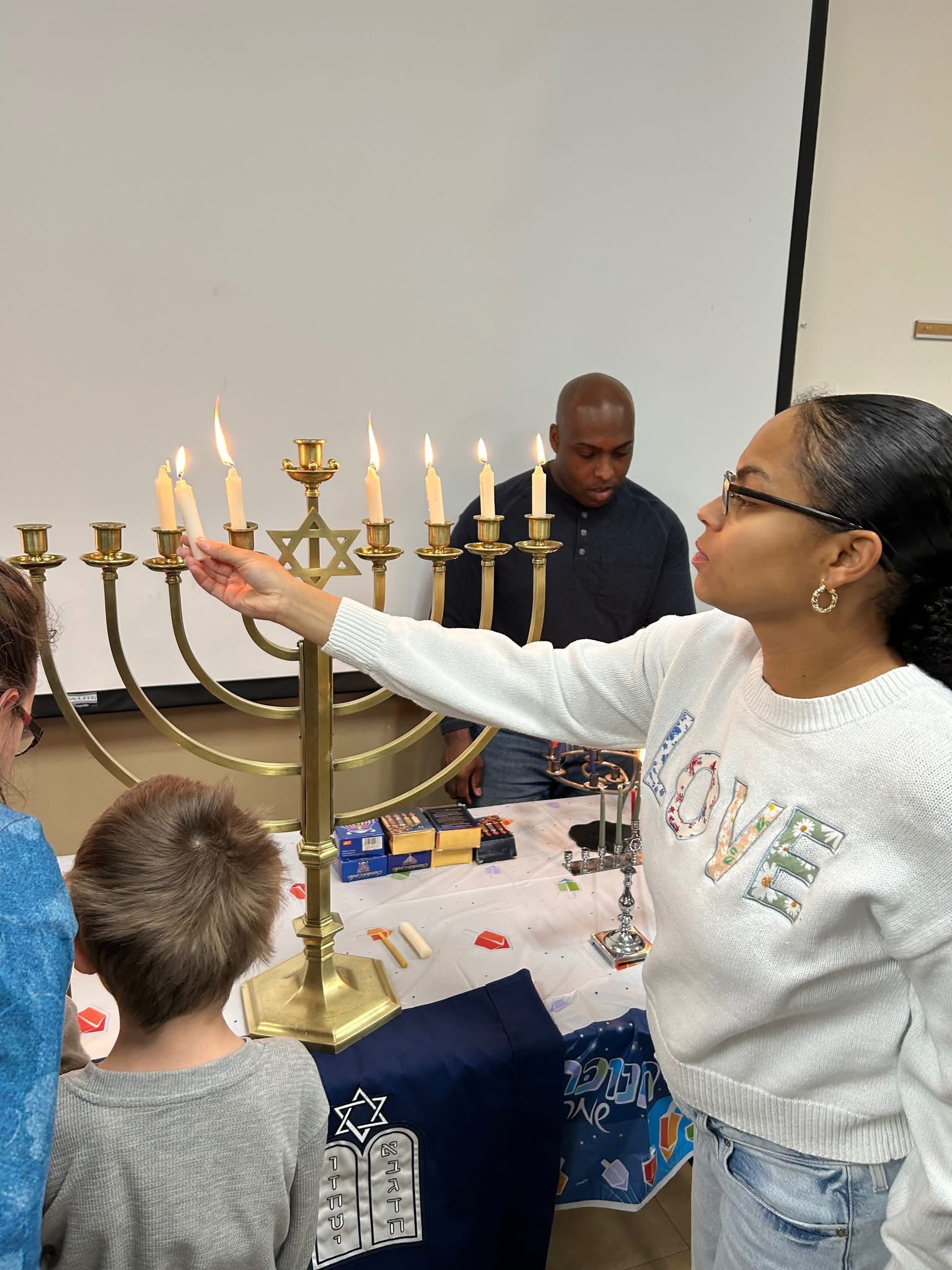
People lighting Hanukkah candles at Fort Leavenworth.
Since then, Jewish programming has steadily expanded. There have been Shabbat services, Hanukkah and Purim celebrations, a weekly Judaism class and family-oriented gatherings, including children’s programming. A community Passover Seder held this month was also a success, with attendees commemorating the liberation of the Israelites from slavery in Egypt.
Food has become central to the experience, both as tradition and as a way to bring people together. Meals are often prepared collaboratively, with participants cooking, sharing recipes and learning from one another. Chicken, latkes and Middle Eastern dishes are among the favorites.
Just as notable as the growth in participation has been the diversity of attendees. Many who come are not Jewish.
“We’ve had a lot of people who just want to learn,” Freiden said. “Families, chaplains, international officers — they’re curious, and they’re engaged.”
That openness has stood out to base leadership. Chaplain Lt. Col. Eric Bryan, the garrison chaplain at Fort Leavenworth, said Freiden’s work has had a meaningful impact both practically and symbolically.
“Jonathan’s help to invigorate Jewish gatherings has been a huge success,” Bryan said. “Our Army takes seriously our First Amendment rights to the freedom of exercise of religion, and know our soldiers and families are stronger when they have a thriving faith community. We are thrilled to have a Jewish community on Fort Leavenworth.
“What I admire most is the collegiality, friendship and mutual support our Christian chaplains and Jewish leaders have shown to one another,” he added. “After attending our first gatherings, the Jewish 101 class, Hanukkah and Purim feasts, I couldn’t help but notice several Christian chaplains and community members who care deeply about our Jewish friends. Jonathan has been a positive part of that process by the kind, helpful and team-centered way he approaches ministry. Jonathan is like a fellow soldier — he joins our weekly staff meetings and contributes new insightful ideas. In years past, I think we were missing a leader who could take the initiative to organize Jewish gatherings. Jonathan’s example I hope encourages us all. People rally around willing leaders.”
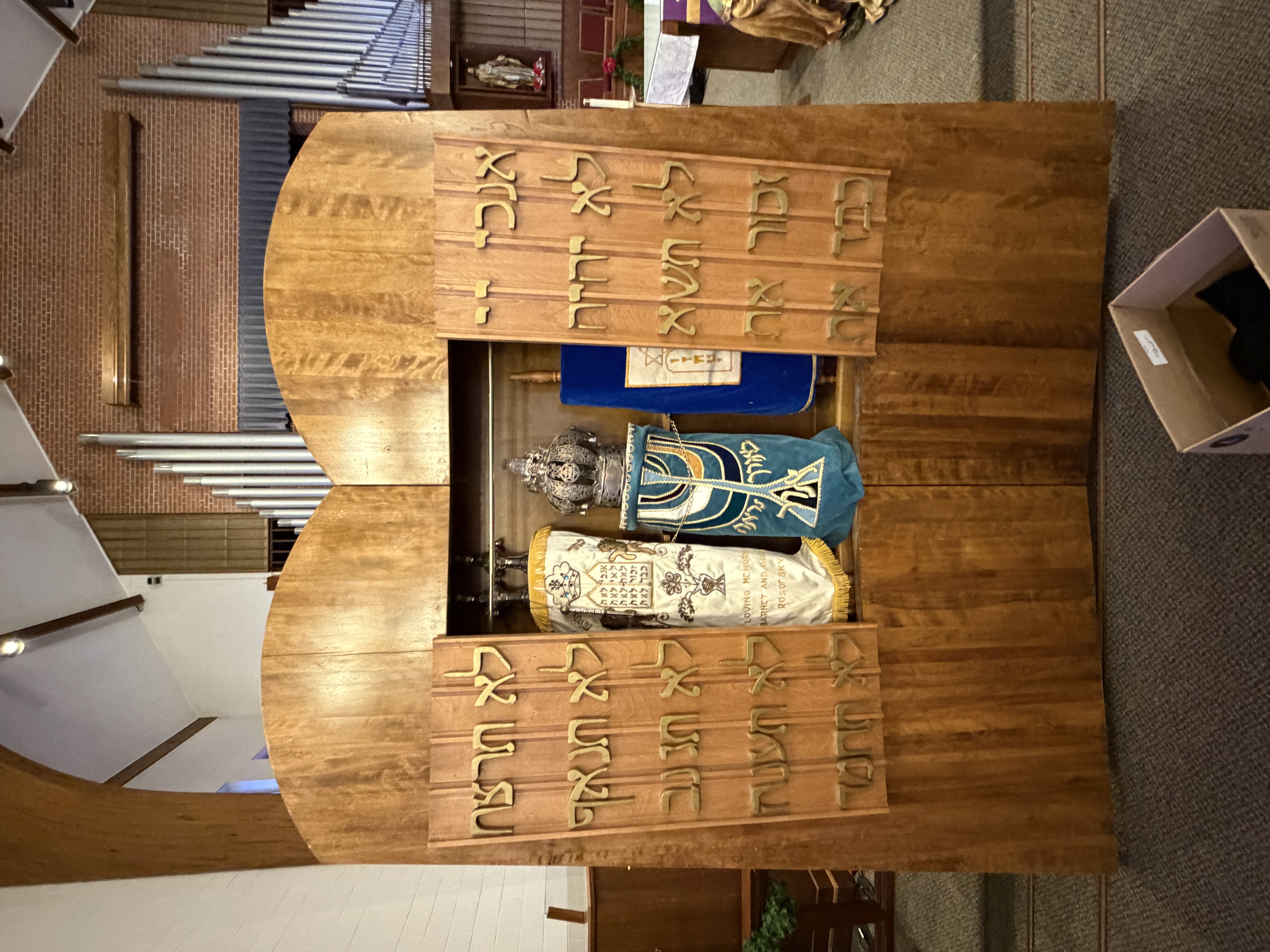
The arc containing Torahs inside a historic chapel at Fort Leavenworth.
Freiden said reaching more Jews has required persistence, outreach through base communications and social posts and word of mouth.
“People don’t always RSVP,” he said. “They just show up. And that’s part of how it grows.”
The rebuilding effort has also been physical. When Freiden first opened an old Jewish ark in one of the chapels, it contained only decorative remnants of Torah scrolls that had long since been removed. Today, through donations of Jewish ritual items from Temple Adath Joseph and communities across the country, the Fort Leavenworth community now has multiple Torah scrolls, along with prayer books, menorahs and other ritual items. Some of those items carry histories of their own, donated by congregations and people who wanted them to continue serving a Jewish community.
“These things were sitting somewhere, and now they’re being used again in this beautiful way at Fort Leavenworth,” Freiden said. “It’s incredible.”
Looking ahead, Freiden hopes to deepen the educational dimension of Jewish life on the base. Among his goals is securing a historic Czech Holocaust Torah scroll dating to the 17th century, part of the Memorial Scrolls Trust, for the Command and General Staff College and the Post Jewish community. The scroll has been set aside by Memorial Scrolls Trust, which cares for some 1,400 Torahs rescued from Jewish communities destroyed during the Holocaust, and places them with congregations and institutions around the world, Freiden said. He hopes to use the scroll as a teaching tool at the Command and General Staff College, helping introduce future military leaders to Jewish history, the Holocaust and broader questions of faith and resilience.
“It would be a powerful way to integrate that history into what is already an educational environment,” he said.
For now, the work continues in small, steady steps. Another service. Another class. Another family walking through the door.
“You show up,” Freiden said. “You create something, and you let it grow.”
Readers who wish to make a charitable contribution to help bring this historic Czech Holocaust Torah scroll to Fort Leavenworth can contact Freiden at (913) 963-2646 or .