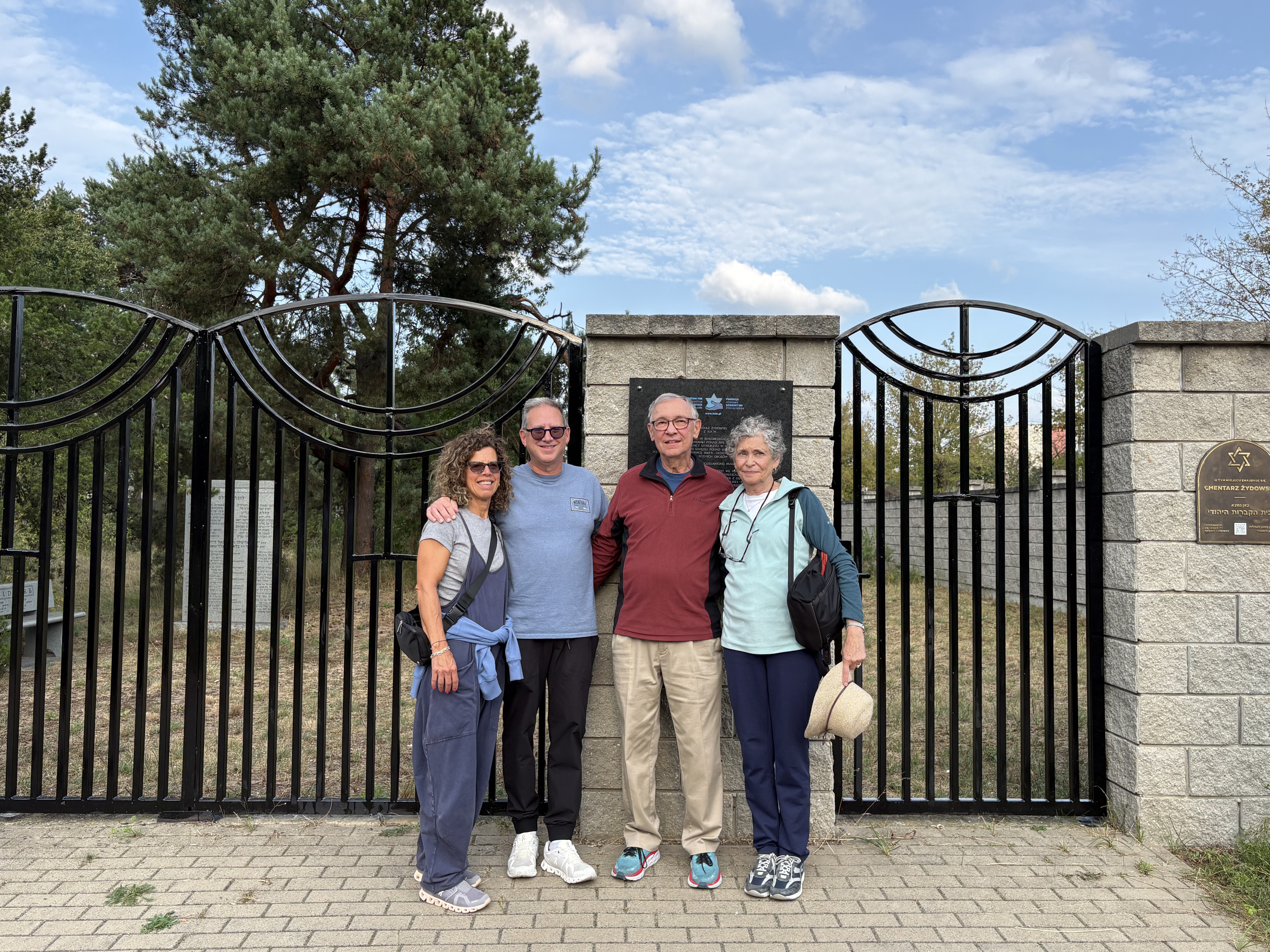
In 2025, the Midwest Center for Holocaust Education (MCHE) led a European study tour, which allowed community members the opportunity to see the historical locations that played a part in the tragedy of the Holocaust.
For several families traveling with MCHE, the journey would include not only sites of destruction and loss, but places of origin — communities where their parents and grandparents once lived full Jewish lives.
These destinations included towns and streets that existed, for these families, largely through fragments of stories, as something only imagined. Standing in these places bridged generations — an encounter with what had been taken from their families and what responsibility now rests with those left to remember.
The descendants of four Holocaust survivors who resided in Kansas City — Abe Flekier (z”l), Joseph and Bertha Gutovitz (z”l) and Sonia Golad (z”l) — shared their experiences with MCHE.
Allen Gutovitz — son of survivors Joseph and Bertha Gutovitz (z”l)
We were in a bus traveling between Krakow and Warsaw, and I was told we were going to be able to stop in a Polish town where my father grew up, where my mother was born, and where my grandparents, aunts, uncles and cousins lived. We approached a small fenced Jewish cemetery, and the bus parked about a block away. I could tell our group was as excited as I was to visit this cemetery with me, my wife and my cousins.
The gate was locked, we could not go in, and there were no headstones because they had been removed by the Nazis. My grandparents and relatives were not in this cemetery — they were all gassed and burned in Treblinka.
What did I feel? It reminded me of movies I had seen and books I had read of visitors to their family’s hometowns in the Pale. It was both exciting that I was able to visit and, of course, very sad. I could feel in person the inhumanity of man to other human beings, which we also witnessed in Berlin, Krakow, Auschwitz-Birkenau, Warsaw, Treblinka and Vilnius. I was happy that I made this very meaningful trip, but I cried many times.
Steve Flekier — son of survivor Abe Flekier (z”l)
My father, Abe Flekier, was from Białobrzegi, a small town in Poland, south of Warsaw and north of Krakow. As the trip plans began to solidify, Jessica [Rockhold, MCHE executive director] indicated that it would be possible for us to drive through the town. While I did not have an address for my father’s family’s home, there was a Jewish cemetery that we could visit.
Although the headstones had been removed by the Nazis, the cemetery remained intact and well maintained. As this was the only Jewish cemetery in town, I am certain that relatives of mine were buried there. Seeing the town that my father was from and often spoke of was a very moving and emotional experience, one that I will not forget.
Allan Golad — son of survivor Sonia Golad (z”l)
There were so many poignant, deeply moving and heartwarming emotions I experienced during our journey across Germany, Poland and Lithuania. I felt a profound sense of spiritual connection to my mother, Sonia Golad. My connection was most deeply felt on the bus ride from Krakow to Warsaw.
My daughter Emma asked me if I saw the email she had just received from the Holocaust Museum Los Angeles (HMLA). As members of HMLA, we receive semi-monthly emails of events at HMLA, but this email was not the typical one. It was a special email asking for second-generation and third-generation descendants to share their survivor’s story with middle and high school students in the LA area. The synchronicity of being in Poland and being asked to do the important work my mother did by giving her testimony to students was not lost on Emma and me. We have completed our speaker training with HMLA, and we look forward to educating students about the Holocaust so that humanity may never forget.
Thank you, Sonia — Message received!
Joyce Hess — daughter of survivor Sonia Golad
My journey to my mother’s hometown was a lifetime in the making. She had no desire to return to Vilna, Poland. She told us that she lived in an apartment building that had a courtyard. That’s really all we knew about her home.
In 1993, she received official Nazi documents from the Stutthoff concentration camp. One of those documents was her brother’s intake papers into Stutthoff. That document included the family address — Zawalnastr 57/50. When MCHE announced the Holocaust trip that included Vilnius, Lithuania, I signed up so that I could try to find my mother’s home and visit her hometown. The twist to the address is that when Russia took over Vilna during World War II, they changed the names of the streets to Russian names. With the help of my daughter Alex’s research and MCHE, we were able to find the current name of that street — Pylimo.
When our tour arrived in Vilnius, we dropped off our luggage at the hotel and started our 30-minute walk to Pylimo 57/50. The journey down cobblestone streets with various plaques and signs commemorating the Vilna Ghetto brought me to tears, just imagining my mother and her family experiencing this walk in a totally different time and circumstance. I realized the close proximity that her home had to the ghetto, as Pylimo was a border street of the ghetto. I imagined her being in the ghetto, knowing that her home was just on the other side of the wall. We also visited a synagogue in Vilnius that was near her home. In my mind, I pictured her sitting in the upper-level women’s section with her mother and sister. This short visit to Vilnius was so impactful, and I hope to return with my family so that they may witness our family’s legacy.
My journey to my mother’s hometown was a lifetime in the making. She had no desire to return to Vilna, Poland. She told us that she lived in an apartment building that had a courtyard. That’s really all we knew about her home.
In 1993, she received official Nazi documents from the Stutthoff concentration camp. One of those documents was her brother’s intake papers into Stutthoff. That document included the family address — Zawalnastr 57/50. When MCHE announced the Holocaust trip that included Vilnius, Lithuania, I signed up so that I could try to find my mother’s home and visit her hometown. The twist to the address is that when Russia took over Vilna during World War II, they changed the names of the streets to Russian names. With the help of my daughter Alex’s research and MCHE, we were able to find the current name of that street — Pylimo.
When our tour arrived in Vilnius, we dropped off our luggage at the hotel and started our 30-minute walk to Pylimo 57/50. The journey down cobblestone streets with various plaques and signs commemorating the Vilna Ghetto brought me to tears, just imagining my mother and her family experiencing this walk in a totally different time and circumstance. I realized the close proximity that her home had to the ghetto, as Pylimo was a border street of the ghetto. I imagined her being in the ghetto, knowing that her home was just on the other side of the wall. We also visited a synagogue in Vilnius that was near her home. In my mind, I pictured her sitting in the upper-level women’s section with her mother and sister. This short visit to Vilnius was so impactful, and I hope to return with my family so that they may witness our family’s legacy.
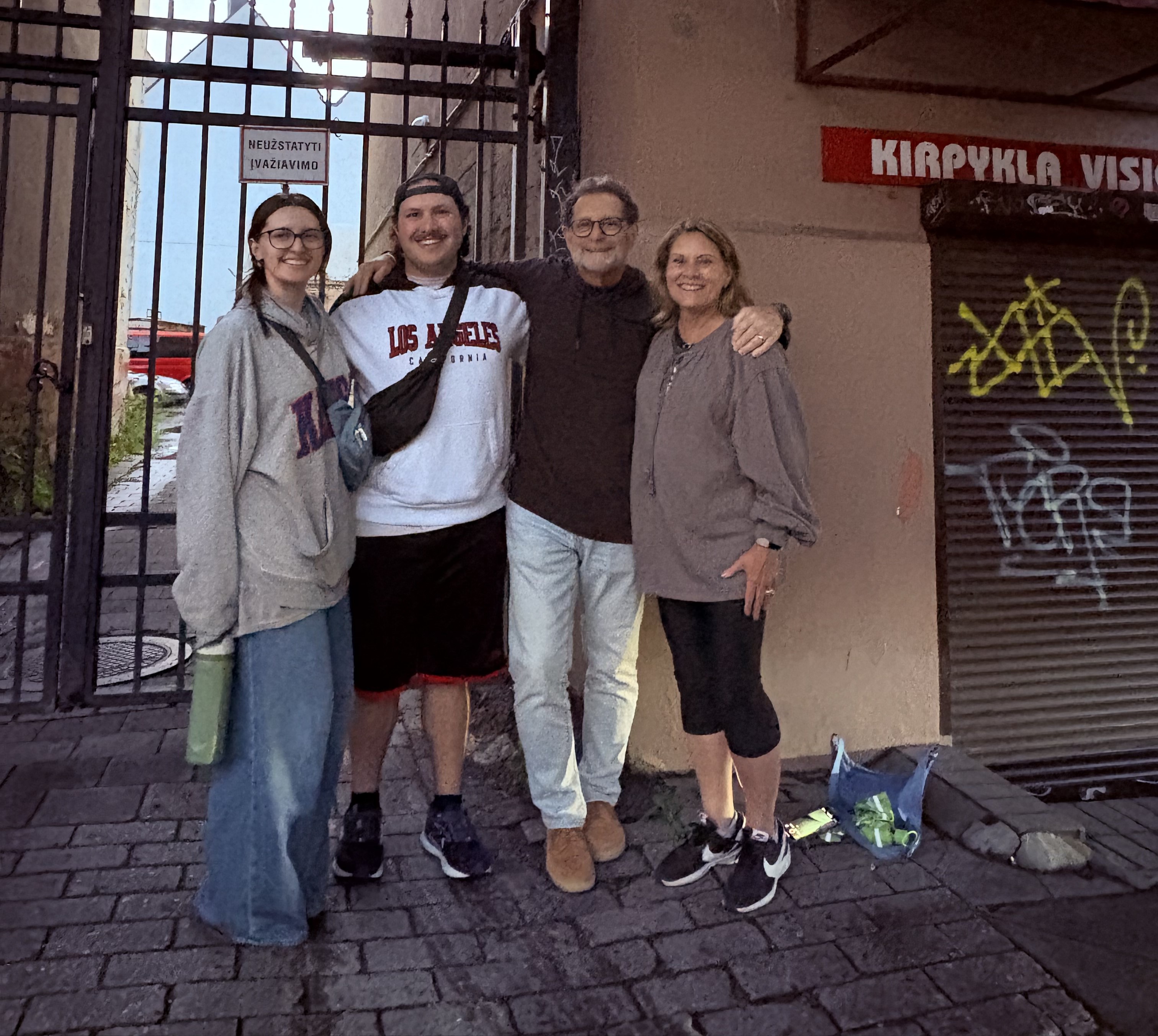
Emma, Bennett and Allan Golan and Joyce Hess in front of Sonia Golad’s former residence in Vilnius, Lithuania.
Emma Pearl Golad — granddaughter of survivor Sonia Golad
My nana, Sonia, passed away when I was seven years old. Although I didn’t know her well in life, I’ve found ways of connecting with her since her passing through practicing Judaism with passion and pride, standing up for causes I believe in, knitting and crocheting. As I’ve explored my identity as a third-generation survivor, I’ve begun to associate the word beshert (Yiddish for “meant to be”) with my Nana.
Visiting her hometown had a profound impact on me because I got a glimpse of what her life was like before the Nazis stripped it away from her. The beauty and comfort I felt there instantly made me feel as if I was coming home and seeing it all in person, providing me with an embodied sense of how she must’ve felt to lose the comfort and safety of home. I felt invigorated with the knowledge that I have a responsibility to my Nana, my great-grandparents and future generations to ensure that the atrocities of the Holocaust are never forgotten and never repeated.
As we walked down the streets of Vilna to visit her family’s apartment, we passed by a sculpture of mushrooms (one of my favorite things to crochet and the translation of Nana’s maiden name, Borowik), signs promoting the YIVO Institute through which I’d taken a class the previous summer, and a restaurant called Balaboste.
Every step toward her family home made me feel closer and closer to her. I remember the rush of wonder and awe when we looked up and saw her address posted next to the big red door that once led to their family apartment. As we explored around the building, I noticed a shop on the ground floor of the building: a knitting supply store.
Beshert. I bought enough yarn to make mushroom plushies for our whole family so each of us can have a piece of her and a piece of Vilna. MCHE gave me the gift of connection, education and cultivated a spark in me to continue Sonia’s legacy. Through sharing her story with HMLA, I know that Sonia and Vilna are always with me.
Bennett Golad — grandson of survivor Sonia Golad
As a 22-year-old who has been shaped by the increasing prevalence of social media and video games, the topic of history has not made a lasting impact on me. This, in tandem with my middle school and high school’s lackluster education on the Holocaust, left me not fully understanding the gravity of it. Yes, my grandma was a Holocaust survivor, but she had passed away when I was young, and yes, I did grow up practicing Judaism, but there was no “Holocaust unit” at Sunday school, so while I was familiar with what the Holocaust was, I did not truly comprehend how heinous and deplorable it was.
During my educational journey around Europe, I was finally able to grasp the number, six million Jews, six million of my people, six million individuals. The weight of that number felt intangible due to the sheer size of it, but when the group and I went to Treblinka, that’s when it set in.
I stood after a long bus ride in the center of a large grass field viewing stones protruding from the ground, indicating all the individuals that had been violently murdered by Nazis. The air was frigid, and the only sounds I could hear were of nearby wildlife; not a single member of the trip group could speak. The silence could burst eardrums, and the weight of the situation could crush a man, and that pressure, that unease, made me realize what the Holocaust was and how it was all our responsibilities to never let an atrocity like this happen again and to break through the deafening silence to let our voices be heard.