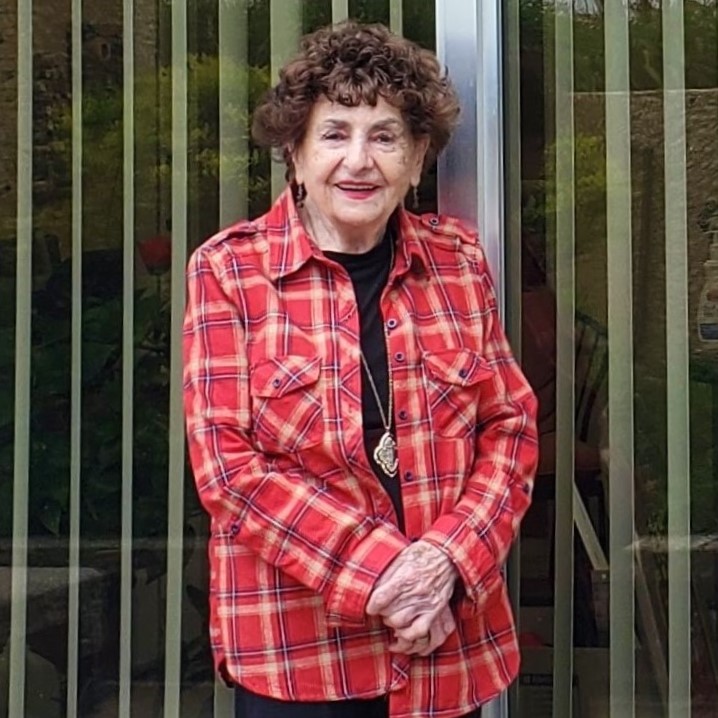
Sonia Warshawski never expected to become a quasi-celebrity or to retire from her beloved John’s Tailoring in Overland Park, Kansas.
But Warshawski, who celebrated her 100th birthday on Nov. 10, is still going strong. She is enjoying life with friends, her three children, five grandchildren and three great-grandchildren from her Prairie Village home, nine years after the release of the documentary “Big Sonia.”
The 2016 film, created and directed by Warshawski’s granddaughter Leah Warshawski and her husband, Todd Soliday, both of Hawaii, covered Warshawski’s experience as a Holocaust survivor, anti-hate advocate and businesswoman.
“If she had a choice, she’d still have the shop,” said Warshawski’s daughter Regina Kort of Leawood, Kansas. “Retirement was difficult for her. We’re talking about someone who always worked. The transition from not having a purpose to get up every morning and be at the shop was very difficult. We’re not surprised that she’s lived to be 100. She’s always had a very strong will to live. That was one of the things that allowed her to survive the camps.”
Warshawski drove until age 96 and retired the following year at age 97 after factors such as rising rent and building renovations made keeping the business unfeasible.
“She has such a big following (from “Big Sonia”) that people call her, want to come visit her and take her out,” Kort said. “Her caregivers try to get her out to the JCC for activities. I don’t think anything will be able to replace her going to work.”
Warshawski grew up in Miedzyrzec, Poland, in the eastern part of the country. She was just 13 years old when Nazi Germany invaded Poland.
“I would never believe (then) that I’d live to be 100,” Warshawski said. “When I was liberated from Bergen-Belsen, I was shot on the day of the liberation. The British liberated Bergen-Belsen. I was in the worst camps. Majdanek was a horrible, horrible thing. It’s impossible for anyone who wasn’t there to really grasp what people can do to other people.”
Warshawski and her late husband, John, a fellow Holocaust survivor who passed away in 1989, settled in Kansas City in the late 1940s. She always worked in women’s clothing stores, and John bought his own store. When John passed away, Sonia decided to take over the business, even though she didn’t know much about tailoring at the time.
Warshawski spent her birthday week with a private family dinner on Nov. 14, followed by a showing of “Big Sonia” at the Glenwood Arts Theatre and a reception.
The film, which will mark its 10th anniversary next year, took seven years to make.
“I never realized how much work goes into it,” Warshawski said. “The movie was about how the second generation was impacted. The second generation suffered too, and we never realized it.”
Leah Warshawski said the film had a major impact on the lives of the entire family.
“Making ‘Big Sonia’ was a huge part of our lives for 10 years and even more as it continues to make an impact and we continue to screen the movie all over the country and the world,” she said. “It’s the most important project I’ve ever worked on for many reasons, but it also feels really good to know that Sonia’s legacy will live on through the movie forever. We know that Holocaust education is more important now than ever, and we are thrilled that teachers and educators continue to use the film to create more compassionate humans. Sonia is an incredibly resilient person, and it’s unbelievable to realize that she’s 100 years old after everything that she’s been through in her life.”
Glenwood Arts Theatre owner Brian Mossman has known Warshawski since the early 1980s. For many years, Glenwood was upstairs from John’s Tailoring at the Metcalf South Shopping Center.
“‘Big Sonia’ is the highest grossing film we’ve ever had at Glenwood,” Mossman said. “Anytime you have a local connection, you’ll have a good audience. Sonia must know a lot of people, because it played for eight months.”
Mossman remembers Warshawski visiting Glenwood when they were business neighbors.
“She’d come upstairs, tap me on the shoulder and say, ‘Brian, what’s a good movie to see?’ And I’d give her suggestions,” Mossman said. “She told me about her experiences in the Holocaust. It’s amazing what she lived through – it’s horrific.”
Mossman recently visited the Kansas City Museum with Leah Warshawski and Soliday, where there’s currently a third floor exhibit where Sonia pre-answered approximately 800 questions.
“Big Sonia” also chronicles Warshawski’s visits to schools, churches and even prisons, among other venues, to share her experiences as a Holocaust survivor.
Warshawski doesn’t speak publicly about her experiences anymore, but Kort continues telling the story. They used to speak together.
“For many, many years, I did not want to participate because the experience of what happened to them is very emotional for me,” Kort said. “I didn’t like talking or thinking about it. I really wanted to get away from it. At some point, I felt an obligation to all of these relatives who were taken away from me. I always felt I missed quite a bit because I didn’t have grandparents. The best part of ‘Big Sonia’ is the legacy for our family and future generations to be able to learn from it and get to know their great-great-great-grandmother.”
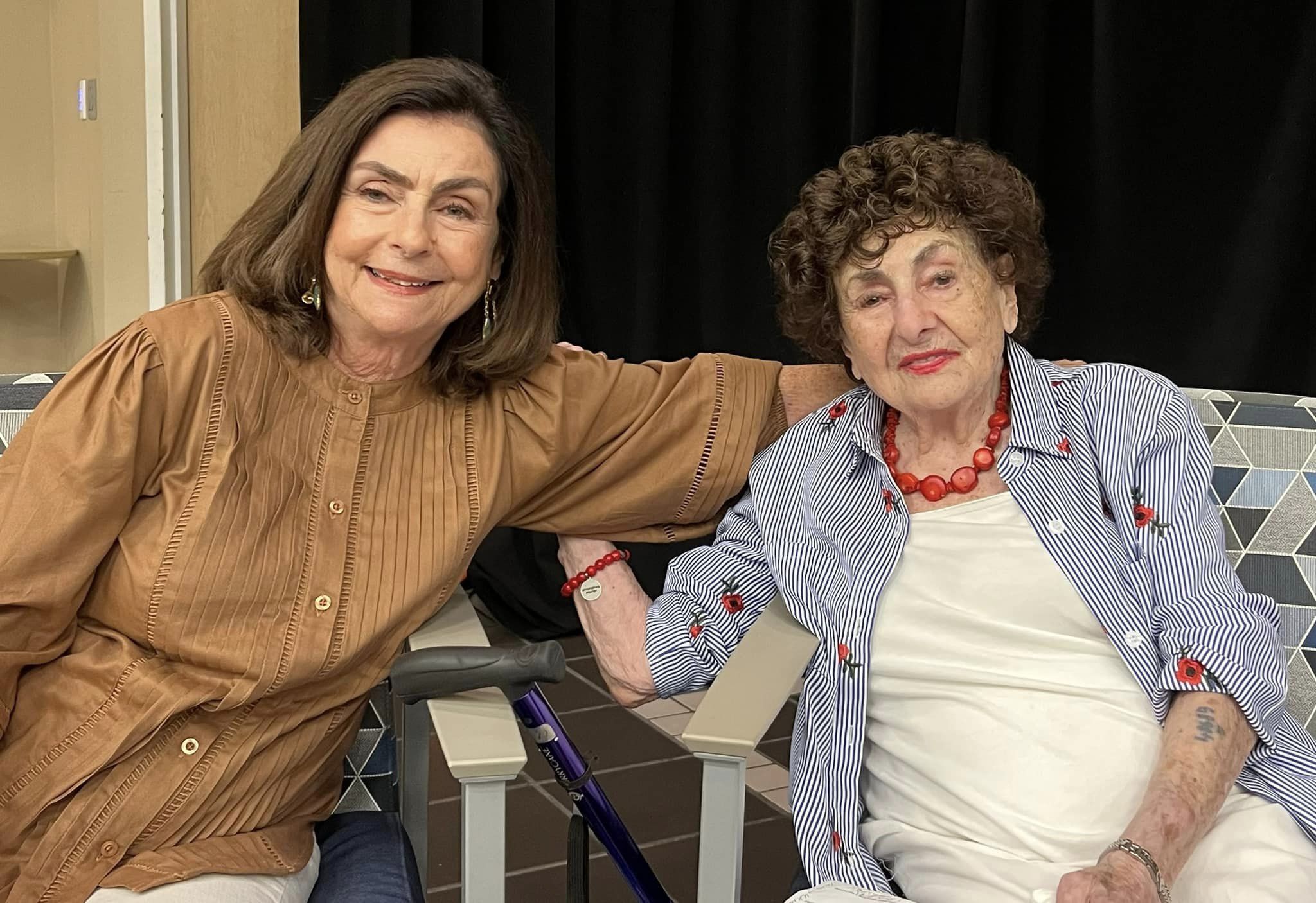
“Big Sonia” Warshawski (right) at a Midwest Center for Holocaust Education event in August 2023. She is pictured with her daughter Regina Kort.
“My grandparents’ experience in surviving the Holocaust really strengthened my Jewish identity,” he said. “It really makes you appreciate the ability to practice Judaism and continuing that legacy moving forward.”
Someday, Warshawski’s great-grandson Asher Kort, a 21-year-old college student in St. Louis, Missouri, wants to continue educating people about the family’s history. He remembers Warshawski speaking at his school when he was a student at Leawood Middle School in the late 2010s.
“Having that perspective and point of view is something that not many other people get from an early age,” said Asher Kort, who was just 12 years old when “Big Sonia” debuted. “I’ve been blessed with that. It makes you more appreciative of things that happen every day.”
Warshawski, at 100 years old, said seeing the resurgence of antisemitism “is unbelievable,” and she hopes the generations younger than her can combat the hatred. Leah Warshawski, like many of her aforementioned relatives, is ready to continue that important work.
“Sonia’s story is more important now than ever because antisemitism and hate crimes are unfortunately on the rise,” she said. “Sonia’s story of what she survived, and her resilience now, is inspiring for anyone who watches, but particularly unique and inspiring for younger generations... Our film teaches kids how to be upstanders and lead with kindness. It teaches them about how to be an empathetic and compassionate person, and to not judge others so quickly, because you never know what someone else is going through.”